




How to simplify\[1 - {\csc ^2}x\]? include identity used
Answer
 Verified
561k+ views
Hint:
The question is related to trigonometry, we have to simplify the given expression by using fundamental trigonometric identities that can be derived using the Pythagoras theorem on Right angled triangle, and on simplifying use the definition of trigonometric ratios after that we get the required solution.
Complete step by step solution:
Trigonometric ratios: Some ratios of the sides of a right-angle triangle with respect to its acute angle called trigonometric ratios of the angle.
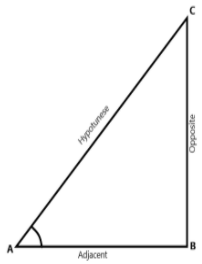
Let us consider the triangle ABC where angle \[CAB\] is an acute angle. BC is the opposite to the angle A and AB is the adjacent to the angle A. So, we call BC as opposite side and AB is adjacent side and AC is hypotenuse.
The trigonometric ratios of angle A in the given right angled triangle are defined as.
Sine of \[A = \dfrac{{Opposite\,side\,of\,A}}{{hypotenuse}} = \dfrac{{BC}}{{AC}}\]
Cosine of \[A = \dfrac{{Adjacent\,side\,of\,A}}{{hypotenuse}} = \dfrac{{AB}}{{AC}}\]
Tangent of \[A = \dfrac{{Opposite\,side\,of\,A}}{{Adjacent\,side\,of\,A}} = \dfrac{{BC}}{{AB}}\]
Cosecant of \[A = \dfrac{{hypotenuse}}{{Opposite\,side\,of\,A}} = \dfrac{{AC}}{{BC}}\]
Secant of \[A = \dfrac{{hypotenuse}}{{Adjacent\,side\,of\,A}} = \dfrac{{AC}}{{AB}}\]
Cotangent of \[A = \dfrac{{Adjacent\,side\,of\,A}}{{Opposite\,\,side\,of\,A}} = \dfrac{{AB}}{{BC}}\]
The ratios defined are abbreviated as sin A, cos A, tan A, csc A or cosec A, sec A and cot A
Now Apply the Pythagoras theorem to the \[\Delta \,ABC\], We have
\[ \Rightarrow \,\,\,A{C^2} = A{B^2} + B{C^2}\]
Now divide the whole equation by \[B{C^2}\].
\[ \Rightarrow \,\,\,\dfrac{{A{C^2}}}{{B{C^2}}} = \dfrac{{A{B^2}}}{{B{C^2}}} + \dfrac{{B{C^2}}}{{B{C^2}}}\]
\[ \Rightarrow \,\,\,{\left( {\dfrac{{AC}}{{BC}}} \right)^2} = {\left( {\dfrac{{AB}}{{BC}}} \right)^2} + 1\]
By using the definition of trigonometric ratios for angle A, the above equation can be written as.
\[ \Rightarrow \,\,\,{\left( {\csc A} \right)^2} = {\left( {\cot A} \right)^2} + 1\]
Put angle \[A = x\], then
\[ \Rightarrow \,\,\,{\csc ^2}x = {\cot ^2}x + 1\]
This is a one of the fundamental trigonometric identity
Subtract both side by 1, then
\[ \Rightarrow \,\,\,{\csc ^2}x - 1 = {\cot ^2}x + 1 - 1\]
On simplification, we get
\[ \Rightarrow \,\,\,{\csc ^2}x - 1 = {\cot ^2}x\]
Multiply both side by -1
\[ \Rightarrow \,\, - 1\,\left( {{{\csc }^2}x - 1} \right) = - 1\left( {{{\cot }^2}x} \right)\]
\[ \Rightarrow \,\,\,1 - {\csc ^2}x = - {\cot ^2}x\]
Therefore, on simplification of \[1 - {\csc ^2}x\] we get \[ - {\cot ^2}x\].
Note:
The trigonometry ratios are sine, cosine, tangent, cosecant, secant and cotangent. These are abbreviated as sin, cos, tan, csc, sec and cot. We must know about the trigonometry identities which are involving the trigonometry ratios. Hence by simple operations we can determine the solution.
The question is related to trigonometry, we have to simplify the given expression by using fundamental trigonometric identities that can be derived using the Pythagoras theorem on Right angled triangle, and on simplifying use the definition of trigonometric ratios after that we get the required solution.
Complete step by step solution:
Trigonometric ratios: Some ratios of the sides of a right-angle triangle with respect to its acute angle called trigonometric ratios of the angle.
Let us consider the triangle ABC where angle \[CAB\] is an acute angle. BC is the opposite to the angle A and AB is the adjacent to the angle A. So, we call BC as opposite side and AB is adjacent side and AC is hypotenuse.
The trigonometric ratios of angle A in the given right angled triangle are defined as.
Sine of \[A = \dfrac{{Opposite\,side\,of\,A}}{{hypotenuse}} = \dfrac{{BC}}{{AC}}\]
Cosine of \[A = \dfrac{{Adjacent\,side\,of\,A}}{{hypotenuse}} = \dfrac{{AB}}{{AC}}\]
Tangent of \[A = \dfrac{{Opposite\,side\,of\,A}}{{Adjacent\,side\,of\,A}} = \dfrac{{BC}}{{AB}}\]
Cosecant of \[A = \dfrac{{hypotenuse}}{{Opposite\,side\,of\,A}} = \dfrac{{AC}}{{BC}}\]
Secant of \[A = \dfrac{{hypotenuse}}{{Adjacent\,side\,of\,A}} = \dfrac{{AC}}{{AB}}\]
Cotangent of \[A = \dfrac{{Adjacent\,side\,of\,A}}{{Opposite\,\,side\,of\,A}} = \dfrac{{AB}}{{BC}}\]
The ratios defined are abbreviated as sin A, cos A, tan A, csc A or cosec A, sec A and cot A
Now Apply the Pythagoras theorem to the \[\Delta \,ABC\], We have
\[ \Rightarrow \,\,\,A{C^2} = A{B^2} + B{C^2}\]
Now divide the whole equation by \[B{C^2}\].
\[ \Rightarrow \,\,\,\dfrac{{A{C^2}}}{{B{C^2}}} = \dfrac{{A{B^2}}}{{B{C^2}}} + \dfrac{{B{C^2}}}{{B{C^2}}}\]
\[ \Rightarrow \,\,\,{\left( {\dfrac{{AC}}{{BC}}} \right)^2} = {\left( {\dfrac{{AB}}{{BC}}} \right)^2} + 1\]
By using the definition of trigonometric ratios for angle A, the above equation can be written as.
\[ \Rightarrow \,\,\,{\left( {\csc A} \right)^2} = {\left( {\cot A} \right)^2} + 1\]
Put angle \[A = x\], then
\[ \Rightarrow \,\,\,{\csc ^2}x = {\cot ^2}x + 1\]
This is a one of the fundamental trigonometric identity
Subtract both side by 1, then
\[ \Rightarrow \,\,\,{\csc ^2}x - 1 = {\cot ^2}x + 1 - 1\]
On simplification, we get
\[ \Rightarrow \,\,\,{\csc ^2}x - 1 = {\cot ^2}x\]
Multiply both side by -1
\[ \Rightarrow \,\, - 1\,\left( {{{\csc }^2}x - 1} \right) = - 1\left( {{{\cot }^2}x} \right)\]
\[ \Rightarrow \,\,\,1 - {\csc ^2}x = - {\cot ^2}x\]
Therefore, on simplification of \[1 - {\csc ^2}x\] we get \[ - {\cot ^2}x\].
Note:
The trigonometry ratios are sine, cosine, tangent, cosecant, secant and cotangent. These are abbreviated as sin, cos, tan, csc, sec and cot. We must know about the trigonometry identities which are involving the trigonometry ratios. Hence by simple operations we can determine the solution.
Recently Updated Pages
Master Class 10 Social Science: Engaging Questions & Answers for Success

Master Class 10 Science: Engaging Questions & Answers for Success
Master Class 10 Maths: Engaging Questions & Answers for Success
Master Class 10 General Knowledge: Engaging Questions & Answers for Success
Master Class 10 Computer Science: Engaging Questions & Answers for Success
Class 10 Question and Answer - Your Ultimate Solutions Guide
Trending doubts
What is the full form of PNG A Petrol Natural Gas B class 10 chemistry CBSE
Explain the Treaty of Vienna of 1815 class 10 social science CBSE
In cricket, how many legal balls are there in a standard over?
Why is there a time difference of about 5 hours between class 10 social science CBSE
Who Won 36 Oscar Awards? Record Holder Revealed
What is the median of the first 10 natural numbers class 10 maths CBSE