




How to simplify $ \tan \left( {arcs\sin \left( x \right)} \right) $ ?
Answer
 Verified
528.6k+ views
Hint: In this question, we need to simplify $ \tan \left( {arcs\sin \left( x \right)} \right) $ . First of all, you must be wondering what arc means. In trigonometry, arc means the inverse of a function. So, $ \arcsin \left( x \right) $ means $ {\sin ^{ - 1}}x $ . To solve this question, we are going to suppose $ {\sin ^{ - 1}}x = \theta $ and then substitute it in our expression. Then, we find the value of $ \sin \theta $ and then draw a right angled triangle in which two sides will be given by $ \sin \theta $ and for finding the third side, we will use Pythagora's theorem. On finding all the three sides, we will get the answer to our question.
Complete step by step solution:
Given expression: $ \tan \left( {arcs\sin \left( x \right)} \right) $
$ = \tan \left( {{{\sin }^{ - 1}}x} \right) - - - - \left( 1 \right) $
Let
$
{\sin ^{ - 1}}x = \theta \\
\Rightarrow \sin \theta = x - - - - \left( 2 \right) \\
$
Putting this value in equation (1), we get
$ \tan \left( {arcs\sin \left( x \right)} \right) = \tan \theta $
Now to find our answer, we need to find the value of $ \tan \theta $ .
For that, we are going to use equation (2) to draw a right angled triangle.
As we know that $ \sin \theta = \dfrac{{opposite}}{{hypotenuse}} $
$
AB = opposite = x \\
AC = hypotenuse = 1 \\
BC = Base = a \;
$
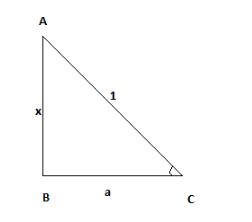
Now to find the value of $ \tan \theta $ we need to find the value of a.
We are going to use the Pythagorean Theorem to find the value of a.
The Pythagoras theorem states that the square of hypotenuse is equal to the sum of squares of the other two sides.
$
A{B^2} + B{C^2} = A{C^2} \\
{x^2} + {a^2} = {1^2} \\
{a^2} = 1 - {x^2} \\
a = \sqrt {1 - {x^2}} \;
$
Now, we have all the values of the triangle and can find $ \tan \theta $ .
We know that, $ \tan \theta = \dfrac{{opposite}}{{adjacent}} $
$ \tan \theta = \dfrac{x}{{\sqrt {1 - {x^2}} }} $
Putting back the value of $ \theta $ , we get
$ \tan \left( {{{\sin }^{ - 1}}x} \right) = \dfrac{x}{{\sqrt {1 - {x^2}} }} $
This is the final answer.
So, the correct answer is “ $ \tan \left( {{{\sin }^{ - 1}}x} \right) = \dfrac{x}{{\sqrt {1 - {x^2}} }} $ ”.
Note:
$
\sin \theta = \dfrac{{opposite}}{{hypotenuse}} \\
\cos \theta = \dfrac{{adjacent}}{{hypotenuse}} \\
\tan \theta = \dfrac{{opposite}}{{hypotenuse}} \\
\cos ec\theta = \dfrac{{hypotenuse}}{{opposite}} \\
\sec \theta = \dfrac{{hypotenuse}}{{adjacent}} \\
\cot \theta = \dfrac{{adjacent}}{{opposite}} \\
$
These are the most basic trigonometric formulas and almost every other formula and relations can be derived from these formulas. So, you must keep these 6 formulas in mind.
Complete step by step solution:
Given expression: $ \tan \left( {arcs\sin \left( x \right)} \right) $
$ = \tan \left( {{{\sin }^{ - 1}}x} \right) - - - - \left( 1 \right) $
Let
$
{\sin ^{ - 1}}x = \theta \\
\Rightarrow \sin \theta = x - - - - \left( 2 \right) \\
$
Putting this value in equation (1), we get
$ \tan \left( {arcs\sin \left( x \right)} \right) = \tan \theta $
Now to find our answer, we need to find the value of $ \tan \theta $ .
For that, we are going to use equation (2) to draw a right angled triangle.
As we know that $ \sin \theta = \dfrac{{opposite}}{{hypotenuse}} $
$
AB = opposite = x \\
AC = hypotenuse = 1 \\
BC = Base = a \;
$
Now to find the value of $ \tan \theta $ we need to find the value of a.
We are going to use the Pythagorean Theorem to find the value of a.
The Pythagoras theorem states that the square of hypotenuse is equal to the sum of squares of the other two sides.
$
A{B^2} + B{C^2} = A{C^2} \\
{x^2} + {a^2} = {1^2} \\
{a^2} = 1 - {x^2} \\
a = \sqrt {1 - {x^2}} \;
$
Now, we have all the values of the triangle and can find $ \tan \theta $ .
We know that, $ \tan \theta = \dfrac{{opposite}}{{adjacent}} $
$ \tan \theta = \dfrac{x}{{\sqrt {1 - {x^2}} }} $
Putting back the value of $ \theta $ , we get
$ \tan \left( {{{\sin }^{ - 1}}x} \right) = \dfrac{x}{{\sqrt {1 - {x^2}} }} $
This is the final answer.
So, the correct answer is “ $ \tan \left( {{{\sin }^{ - 1}}x} \right) = \dfrac{x}{{\sqrt {1 - {x^2}} }} $ ”.
Note:
$
\sin \theta = \dfrac{{opposite}}{{hypotenuse}} \\
\cos \theta = \dfrac{{adjacent}}{{hypotenuse}} \\
\tan \theta = \dfrac{{opposite}}{{hypotenuse}} \\
\cos ec\theta = \dfrac{{hypotenuse}}{{opposite}} \\
\sec \theta = \dfrac{{hypotenuse}}{{adjacent}} \\
\cot \theta = \dfrac{{adjacent}}{{opposite}} \\
$
These are the most basic trigonometric formulas and almost every other formula and relations can be derived from these formulas. So, you must keep these 6 formulas in mind.
Recently Updated Pages
Master Class 11 English: Engaging Questions & Answers for Success

Master Class 11 Maths: Engaging Questions & Answers for Success
Master Class 11 Biology: Engaging Questions & Answers for Success
Master Class 11 Physics: Engaging Questions & Answers for Success
Master Class 11 Accountancy: Engaging Questions & Answers for Success
Class 11 Question and Answer - Your Ultimate Solutions Guide
Trending doubts
One Metric ton is equal to kg A 10000 B 1000 C 100 class 11 physics CBSE
Discuss the various forms of bacteria class 11 biology CBSE
Draw a diagram of a plant cell and label at least eight class 11 biology CBSE
State the laws of reflection of light
Explain zero factorial class 11 maths CBSE
10 examples of friction in our daily life