



How do you simplify \[\ln \left( x+3 \right)+\ln \left( x-3 \right)=\ln 16\]?
Answer
 Verified
573.3k+ views
Hint: Apply the formula: - \[\ln m+\ln n=\ln \left( mn \right)\] in the expression present in the left-hand side. Now, compare the arguments of the logarithmic function by removing \[\ln \] from both the sides. Solve the quadratic equation obtained to obtain the values of x. Reject the value of x that is invalid by using the information that “argument of the logarithmic function must be greater than 0”.
Complete step by step answer:
Here, we have been provided with the equation: - \[\ln \left( x+3 \right)+\ln \left( x-3 \right)=\ln 16\] and we are asked to simplify it, that means we have to find the value of x.
Now, applying the sum to protect conversion formula of log given as: - \[\ln m+\ln n=\ln \left( mn \right)\], we have,
\[\Rightarrow \ln \left[ \left( x+3 \right)\left( x-3 \right) \right]=\ln 16\]
Here, ln is the natural log, i.e., log to the base \[\left( {{\log }_{e}} \right)\]. So, using the algebraic identity: - \[\left( a+b \right)\left( a-b \right)\], we get,
\[\begin{align}
& \Rightarrow \ln \left( {{x}^{2}}-{{3}^{2}} \right)=\ln 16 \\
& \Rightarrow \ln \left( {{x}^{2}}-9 \right)=\ln 16 \\
\end{align}\]
Now, comparing the arguments of ln on both the sides by removing the logarithmic function, we have,
\[\begin{align}
& \Rightarrow {{x}^{2}}-9=16 \\
& \Rightarrow {{x}^{2}}-9-16=0 \\
& \Rightarrow {{x}^{2}}-25=0 \\
& \Rightarrow {{x}^{2}}-{{5}^{2}}=0 \\
\end{align}\]
Again, using the algebraic identity: - \[{{a}^{2}}-{{b}^{2}}=\left( a+b \right)\left( a-b \right)\], we get,
\[\Rightarrow \left( x+5 \right)\left( x-5 \right)=0\]
Substituting each term equal to 0, one – by – one, we get,
\[\Rightarrow x+5=0\] or x – 5 = 0
\[\Rightarrow x=-5\] or x = 5
Here, we have obtained two values of x. Now, let us check if any of the two values is invalid or not.
We know that a logarithmic function is only defined when its argument is greater than 0 and base is greater than 0 but unequal to 1. In the above question we have log to the base ‘e’ and the value of ‘e’ is 2.71 which is greater than 0 and also unequal to 1. So, base is defined. Now, let us define the argument. In the L.H.S. we have (x + 3) and (x – 3) as the arguments. So, we must have,
(i) x + 3 > 0 \[\Rightarrow \] x > - 3 \[\Rightarrow x\in \left( -3,\infty \right)\]
(ii) x – 3 > 0 \[\Rightarrow \] x > 3 \[\Rightarrow x\in \left( 3,\infty \right)\]
Since, we need to satisfy both the conditions, therefore we must consider the intersection of the two sets of values of x obtained. So, we have,
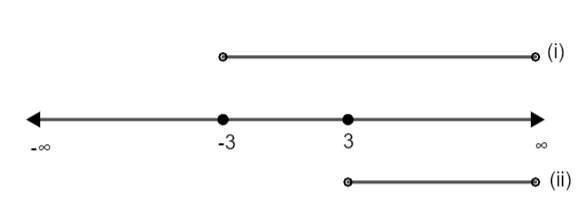
Therefore, \[x\in \left( 3,\infty \right)\], which is the final condition.
Clearly, we can see that x = -5 does not satisfy the above condition, therefore x = -5 must be rejected.
Hence, x = 5 is our answer.
Note: One may note that we cannot remove the logarithmic function directly from the initial expression: - \[\ln \left( x+3 \right)+\ln \left( x-3 \right)=\ln 16\], because it will be a wrong approach. First, we need to convert the two logarithmic terms in the L.H.S into a single logarithmic term by using the sum to product rule and then only we can remove the function. Remember that we do not just have to calculate the value of x but we must check if it satisfies the domain or not. We must reject the invalid value as it makes the function undefined.
Complete step by step answer:
Here, we have been provided with the equation: - \[\ln \left( x+3 \right)+\ln \left( x-3 \right)=\ln 16\] and we are asked to simplify it, that means we have to find the value of x.
Now, applying the sum to protect conversion formula of log given as: - \[\ln m+\ln n=\ln \left( mn \right)\], we have,
\[\Rightarrow \ln \left[ \left( x+3 \right)\left( x-3 \right) \right]=\ln 16\]
Here, ln is the natural log, i.e., log to the base \[\left( {{\log }_{e}} \right)\]. So, using the algebraic identity: - \[\left( a+b \right)\left( a-b \right)\], we get,
\[\begin{align}
& \Rightarrow \ln \left( {{x}^{2}}-{{3}^{2}} \right)=\ln 16 \\
& \Rightarrow \ln \left( {{x}^{2}}-9 \right)=\ln 16 \\
\end{align}\]
Now, comparing the arguments of ln on both the sides by removing the logarithmic function, we have,
\[\begin{align}
& \Rightarrow {{x}^{2}}-9=16 \\
& \Rightarrow {{x}^{2}}-9-16=0 \\
& \Rightarrow {{x}^{2}}-25=0 \\
& \Rightarrow {{x}^{2}}-{{5}^{2}}=0 \\
\end{align}\]
Again, using the algebraic identity: - \[{{a}^{2}}-{{b}^{2}}=\left( a+b \right)\left( a-b \right)\], we get,
\[\Rightarrow \left( x+5 \right)\left( x-5 \right)=0\]
Substituting each term equal to 0, one – by – one, we get,
\[\Rightarrow x+5=0\] or x – 5 = 0
\[\Rightarrow x=-5\] or x = 5
Here, we have obtained two values of x. Now, let us check if any of the two values is invalid or not.
We know that a logarithmic function is only defined when its argument is greater than 0 and base is greater than 0 but unequal to 1. In the above question we have log to the base ‘e’ and the value of ‘e’ is 2.71 which is greater than 0 and also unequal to 1. So, base is defined. Now, let us define the argument. In the L.H.S. we have (x + 3) and (x – 3) as the arguments. So, we must have,
(i) x + 3 > 0 \[\Rightarrow \] x > - 3 \[\Rightarrow x\in \left( -3,\infty \right)\]
(ii) x – 3 > 0 \[\Rightarrow \] x > 3 \[\Rightarrow x\in \left( 3,\infty \right)\]
Since, we need to satisfy both the conditions, therefore we must consider the intersection of the two sets of values of x obtained. So, we have,
Therefore, \[x\in \left( 3,\infty \right)\], which is the final condition.
Clearly, we can see that x = -5 does not satisfy the above condition, therefore x = -5 must be rejected.
Hence, x = 5 is our answer.
Note: One may note that we cannot remove the logarithmic function directly from the initial expression: - \[\ln \left( x+3 \right)+\ln \left( x-3 \right)=\ln 16\], because it will be a wrong approach. First, we need to convert the two logarithmic terms in the L.H.S into a single logarithmic term by using the sum to product rule and then only we can remove the function. Remember that we do not just have to calculate the value of x but we must check if it satisfies the domain or not. We must reject the invalid value as it makes the function undefined.

Recently Updated Pages
Basicity of sulphurous acid and sulphuric acid are

Master Class 11 Business Studies: Engaging Questions & Answers for Success
Master Class 11 Computer Science: Engaging Questions & Answers for Success
Master Class 11 Economics: Engaging Questions & Answers for Success
Master Class 12 English: Engaging Questions & Answers for Success
Master Class 12 Social Science: Engaging Questions & Answers for Success
Trending doubts
Fill the blanks with the suitable prepositions 1 The class 9 english CBSE
Difference Between Plant Cell and Animal Cell
Find the sum of series 1 + 2 + 3 + 4 + 5 + + 100 class 9 maths CBSE
Distinguish between Conventional and nonconventional class 9 social science CBSE
Find the greatest fivedigit number which is a perfect class 9 maths CBSE
Find the mode and median of the data 13 16 12 14 1-class-9-maths-CBSE