




How do you simplify $\dfrac{\tan {{80}^{\circ }}+\tan {{55}^{\circ }}}{1-\tan {{80}^{\circ }}\tan {{55}^{\circ }}}$ ?
Answer
 Verified
547.8k+ views
Hint: We are given term as $\dfrac{\tan {{80}^{\circ }}+\tan {{55}^{\circ }}}{1-\tan {{80}^{\circ }}\tan {{55}^{\circ }}}$, we have to simplify.
Simplification means we have to find the value of a given fraction, we do not know the value of tan at 80, 55. So we will use relation to get some definable terms, we will use formula $\tan \left( x+y \right)=\dfrac{\tan x+\tan y}{1-\tan x\tan y}$ , then we will learn in which quadrant tan is positive or negative, and lastly we will find the exact value, we also use $\tan \left( 180-0 \right)=-\tan \theta $ .
Complete step by step answer:
We are given a term in form of fraction as $\dfrac{\tan {{80}^{\circ }}+\tan {{55}^{\circ }}}{1-\tan {{80}^{\circ }}\tan {{55}^{\circ }}}$.
We have to simplify it, here simplification means we need to find the exact value of the given fraction, to do so we will need to change the fraction into a single term.
To do so, we will be using identity as we see that our fraction has the sum of two tan functions.
So, we will be using identity in addition to the value of tan ratio.
We have that $\tan \left( x+y \right)=\dfrac{\tan x+\tan }{1-\tan x\tan y}$ .
So, comparing the right side by one fraction, we can see that they are similar.
So, we consider $x=80{}^\circ $ and $y=55{}^\circ $ .
So, using $\dfrac{\tan x+\tan y}{1-\tan x\tan y}=\tan \left( x+y \right)$, we will get that –
\[\Rightarrow \dfrac{\tan \left( {{80}^{\circ }} \right)+\tan \left( {{55}^{\circ }} \right)}{1-\tan \left( {{80}^{\circ }} \right)\tan \left( {{55}^{\circ }} \right)}=\tan \left( {{80}^{\circ }}+{{55}^{\circ }} \right)\]
By simplifying right side, we get –
$=\tan \left( {{135}^{\circ }} \right)$
So, we get our fraction $\dfrac{\tan {{80}^{\circ }}+\tan {{55}^{\circ }}}{1-\tan {{80}^{\circ }}\tan {{55}^{\circ }}}$ is same as \[\tan \left( {{135}^{\circ }} \right)\] .
Now to find the exact value, we will see that ${{135}^{\circ }}$ will lie in which quadrant.
${{135}^{\circ }}$ lie between ${{90}^{\circ }}$ and ${{180}^{\circ }}$ . so, it lie in quadrant second.
We know that in the second quadrant, tan is negative and $\tan \left( 180-\theta \right)$ is given as $-\tan \theta $ .
Now we can see that ${{135}^{\circ }}$ can be written as –
$\Rightarrow 135=180-45$
So, $\tan \left( {{135}^{\circ }} \right)=\tan \left( {{180}^{\circ }}-{{45}^{\circ }} \right)$ .
Now using $\tan \left( 180-0 \right)=-\tan \left( 0 \right)$ . We get –
$\Rightarrow \tan \left( {{135}^{\circ }} \right)=-\tan \left( {{45}^{\circ }} \right)$ (as $\theta ={{45}^{\circ }}$ .
We know that $\tan \left( {{45}^{\circ }} \right)=1$ . So, we get –
$\tan \left( {{135}^{\circ }} \right)=-1$
Note:
Easiest way to recall that $\dfrac{\tan x+\tan y}{1-\tan x\tan y}$ is the formula for sum of difference is to check the sign between the terms in numerator, if it is of the sum, then sign between will be ‘+’, and if it is difference then it will be ‘-‘.
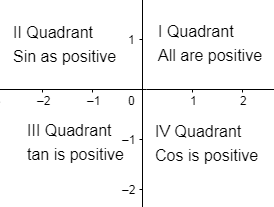
Also remember that we need to take care of the quadrant as the different quadrant is different depending upon the sigh of that ratio in that quadrant.
For sin, cos and tan sign in all quadrant given as –
Simplification means we have to find the value of a given fraction, we do not know the value of tan at 80, 55. So we will use relation to get some definable terms, we will use formula $\tan \left( x+y \right)=\dfrac{\tan x+\tan y}{1-\tan x\tan y}$ , then we will learn in which quadrant tan is positive or negative, and lastly we will find the exact value, we also use $\tan \left( 180-0 \right)=-\tan \theta $ .
Complete step by step answer:
We are given a term in form of fraction as $\dfrac{\tan {{80}^{\circ }}+\tan {{55}^{\circ }}}{1-\tan {{80}^{\circ }}\tan {{55}^{\circ }}}$.
We have to simplify it, here simplification means we need to find the exact value of the given fraction, to do so we will need to change the fraction into a single term.
To do so, we will be using identity as we see that our fraction has the sum of two tan functions.
So, we will be using identity in addition to the value of tan ratio.
We have that $\tan \left( x+y \right)=\dfrac{\tan x+\tan }{1-\tan x\tan y}$ .
So, comparing the right side by one fraction, we can see that they are similar.
So, we consider $x=80{}^\circ $ and $y=55{}^\circ $ .
So, using $\dfrac{\tan x+\tan y}{1-\tan x\tan y}=\tan \left( x+y \right)$, we will get that –
\[\Rightarrow \dfrac{\tan \left( {{80}^{\circ }} \right)+\tan \left( {{55}^{\circ }} \right)}{1-\tan \left( {{80}^{\circ }} \right)\tan \left( {{55}^{\circ }} \right)}=\tan \left( {{80}^{\circ }}+{{55}^{\circ }} \right)\]
By simplifying right side, we get –
$=\tan \left( {{135}^{\circ }} \right)$
So, we get our fraction $\dfrac{\tan {{80}^{\circ }}+\tan {{55}^{\circ }}}{1-\tan {{80}^{\circ }}\tan {{55}^{\circ }}}$ is same as \[\tan \left( {{135}^{\circ }} \right)\] .
Now to find the exact value, we will see that ${{135}^{\circ }}$ will lie in which quadrant.
${{135}^{\circ }}$ lie between ${{90}^{\circ }}$ and ${{180}^{\circ }}$ . so, it lie in quadrant second.
We know that in the second quadrant, tan is negative and $\tan \left( 180-\theta \right)$ is given as $-\tan \theta $ .
Now we can see that ${{135}^{\circ }}$ can be written as –
$\Rightarrow 135=180-45$
So, $\tan \left( {{135}^{\circ }} \right)=\tan \left( {{180}^{\circ }}-{{45}^{\circ }} \right)$ .
Now using $\tan \left( 180-0 \right)=-\tan \left( 0 \right)$ . We get –
$\Rightarrow \tan \left( {{135}^{\circ }} \right)=-\tan \left( {{45}^{\circ }} \right)$ (as $\theta ={{45}^{\circ }}$ .
We know that $\tan \left( {{45}^{\circ }} \right)=1$ . So, we get –
$\tan \left( {{135}^{\circ }} \right)=-1$
Note:
Easiest way to recall that $\dfrac{\tan x+\tan y}{1-\tan x\tan y}$ is the formula for sum of difference is to check the sign between the terms in numerator, if it is of the sum, then sign between will be ‘+’, and if it is difference then it will be ‘-‘.
Also remember that we need to take care of the quadrant as the different quadrant is different depending upon the sigh of that ratio in that quadrant.
For sin, cos and tan sign in all quadrant given as –
Recently Updated Pages
Master Class 11 Computer Science: Engaging Questions & Answers for Success

Master Class 11 Business Studies: Engaging Questions & Answers for Success
Master Class 11 Economics: Engaging Questions & Answers for Success
Master Class 11 English: Engaging Questions & Answers for Success
Master Class 11 Maths: Engaging Questions & Answers for Success
Master Class 11 Biology: Engaging Questions & Answers for Success
Trending doubts
One Metric ton is equal to kg A 10000 B 1000 C 100 class 11 physics CBSE
There are 720 permutations of the digits 1 2 3 4 5 class 11 maths CBSE
Discuss the various forms of bacteria class 11 biology CBSE
Draw a diagram of a plant cell and label at least eight class 11 biology CBSE
State the laws of reflection of light
Explain zero factorial class 11 maths CBSE