




Sides AB, AC and median AD of a triangle ABC are respectively proportional to sides PQ, PR and median PM of another triangle PQR. Show that$\Delta ABC\sim \Delta PQR$.
Answer
 Verified
690.3k+ views
Hint: First draw a rough sketch of $\Delta ABC$and $\Delta PQR$and then draw construction as to produce AD to E such that AD = DE and PM to F such that PM = MF. Then proof $\Delta ABD\cong \Delta CDE$ and $\Delta PQM\cong \Delta RMF$, using SAS criteria then proof $\Delta ACE\cong \Delta PRF$, using SSS congruence criteria. After that proof $\angle A=\angle P$ using $\angle 1=\angle 2$ and $\angle 3=\angle 4$. Then, in $\Delta ABC$ and $\Delta PQR$, proof $\Delta ABC\sim \Delta PQR$ using SAS similarity criteria.
Complete step-by-step answer:
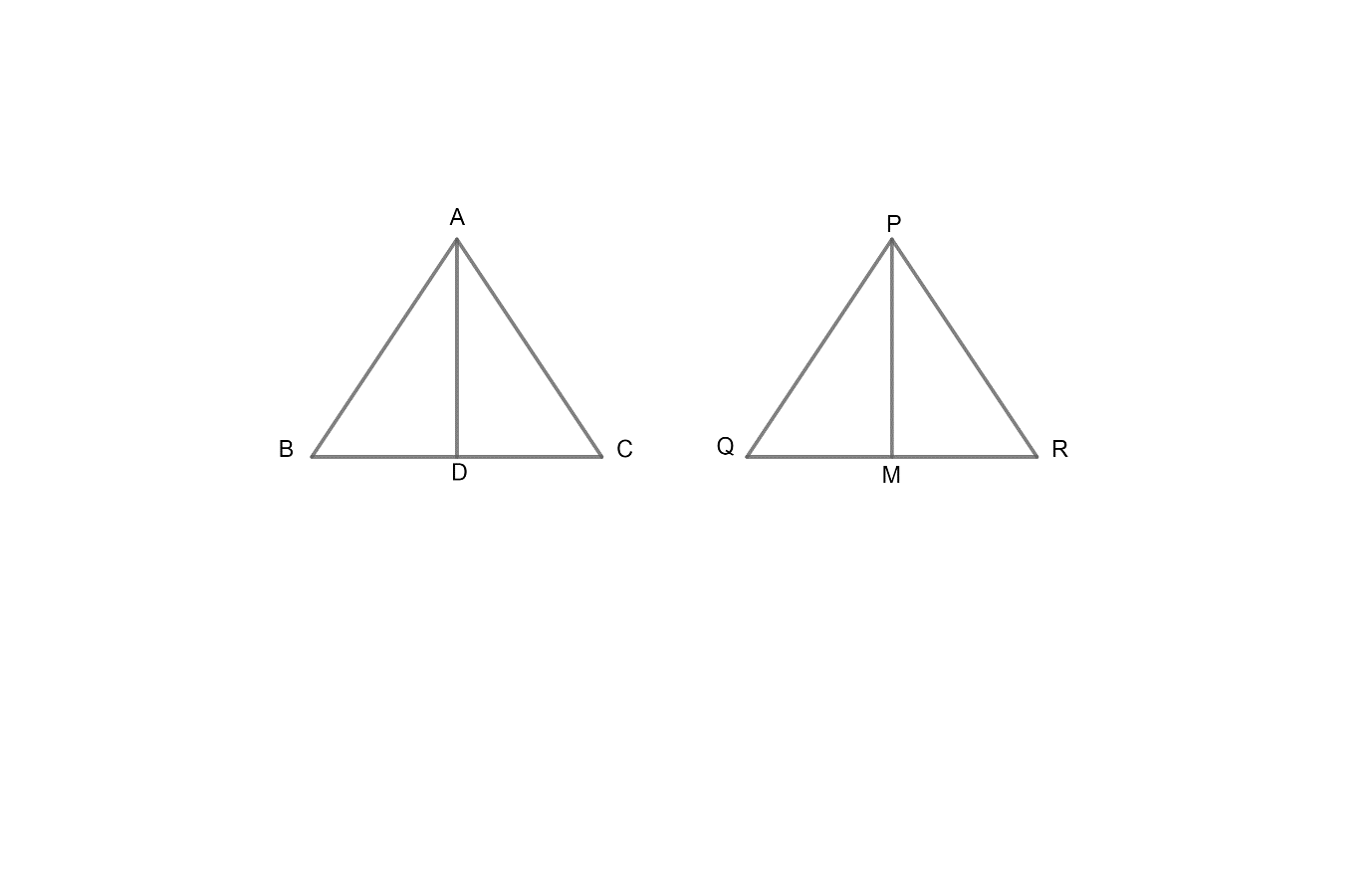
Given, $\Delta ABC$ and $\Delta PQR$in which AD and PM are medians drawn on sides BC and QR respectively.
It is given that , $\dfrac{AB}{PQ}=\dfrac{AC}{PR}=\dfrac{AD}{PM}$
To prove: $\Delta ABC\sim \Delta PQR$.
Construction: Produce AD to E such that AD = DE and PM to F such that PM = MF.
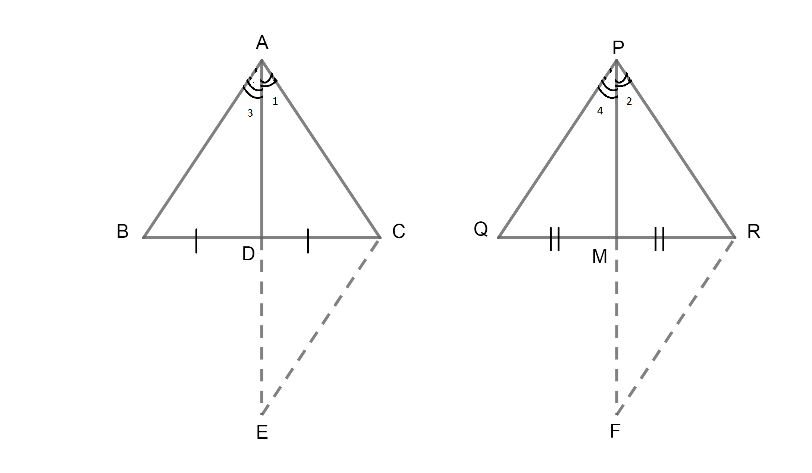
Proof: In $\Delta ABD$and $\Delta CDE$
AD = DE (by construction)
$\angle ADB=\angle CDE$ (Vertically opposite angles) and BD = DC (AD is median)
Therefore, by using SAS congruent condition,
$\Delta ABD\cong \Delta CDE$
$\Rightarrow AB=CE$ (by corresponding parts of congruent triangles i.e. CPCT)
Similarly,
In $\Delta PQM$ and $\Delta RMF$
PM = MF (by construction)
$\angle PMQ=\angle RMF$(Vertically opposite angles)
And QM = MR (PM is a median)
Since, the median divides the opposite side in two equal parts.
Therefore, by using SAS congruence criteria
\[\Delta PQM\cong \Delta RMF\]
\[\Rightarrow PQ=RF\](by CPCT)
It is given that;
$\begin{align}
& \dfrac{AB}{PQ}=\dfrac{AC}{PR}=\dfrac{AD}{PM} \\
& \Rightarrow \dfrac{CE}{RF}=\dfrac{AC}{PR}=\dfrac{2AD}{2PM}\ \ \ \left[ \therefore AB=CE,PQ=RF \right] \\
& \Rightarrow \dfrac{CE}{RF}=\dfrac{AC}{PR}=\dfrac{AE}{PF} \\
\end{align}$
Therefore, by using SSS congruent condition;
$\Delta ACE\cong \Delta PRF$
$\Rightarrow \angle 1=\angle 2.................\left( i \right)$(Demonstrated in figure)
Similarity, $\Rightarrow \angle 3=\angle 4.................\left( ii \right)$(Demonstrated in figure)
Adding equation (i) and (ii), we get,
\[\begin{align}
& \angle 1+\angle 3=\angle 2+\angle 4 \\
& \Rightarrow \angle A=\angle P \\
\end{align}\]
Now, in $\Delta ABC$ and $\Delta PQR$;
$\begin{align}
& \dfrac{AB}{PQ}=\dfrac{AC}{PR} \\
& and\ \angle A=\angle P \\
\end{align}$
Therefore, by using SAS similarity criteria;
$\Delta ABC\sim \Delta PQR$
Note: Students may try in this question to prove $\Delta ABC\sim \Delta PQR$by using SSS similarity criteria. Since, it is given that two sides are already proportional to the two corresponding sides of another triangle, but this approach should not be taken. In this question, it is required to do proper construction and hence to prove $\Delta ABC\sim \Delta PQR$by using SAS similarity criteria.
Complete step-by-step answer:
Given, $\Delta ABC$ and $\Delta PQR$in which AD and PM are medians drawn on sides BC and QR respectively.
It is given that , $\dfrac{AB}{PQ}=\dfrac{AC}{PR}=\dfrac{AD}{PM}$
To prove: $\Delta ABC\sim \Delta PQR$.
Construction: Produce AD to E such that AD = DE and PM to F such that PM = MF.
Proof: In $\Delta ABD$and $\Delta CDE$
AD = DE (by construction)
$\angle ADB=\angle CDE$ (Vertically opposite angles) and BD = DC (AD is median)
Therefore, by using SAS congruent condition,
$\Delta ABD\cong \Delta CDE$
$\Rightarrow AB=CE$ (by corresponding parts of congruent triangles i.e. CPCT)
Similarly,
In $\Delta PQM$ and $\Delta RMF$
PM = MF (by construction)
$\angle PMQ=\angle RMF$(Vertically opposite angles)
And QM = MR (PM is a median)
Since, the median divides the opposite side in two equal parts.
Therefore, by using SAS congruence criteria
\[\Delta PQM\cong \Delta RMF\]
\[\Rightarrow PQ=RF\](by CPCT)
It is given that;
$\begin{align}
& \dfrac{AB}{PQ}=\dfrac{AC}{PR}=\dfrac{AD}{PM} \\
& \Rightarrow \dfrac{CE}{RF}=\dfrac{AC}{PR}=\dfrac{2AD}{2PM}\ \ \ \left[ \therefore AB=CE,PQ=RF \right] \\
& \Rightarrow \dfrac{CE}{RF}=\dfrac{AC}{PR}=\dfrac{AE}{PF} \\
\end{align}$
Therefore, by using SSS congruent condition;
$\Delta ACE\cong \Delta PRF$
$\Rightarrow \angle 1=\angle 2.................\left( i \right)$(Demonstrated in figure)
Similarity, $\Rightarrow \angle 3=\angle 4.................\left( ii \right)$(Demonstrated in figure)
Adding equation (i) and (ii), we get,
\[\begin{align}
& \angle 1+\angle 3=\angle 2+\angle 4 \\
& \Rightarrow \angle A=\angle P \\
\end{align}\]
Now, in $\Delta ABC$ and $\Delta PQR$;
$\begin{align}
& \dfrac{AB}{PQ}=\dfrac{AC}{PR} \\
& and\ \angle A=\angle P \\
\end{align}$
Therefore, by using SAS similarity criteria;
$\Delta ABC\sim \Delta PQR$
Note: Students may try in this question to prove $\Delta ABC\sim \Delta PQR$by using SSS similarity criteria. Since, it is given that two sides are already proportional to the two corresponding sides of another triangle, but this approach should not be taken. In this question, it is required to do proper construction and hence to prove $\Delta ABC\sim \Delta PQR$by using SAS similarity criteria.
Recently Updated Pages
Master Class 10 Computer Science: Engaging Questions & Answers for Success

Differentiate between voluntary action and reflex class 10 biology CBSE
The uses of bleaching powder are A It is used bleaching class 10 chemistry CBSE
Fill in the blanks with abstract nouns of the words class 10 english CBSE
How many threedigit numbers are there class 10 maths CBSE
What is a reflex arc class 10 biology CBSE
Trending doubts
Explain the Treaty of Vienna of 1815 class 10 social science CBSE
10 examples of evaporation in daily life with explanations
Which country is known as "The land of Fire and Ice"?
What is the full form of POSCO class 10 social science CBSE
Make a sketch of the human nerve cell What function class 10 biology CBSE
In which year voting age was reduced from 21 to 18?