




SI units of thermal conductivity are
A. W/m-K
B. W/m
C. W/K
D. None
Answer
 Verified
663.3k+ views
Hint: The thermal conductivity of a material describes the ability of that material to conduct heat energy through it. The SI units of thermal conductivity can be found from the definition of the thermal conductivity and quantities that it depends on.
Complete answer: The thermal conductivity of a material can be defined as the ability of a material to conduct thermal energy or heat energy through itself. We denote the thermal conductivity of a material with the symbol ‘k’.
Consider a conductor of length L and cross-sectional area A. The face 1 is at temperature ${T_1}$ and the face 2 is at temperature ${T_2}$. The temperature difference leads to flow of heat from one face of the conductor to another.
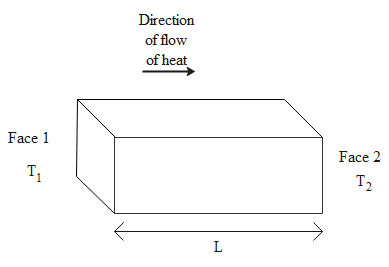
The expression for thermal conductivity is given as
$k = \dfrac{{QL}}{{A\Delta T}}$
Here Q denotes the amount of heat energy that can be transferred through the given material in the units of power. L is the length of the given conductor while A represents the area of cross-section of the conductor. $\Delta T$ represents the temperature difference between two ends of the conductor.
Therefore, the SI units of thermal conductivity can be calculated from the above formula by using the SI units of the quantities involved.
Units of k $ = \dfrac{{Wm}}{{\left( {{m^2}} \right)K}} = W{m^{ - 1}}{K^{ - 1}}$
These are the required units of thermal conductivity.
So, the correct answer is “Option A”.
Note:
The reverse of thermal conductivity is the thermal resistivity of the material which describes the resistance offered by a material towards the flow of heat energy or thermal energy through itself. The units of thermal resistivity are inverse of the units of thermal conductivity and the SI units are given as Kelvin metre per Watt (K m/W).
Complete answer: The thermal conductivity of a material can be defined as the ability of a material to conduct thermal energy or heat energy through itself. We denote the thermal conductivity of a material with the symbol ‘k’.
Consider a conductor of length L and cross-sectional area A. The face 1 is at temperature ${T_1}$ and the face 2 is at temperature ${T_2}$. The temperature difference leads to flow of heat from one face of the conductor to another.
The expression for thermal conductivity is given as
$k = \dfrac{{QL}}{{A\Delta T}}$
Here Q denotes the amount of heat energy that can be transferred through the given material in the units of power. L is the length of the given conductor while A represents the area of cross-section of the conductor. $\Delta T$ represents the temperature difference between two ends of the conductor.
Therefore, the SI units of thermal conductivity can be calculated from the above formula by using the SI units of the quantities involved.
Units of k $ = \dfrac{{Wm}}{{\left( {{m^2}} \right)K}} = W{m^{ - 1}}{K^{ - 1}}$
These are the required units of thermal conductivity.
So, the correct answer is “Option A”.
Note:
The reverse of thermal conductivity is the thermal resistivity of the material which describes the resistance offered by a material towards the flow of heat energy or thermal energy through itself. The units of thermal resistivity are inverse of the units of thermal conductivity and the SI units are given as Kelvin metre per Watt (K m/W).
Recently Updated Pages
If x a + bt + ct2 where x is in meters and t is in class 11 physics CBSE

A car covers the first half distance between two places class 11 physics CBSE
The resultant of two vectors overrightarrow P and overrightarrow class 11 physics CBSE
Find the value of cos 135 class 11 maths CBSE
A mass M is held in place by an applied force F and class 11 physics CBSE
A solution of glucose in water is labelled as 10 dfracwv class 11 chemistry CBSE
Trending doubts
One Metric ton is equal to kg A 10000 B 1000 C 100 class 11 physics CBSE
Find the value of the expression given below sin 30circ class 11 maths CBSE
What do you mean by retardation What is its SI uni class 11 physics CBSE
Draw a diagram of nephron and explain its structur class 11 biology CBSE
10 examples of friction in our daily life
Difference between physical and chemical change class 11 chemistry CBSE