




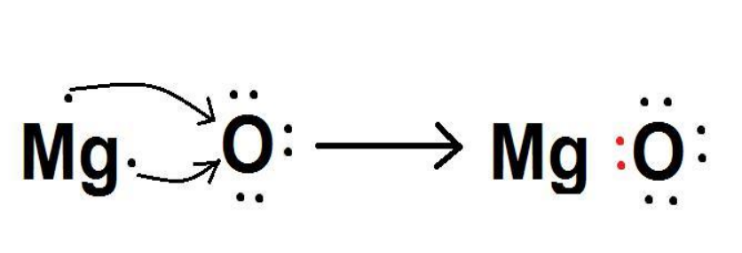
Show the formation of \[MgO\] by transfer of electrons between combining atoms.
Answer
 Verified
600.9k+ views
Hint: Magnesium oxide is an inorganic compound that occurs in nature as the mineral periclase. Aqueous media combines quickly with water to form magnesium hydroxide. It is used as an antacid and mild laxative and has many non medicinal uses.
Complete step by step answer:
The atomic number of Magnesium is\[12\].
The electronic configuration of magnesium is
\[Mg\left( {Z = 12} \right){\text{ }} = {\text{ }}1{s^2}2{s^2}2{p^6}3{s^2}\]
In order to obtain an octet configuration, it will lose two electrons.
The atomic number of oxygen is\[8\].
The electronic configuration of oxygen is
\[O\left( {Z{\text{ }} = {\text{ }}8} \right){\text{ }} = {\text{ }}1{s^2}2{s^2}2{p^4}\]
In order to obtain an octet configuration, it has to gain two electrons.
When magnesium reacts with oxygen, the magnesium atom transfers its two outermost electrons to an oxygen atom. By losing two electrons, the magnesium atoms form a magnesium ion (\[M{g^{2 + }}\]) and by gaining two electrons, the oxygen atom forms an oxide ion (\[{O^{2 - }}\]).
\[Mg:{\text{ }} + {\text{ }}O{\text{ }} \to {\text{ }}MgO\]
Note: Magnesium oxide nanoparticles can be prepared using the hydroxide precipitation process, which is followed by the thermal decomposition of the hydroxide. \[MgO\] Can be characterized by X-ray powder diffraction and scanning electron microscopes.
Magnesium oxide nanoparticles can be applied in electronics, catalysis, ceramics, petrochemical products, coatings, and many other fields. Magnesium oxide nanoparticles can be used along with wood chips and shavings to make materials such as sound-proof, light-weight, heat-insulating, and refractory fiberboard and metallic ceramics.
Magnesia (magnesium oxide,\[MgO\]) is mainly produced from the calcination of magnesite in a process similar to the production of lime from limestone. A smaller proportion of the world's \[MgO\] production comes from seawater and brine sources.
Complete step by step answer:
The atomic number of Magnesium is\[12\].
The electronic configuration of magnesium is
\[Mg\left( {Z = 12} \right){\text{ }} = {\text{ }}1{s^2}2{s^2}2{p^6}3{s^2}\]
In order to obtain an octet configuration, it will lose two electrons.
The atomic number of oxygen is\[8\].
The electronic configuration of oxygen is
\[O\left( {Z{\text{ }} = {\text{ }}8} \right){\text{ }} = {\text{ }}1{s^2}2{s^2}2{p^4}\]
In order to obtain an octet configuration, it has to gain two electrons.
When magnesium reacts with oxygen, the magnesium atom transfers its two outermost electrons to an oxygen atom. By losing two electrons, the magnesium atoms form a magnesium ion (\[M{g^{2 + }}\]) and by gaining two electrons, the oxygen atom forms an oxide ion (\[{O^{2 - }}\]).
\[Mg:{\text{ }} + {\text{ }}O{\text{ }} \to {\text{ }}MgO\]
Note: Magnesium oxide nanoparticles can be prepared using the hydroxide precipitation process, which is followed by the thermal decomposition of the hydroxide. \[MgO\] Can be characterized by X-ray powder diffraction and scanning electron microscopes.
Magnesium oxide nanoparticles can be applied in electronics, catalysis, ceramics, petrochemical products, coatings, and many other fields. Magnesium oxide nanoparticles can be used along with wood chips and shavings to make materials such as sound-proof, light-weight, heat-insulating, and refractory fiberboard and metallic ceramics.
Magnesia (magnesium oxide,\[MgO\]) is mainly produced from the calcination of magnesite in a process similar to the production of lime from limestone. A smaller proportion of the world's \[MgO\] production comes from seawater and brine sources.
Recently Updated Pages
If x a + bt + ct2 where x is in meters and t is in class 11 physics CBSE

A car covers the first half distance between two places class 11 physics CBSE
The resultant of two vectors overrightarrow P and overrightarrow class 11 physics CBSE
Find the value of cos 135 class 11 maths CBSE
A mass M is held in place by an applied force F and class 11 physics CBSE
A solution of glucose in water is labelled as 10 dfracwv class 11 chemistry CBSE
Trending doubts
Find the value of the expression given below sin 30circ class 11 maths CBSE
One Metric ton is equal to kg A 10000 B 1000 C 100 class 11 physics CBSE
Draw a diagram of nephron and explain its structur class 11 biology CBSE
10 examples of friction in our daily life
Proton was discovered by A Thomson B Rutherford C Chadwick class 11 chemistry CBSE
Bond order ofO2 O2+ O2 and O22 is in order A O2 langle class 11 chemistry CBSE