




How do you show the breakdown of a phospholipid into its components?
Answer
 Verified
605.1k+ views
Hint: Phospholipids are the type of lipid-containing phosphoric acid group. It forms the outermost layer of an animal cell that is the plasma membrane.
Complete answer:
Lipids are hydrophobic biomolecules that play an important role in living organisms. The functions of lipids are the storage of energy for the long term, protection, insulation, and lubrication. It can also act as a precursor for hormones as well as is a primary component of the cell membrane. Lipids are divided into four major groups: triglycerides (include fats and oils), phospholipids, steroids, and waxes. All of these have a common characteristic that they are hydrophobic and cannot mix in water.
Phospholipids are a group of complex lipids containing a glycerol molecule attached to two fatty acids either saturated or unsaturated and a phosphate group with a nitrogen base. Glycerol is three-carbon alcohol where the two fatty acids are attached to carbon one and two while the phosphate group with nitrogen base is attached to the third carbon of the glycerol molecule. Phospholipids have a polar head made up of glycerol molecule and phosphate group with nitrogen attached that is hydrophilic and can mix in water; and a nonpolar tail that are two chains of fatty acids that are hydrophobic.
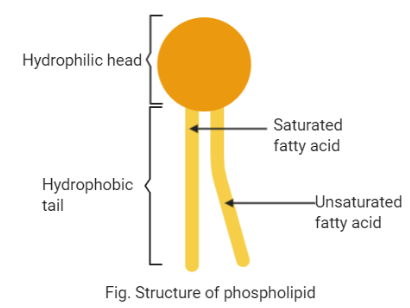
Hence, phospholipids in the cell membrane are arranged in a bilayer in such a way that the hydrophilic part interacts with the water containing environment and the hydrophobic part of the phospholipid is not in contact with water.
Hence, we can say that when a phospholipid is broken down it will dissociate into a glycerol molecule, a phosphate group with one organic group mostly nitrogen, and two chains of fatty acids.
Note:
Phospholipids are of two types glycerophospholipid and sphingophospholipids. Sphingophospholipids are eighteen carbon compounds containing sphingosine alcohol, a phosphate group attached to a nitrogen base called choline. The only example of sphingophospholipid is sphingomyelin.
Complete answer:
Lipids are hydrophobic biomolecules that play an important role in living organisms. The functions of lipids are the storage of energy for the long term, protection, insulation, and lubrication. It can also act as a precursor for hormones as well as is a primary component of the cell membrane. Lipids are divided into four major groups: triglycerides (include fats and oils), phospholipids, steroids, and waxes. All of these have a common characteristic that they are hydrophobic and cannot mix in water.
Phospholipids are a group of complex lipids containing a glycerol molecule attached to two fatty acids either saturated or unsaturated and a phosphate group with a nitrogen base. Glycerol is three-carbon alcohol where the two fatty acids are attached to carbon one and two while the phosphate group with nitrogen base is attached to the third carbon of the glycerol molecule. Phospholipids have a polar head made up of glycerol molecule and phosphate group with nitrogen attached that is hydrophilic and can mix in water; and a nonpolar tail that are two chains of fatty acids that are hydrophobic.
Hence, phospholipids in the cell membrane are arranged in a bilayer in such a way that the hydrophilic part interacts with the water containing environment and the hydrophobic part of the phospholipid is not in contact with water.
Hence, we can say that when a phospholipid is broken down it will dissociate into a glycerol molecule, a phosphate group with one organic group mostly nitrogen, and two chains of fatty acids.
Note:
Phospholipids are of two types glycerophospholipid and sphingophospholipids. Sphingophospholipids are eighteen carbon compounds containing sphingosine alcohol, a phosphate group attached to a nitrogen base called choline. The only example of sphingophospholipid is sphingomyelin.
Recently Updated Pages
Basicity of sulphurous acid and sulphuric acid are

Master Class 11 English: Engaging Questions & Answers for Success
Master Class 11 Physics: Engaging Questions & Answers for Success
Master Class 11 Computer Science: Engaging Questions & Answers for Success
Master Class 11 Chemistry: Engaging Questions & Answers for Success
Master Class 11 Social Science: Engaging Questions & Answers for Success
Trending doubts
Draw a diagram of a plant cell and label at least eight class 11 biology CBSE
Proton was discovered by A Thomson B Rutherford C Chadwick class 11 chemistry CBSE
What is the purity of pure gold in carat class 11 chemistry CBSE
Can anyone list 10 advantages and disadvantages of friction
Lysosomes are known as suicidal bags of cell why class 11 biology CBSE
Derive the equation of motion by the calculus method class 11 physics CBSE