




Show that the semi-vertical angle of a cone of maximum volume and given slant height is-
$\cos^{-1}\left(\dfrac1{\sqrt3}\right)$
Answer
 Verified
630.9k+ views
Hint: In this question, we will use the formula for the volume of the cone to form the function, and then differentiate it in order to find the maxima and find the semi-vertical angle. The volume of cone is given by-
$\dfrac{1}{3} \pi{r}^{2} \times h$
Complete step-by-step solution -
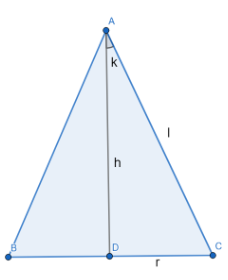
Let this be the front view of the cone, with semi-vertical angle k and given slant height l. By applying trigonometric properties, we can write that-
$h = l \cos k$
$r = l \sin k$
The volume of the cone is given by-
$\mathrm V=\dfrac13\mathrm{πr}^2\mathrm h\\\mathrm V=\dfrac13\mathrm{πsin}^2\mathrm{k cosk}$
To find the maximum value of V, we will differentiate the function V and equate it to zero. Then we can get the corresponding value of k. So-
$\dfrac{\operatorname d\mathrm V}{\operatorname d\mathrm k}=\dfrac13\mathrm\pi\left(\left(2\mathrm{sink cosk}\right)\mathrm{cosk}+\sin^2\mathrm k\left(-\mathrm{sink}\right)\right)=0\\
\Rightarrow \dfrac{\operatorname d\mathrm V}{\operatorname d\mathrm k}=\dfrac13\mathrm\pi\left(2\mathrm{sink cos}^2\mathrm k-\sin^3\mathrm k\right)=0\\
\Rightarrow \dfrac{\operatorname d\mathrm V}{\operatorname d\mathrm k}=\mathrm{sink}\left(2\cos^2\mathrm k-\sin^2\mathrm k\right)=0\\$
$\Rightarrow \sin k = 0$ or $2 \cos 2k = \sin 2k$
As angle k = 0 or k < 0 is not possible, so using $\sin^{2}k + \cos^{2}k = 1$,.
$\Rightarrow 2 \cos^{2}k = 1 -\cos^{2}k$
$\Rightarrow\cos^{2}k$ = $\dfrac{1}{3}$
$\Rightarrow\mathrm{cosk}=\dfrac{1}{\sqrt3}\\
\Rightarrow \mathrm k=\cos^{-1}\left(\dfrac{1}{\sqrt3}\right)$
This is the required answer.
Note: In this we can also satisfy the condition for maxima by proving the second differential to be less than zero. But it is not required because the minima condition is when k = 0, so the other condition will clearly become the maxima condition.
$\dfrac{1}{3} \pi{r}^{2} \times h$
Complete step-by-step solution -
Let this be the front view of the cone, with semi-vertical angle k and given slant height l. By applying trigonometric properties, we can write that-
$h = l \cos k$
$r = l \sin k$
The volume of the cone is given by-
$\mathrm V=\dfrac13\mathrm{πr}^2\mathrm h\\\mathrm V=\dfrac13\mathrm{πsin}^2\mathrm{k cosk}$
To find the maximum value of V, we will differentiate the function V and equate it to zero. Then we can get the corresponding value of k. So-
$\dfrac{\operatorname d\mathrm V}{\operatorname d\mathrm k}=\dfrac13\mathrm\pi\left(\left(2\mathrm{sink cosk}\right)\mathrm{cosk}+\sin^2\mathrm k\left(-\mathrm{sink}\right)\right)=0\\
\Rightarrow \dfrac{\operatorname d\mathrm V}{\operatorname d\mathrm k}=\dfrac13\mathrm\pi\left(2\mathrm{sink cos}^2\mathrm k-\sin^3\mathrm k\right)=0\\
\Rightarrow \dfrac{\operatorname d\mathrm V}{\operatorname d\mathrm k}=\mathrm{sink}\left(2\cos^2\mathrm k-\sin^2\mathrm k\right)=0\\$
$\Rightarrow \sin k = 0$ or $2 \cos 2k = \sin 2k$
As angle k = 0 or k < 0 is not possible, so using $\sin^{2}k + \cos^{2}k = 1$,.
$\Rightarrow 2 \cos^{2}k = 1 -\cos^{2}k$
$\Rightarrow\cos^{2}k$ = $\dfrac{1}{3}$
$\Rightarrow\mathrm{cosk}=\dfrac{1}{\sqrt3}\\
\Rightarrow \mathrm k=\cos^{-1}\left(\dfrac{1}{\sqrt3}\right)$
This is the required answer.
Note: In this we can also satisfy the condition for maxima by proving the second differential to be less than zero. But it is not required because the minima condition is when k = 0, so the other condition will clearly become the maxima condition.
Recently Updated Pages
Master Class 11 English: Engaging Questions & Answers for Success

Master Class 11 Maths: Engaging Questions & Answers for Success
Class 11 Question and Answer - Your Ultimate Solutions Guide
Master Class 11 Biology: Engaging Questions & Answers for Success
Master Class 11 Physics: Engaging Questions & Answers for Success
Master Class 11 Accountancy: Engaging Questions & Answers for Success
Trending doubts
Explain the Treaty of Vienna of 1815 class 10 social science CBSE
Who Won 36 Oscar Awards? Record Holder Revealed
What is the median of the first 10 natural numbers class 10 maths CBSE
Why is it 530 pm in india when it is 1200 afternoon class 10 social science CBSE
Why is there a time difference of about 5 hours between class 10 social science CBSE
What is the full form of POSCO class 10 social science CBSE