




Show that the points \[2\bar{i}-\bar{j}+\bar{k},\bar{i}-3\bar{j}-5\bar{k},3\bar{i}-4\bar{j}-4\bar{k}\] are the vertices of a right angled triangle. Also find the other two angles.
Answer
 Verified
594.3k+ views
Hint: let us take a rough figure of the given triangle.
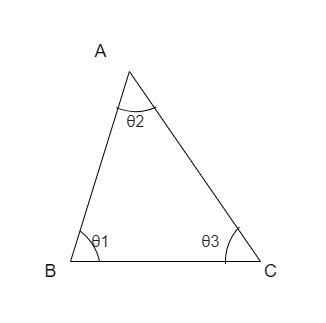
We are given that the points in vector form. The given points will be the position vectors of vertices of the triangle from the origin.
We solve this problem by finding the sides of the triangle using the position vectors.
We have the formula of finding the side using position vectors as
\[\overline{AB}=\overline{OB}-\overline{OA}\]
Complete step by step answer:
By using this formula we find the sides of the given triangle.
Then we use the dot product property to find the angle between the sides.
If \[\theta \] is the angle between \[\bar{a}={{x}_{1}}\bar{i}+{{y}_{1}}\bar{j}+{{z}_{1}}\bar{k}\] and \[\bar{b}={{x}_{2}}\bar{i}+{{y}_{2}}\bar{j}+{{z}_{2}}\bar{k}\] then
\[\cos \theta =\dfrac{\bar{a}\cdot \bar{b}}{\left| {\bar{a}} \right|\times \left| {\bar{b}} \right|}\]
Where, \[\bar{a}\cdot \bar{b}={{x}_{1}}{{x}_{2}}+{{y}_{1}}{{y}_{2}}+{{z}_{1}}{{z}_{2}}\] and \[\left| {\bar{a}} \right|=\sqrt{{{x}_{1}}^{2}+{{y}_{1}}^{2}+{{z}_{1}}^{2}},\left| {\bar{b}} \right|=\sqrt{{{x}_{2}}^{2}+{{y}_{2}}^{2}+{{z}_{2}}^{2}}\]
We need to keep in mind this formula is applicable when \[\theta \] is an angle between two tails that is the figure should be
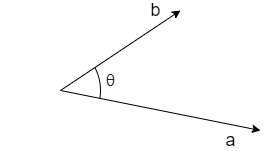
This means that we need to find the angle between \[\overline{BA},\overline{BC}\] but not between \[\overline{AB},\overline{BC}\]
We have the other formula of vectors that is
\[\overline{BA}=-\overline{AB}\]
We are given that the position vectors of vertices of a triangle as \[2\bar{i}-\bar{j}+\bar{k},\bar{i}-3\bar{j}-5\bar{k},3\bar{i}-4\bar{j}-4\bar{k}\]
Let us assume that the position vectors of vertices as
\[\begin{align}
& \Rightarrow \overline{OA}=2\bar{i}-\bar{j}+\bar{k} \\
& \Rightarrow \overline{OB}=\bar{i}-3\bar{j}-5\bar{k} \\
& \Rightarrow \overline{OC}=3\bar{i}-4\bar{j}-4\bar{k} \\
\end{align}\]
Now, let us find the sides of triangle in vector form.
We know that the formula of finding the side using position vectors as
\[\overline{AB}=\overline{OB}-\overline{OA}\]
By using the above formula let us find the side AB then we get
\[\begin{align}
& \Rightarrow \overline{AB}=\overline{OB}-\overline{OA} \\
& \Rightarrow \overline{AB}=\left( \bar{i}-3\bar{j}-5\bar{k} \right)-\left( 2\bar{i}-\bar{j}+\bar{k} \right) \\
& \Rightarrow \overline{AB}=-\bar{i}-2\bar{j}-6\bar{k} \\
\end{align}\]
Similarly let us find the side BC then we get
\[\begin{align}
& \Rightarrow \overline{BC}=\overline{OC}-\overline{OB} \\
& \Rightarrow \overline{BC}=\left( 3\bar{i}-4\bar{j}-4\bar{k} \right)-\left( \bar{i}-3\bar{j}-5\bar{k} \right) \\
& \Rightarrow \overline{BC}=2\bar{i}-\bar{j}+\bar{k} \\
\end{align}\]
Now, let us find the side CA then we get
\[\begin{align}
& \Rightarrow \overline{CA}=\overline{OA}-\overline{OC} \\
& \Rightarrow \overline{CA}=\left( 2\bar{i}-\bar{j}+\bar{k} \right)-\left( 3\bar{i}-4\bar{j}-4\bar{k} \right) \\
& \Rightarrow \overline{CA}=-\bar{i}+3\bar{j}+5\bar{k} \\
\end{align}\]
Now, let us consider the two sides that are \[\overline{BA},\overline{BC}\]
Let us assume that \[{{\theta }_{1}}\] be that angle between \[\overline{BA},\overline{BC}\]
We know that the condition that is
\[\overline{BA}=-\overline{AB}\]
By using this condition we get
\[\begin{align}
& \Rightarrow \overline{BA}=-\left( -\bar{i}-2\bar{j}-6\bar{k} \right) \\
& \Rightarrow \overline{BA}=\bar{i}+2\bar{j}+6\bar{k} \\
\end{align}\]
We know that if \[\theta \] is the angle between \[\bar{a}={{x}_{1}}\bar{i}+{{y}_{1}}\bar{j}+{{z}_{1}}\bar{k}\] and \[\bar{b}={{x}_{2}}\bar{i}+{{y}_{2}}\bar{j}+{{z}_{2}}\bar{k}\] then
\[\cos \theta =\dfrac{\bar{a}\cdot \bar{b}}{\left| {\bar{a}} \right|\times \left| {\bar{b}} \right|}\]
Where, \[\bar{a}\cdot \bar{b}={{x}_{1}}{{x}_{2}}+{{y}_{1}}{{y}_{2}}+{{z}_{1}}{{z}_{2}}\] and \[\left| {\bar{a}} \right|=\sqrt{{{x}_{1}}^{2}+{{y}_{1}}^{2}+{{z}_{1}}^{2}},\left| {\bar{b}} \right|=\sqrt{{{x}_{2}}^{2}+{{y}_{2}}^{2}+{{z}_{2}}^{2}}\]
By using this formula to \[\overline{BA},\overline{BC}\] we get
\[\Rightarrow \cos {{\theta }_{1}}=\dfrac{\overline{BA}\cdot \overline{BC}}{\left| \overline{BA} \right|\times \left| \overline{BC} \right|}\]
By substituting the vectors in above equation we get
\[\begin{align}
& \Rightarrow \cos {{\theta }_{1}}=\dfrac{\left( 2 \right)+\left( -2 \right)+\left( 6 \right)}{\sqrt{1+4+36}\sqrt{4+1+1}} \\
& \Rightarrow \cos {{\theta }_{1}}=\dfrac{6}{\sqrt{41}\sqrt{6}} \\
& \Rightarrow {{\theta }_{1}}={{\cos }^{-1}}\left( \sqrt{\dfrac{6}{41}} \right) \\
\end{align}\]
Now, let us assume that \[{{\theta }_{2}}\] be the angle between \[\overline{AB},\overline{AC}\]
We know that the condition that is
\[\Rightarrow \overline{AC}=-\overline{CA}\]
By substituting the required vector in above equation we get
\[\begin{align}
& \Rightarrow \overline{AC}=-\left( -\bar{i}+3\bar{j}+5\bar{k} \right) \\
& \Rightarrow \overline{AC}=\bar{i}-3\bar{j}-5\bar{k} \\
\end{align}\]
Now, by using the dot product formula we get
\[\Rightarrow \cos {{\theta }_{2}}=\dfrac{\overline{AB}\cdot \overline{AC}}{\left| \overline{AB} \right|\times \left| \overline{AC} \right|}\]
By substituting the vectors in above equation we get
\[\begin{align}
& \Rightarrow \cos {{\theta }_{2}}=\dfrac{\left( -1 \right)+\left( 6 \right)+\left( 30 \right)}{\sqrt{1+4+36}\sqrt{1+9+25}} \\
& \Rightarrow \cos {{\theta }_{2}}=\dfrac{35}{\sqrt{41}\sqrt{35}} \\
& \Rightarrow {{\theta }_{2}}={{\cos }^{-1}}\left( \sqrt{\dfrac{35}{41}} \right) \\
\end{align}\]
Now, let us assume that \[{{\theta }_{3}}\] be the angle between \[\overline{CB},\overline{CA}\]
We know that the condition that is
\[\begin{align}
& \Rightarrow \overline{CB}=-\overline{BC} \\
& \Rightarrow \overline{CB}=-\left( 2\bar{i}-\bar{j}+\bar{k} \right)=-2\bar{i}+\bar{j}-\bar{k} \\
\end{align}\]
Now, by using the dot product formula we get
\[\Rightarrow \cos {{\theta }_{3}}=\dfrac{\overline{BC}\cdot \overline{CA}}{\left| \overline{BC} \right|\times \left| \overline{CA} \right|}\]
By substituting the vectors in above equation we get
\[\begin{align}
& \Rightarrow \cos {{\theta }_{2}}=\dfrac{\left( 2 \right)+\left( 3 \right)+\left( -5 \right)}{\sqrt{4+1+1}\sqrt{1+9+25}} \\
& \Rightarrow \cos {{\theta }_{2}}=\dfrac{0}{\sqrt{41}\sqrt{35}} \\
& \Rightarrow {{\theta }_{2}}={{90}^{\circ }} \\
\end{align}\]
Here, we can see that one of the angles of three angles of the triangle is \[{{90}^{\circ }}\]
So, we can conclude that the given vertices form a right angles triangle and the remaining angles are given as \[{{\cos }^{-1}}\left( \sqrt{\dfrac{6}{41}} \right)\] and \[{{\cos }^{-1}}\left( \sqrt{\dfrac{35}{41}} \right)\]
Note:
Students may do mistakes in taking the angle between two vectors.
The angle between two vectors is the angle between two tails or two heads.
Let us assume that \[{{\theta }_{1}}\] be that angle between \[\overline{BA},\overline{BC}\]
Then this angle is represented as
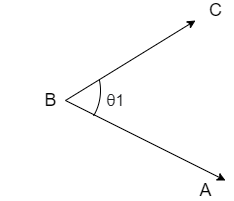
This is the correct representation.
If \[{{\theta }_{1}}\] be that angle between \[\overline{AB},\overline{BC}\] then it is represented as
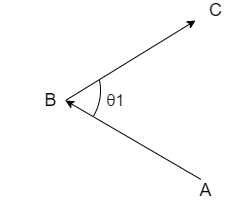
This is wrong because here the angle is between the tail of one vector and the head of the second vector.The arrow represents the head and the other end represents the tail.
We are given that the points in vector form. The given points will be the position vectors of vertices of the triangle from the origin.
We solve this problem by finding the sides of the triangle using the position vectors.
We have the formula of finding the side using position vectors as
\[\overline{AB}=\overline{OB}-\overline{OA}\]
Complete step by step answer:
By using this formula we find the sides of the given triangle.
Then we use the dot product property to find the angle between the sides.
If \[\theta \] is the angle between \[\bar{a}={{x}_{1}}\bar{i}+{{y}_{1}}\bar{j}+{{z}_{1}}\bar{k}\] and \[\bar{b}={{x}_{2}}\bar{i}+{{y}_{2}}\bar{j}+{{z}_{2}}\bar{k}\] then
\[\cos \theta =\dfrac{\bar{a}\cdot \bar{b}}{\left| {\bar{a}} \right|\times \left| {\bar{b}} \right|}\]
Where, \[\bar{a}\cdot \bar{b}={{x}_{1}}{{x}_{2}}+{{y}_{1}}{{y}_{2}}+{{z}_{1}}{{z}_{2}}\] and \[\left| {\bar{a}} \right|=\sqrt{{{x}_{1}}^{2}+{{y}_{1}}^{2}+{{z}_{1}}^{2}},\left| {\bar{b}} \right|=\sqrt{{{x}_{2}}^{2}+{{y}_{2}}^{2}+{{z}_{2}}^{2}}\]
We need to keep in mind this formula is applicable when \[\theta \] is an angle between two tails that is the figure should be
This means that we need to find the angle between \[\overline{BA},\overline{BC}\] but not between \[\overline{AB},\overline{BC}\]
We have the other formula of vectors that is
\[\overline{BA}=-\overline{AB}\]
We are given that the position vectors of vertices of a triangle as \[2\bar{i}-\bar{j}+\bar{k},\bar{i}-3\bar{j}-5\bar{k},3\bar{i}-4\bar{j}-4\bar{k}\]
Let us assume that the position vectors of vertices as
\[\begin{align}
& \Rightarrow \overline{OA}=2\bar{i}-\bar{j}+\bar{k} \\
& \Rightarrow \overline{OB}=\bar{i}-3\bar{j}-5\bar{k} \\
& \Rightarrow \overline{OC}=3\bar{i}-4\bar{j}-4\bar{k} \\
\end{align}\]
Now, let us find the sides of triangle in vector form.
We know that the formula of finding the side using position vectors as
\[\overline{AB}=\overline{OB}-\overline{OA}\]
By using the above formula let us find the side AB then we get
\[\begin{align}
& \Rightarrow \overline{AB}=\overline{OB}-\overline{OA} \\
& \Rightarrow \overline{AB}=\left( \bar{i}-3\bar{j}-5\bar{k} \right)-\left( 2\bar{i}-\bar{j}+\bar{k} \right) \\
& \Rightarrow \overline{AB}=-\bar{i}-2\bar{j}-6\bar{k} \\
\end{align}\]
Similarly let us find the side BC then we get
\[\begin{align}
& \Rightarrow \overline{BC}=\overline{OC}-\overline{OB} \\
& \Rightarrow \overline{BC}=\left( 3\bar{i}-4\bar{j}-4\bar{k} \right)-\left( \bar{i}-3\bar{j}-5\bar{k} \right) \\
& \Rightarrow \overline{BC}=2\bar{i}-\bar{j}+\bar{k} \\
\end{align}\]
Now, let us find the side CA then we get
\[\begin{align}
& \Rightarrow \overline{CA}=\overline{OA}-\overline{OC} \\
& \Rightarrow \overline{CA}=\left( 2\bar{i}-\bar{j}+\bar{k} \right)-\left( 3\bar{i}-4\bar{j}-4\bar{k} \right) \\
& \Rightarrow \overline{CA}=-\bar{i}+3\bar{j}+5\bar{k} \\
\end{align}\]
Now, let us consider the two sides that are \[\overline{BA},\overline{BC}\]
Let us assume that \[{{\theta }_{1}}\] be that angle between \[\overline{BA},\overline{BC}\]
We know that the condition that is
\[\overline{BA}=-\overline{AB}\]
By using this condition we get
\[\begin{align}
& \Rightarrow \overline{BA}=-\left( -\bar{i}-2\bar{j}-6\bar{k} \right) \\
& \Rightarrow \overline{BA}=\bar{i}+2\bar{j}+6\bar{k} \\
\end{align}\]
We know that if \[\theta \] is the angle between \[\bar{a}={{x}_{1}}\bar{i}+{{y}_{1}}\bar{j}+{{z}_{1}}\bar{k}\] and \[\bar{b}={{x}_{2}}\bar{i}+{{y}_{2}}\bar{j}+{{z}_{2}}\bar{k}\] then
\[\cos \theta =\dfrac{\bar{a}\cdot \bar{b}}{\left| {\bar{a}} \right|\times \left| {\bar{b}} \right|}\]
Where, \[\bar{a}\cdot \bar{b}={{x}_{1}}{{x}_{2}}+{{y}_{1}}{{y}_{2}}+{{z}_{1}}{{z}_{2}}\] and \[\left| {\bar{a}} \right|=\sqrt{{{x}_{1}}^{2}+{{y}_{1}}^{2}+{{z}_{1}}^{2}},\left| {\bar{b}} \right|=\sqrt{{{x}_{2}}^{2}+{{y}_{2}}^{2}+{{z}_{2}}^{2}}\]
By using this formula to \[\overline{BA},\overline{BC}\] we get
\[\Rightarrow \cos {{\theta }_{1}}=\dfrac{\overline{BA}\cdot \overline{BC}}{\left| \overline{BA} \right|\times \left| \overline{BC} \right|}\]
By substituting the vectors in above equation we get
\[\begin{align}
& \Rightarrow \cos {{\theta }_{1}}=\dfrac{\left( 2 \right)+\left( -2 \right)+\left( 6 \right)}{\sqrt{1+4+36}\sqrt{4+1+1}} \\
& \Rightarrow \cos {{\theta }_{1}}=\dfrac{6}{\sqrt{41}\sqrt{6}} \\
& \Rightarrow {{\theta }_{1}}={{\cos }^{-1}}\left( \sqrt{\dfrac{6}{41}} \right) \\
\end{align}\]
Now, let us assume that \[{{\theta }_{2}}\] be the angle between \[\overline{AB},\overline{AC}\]
We know that the condition that is
\[\Rightarrow \overline{AC}=-\overline{CA}\]
By substituting the required vector in above equation we get
\[\begin{align}
& \Rightarrow \overline{AC}=-\left( -\bar{i}+3\bar{j}+5\bar{k} \right) \\
& \Rightarrow \overline{AC}=\bar{i}-3\bar{j}-5\bar{k} \\
\end{align}\]
Now, by using the dot product formula we get
\[\Rightarrow \cos {{\theta }_{2}}=\dfrac{\overline{AB}\cdot \overline{AC}}{\left| \overline{AB} \right|\times \left| \overline{AC} \right|}\]
By substituting the vectors in above equation we get
\[\begin{align}
& \Rightarrow \cos {{\theta }_{2}}=\dfrac{\left( -1 \right)+\left( 6 \right)+\left( 30 \right)}{\sqrt{1+4+36}\sqrt{1+9+25}} \\
& \Rightarrow \cos {{\theta }_{2}}=\dfrac{35}{\sqrt{41}\sqrt{35}} \\
& \Rightarrow {{\theta }_{2}}={{\cos }^{-1}}\left( \sqrt{\dfrac{35}{41}} \right) \\
\end{align}\]
Now, let us assume that \[{{\theta }_{3}}\] be the angle between \[\overline{CB},\overline{CA}\]
We know that the condition that is
\[\begin{align}
& \Rightarrow \overline{CB}=-\overline{BC} \\
& \Rightarrow \overline{CB}=-\left( 2\bar{i}-\bar{j}+\bar{k} \right)=-2\bar{i}+\bar{j}-\bar{k} \\
\end{align}\]
Now, by using the dot product formula we get
\[\Rightarrow \cos {{\theta }_{3}}=\dfrac{\overline{BC}\cdot \overline{CA}}{\left| \overline{BC} \right|\times \left| \overline{CA} \right|}\]
By substituting the vectors in above equation we get
\[\begin{align}
& \Rightarrow \cos {{\theta }_{2}}=\dfrac{\left( 2 \right)+\left( 3 \right)+\left( -5 \right)}{\sqrt{4+1+1}\sqrt{1+9+25}} \\
& \Rightarrow \cos {{\theta }_{2}}=\dfrac{0}{\sqrt{41}\sqrt{35}} \\
& \Rightarrow {{\theta }_{2}}={{90}^{\circ }} \\
\end{align}\]
Here, we can see that one of the angles of three angles of the triangle is \[{{90}^{\circ }}\]
So, we can conclude that the given vertices form a right angles triangle and the remaining angles are given as \[{{\cos }^{-1}}\left( \sqrt{\dfrac{6}{41}} \right)\] and \[{{\cos }^{-1}}\left( \sqrt{\dfrac{35}{41}} \right)\]
Note:
Students may do mistakes in taking the angle between two vectors.
The angle between two vectors is the angle between two tails or two heads.
Let us assume that \[{{\theta }_{1}}\] be that angle between \[\overline{BA},\overline{BC}\]
Then this angle is represented as
This is the correct representation.
If \[{{\theta }_{1}}\] be that angle between \[\overline{AB},\overline{BC}\] then it is represented as
This is wrong because here the angle is between the tail of one vector and the head of the second vector.The arrow represents the head and the other end represents the tail.
Recently Updated Pages
Master Class 12 Business Studies: Engaging Questions & Answers for Success

Master Class 12 Biology: Engaging Questions & Answers for Success
Master Class 12 Chemistry: Engaging Questions & Answers for Success
Class 12 Question and Answer - Your Ultimate Solutions Guide
Master Class 11 Social Science: Engaging Questions & Answers for Success
Master Class 11 English: Engaging Questions & Answers for Success
Trending doubts
Explain the Treaty of Vienna of 1815 class 10 social science CBSE
Who Won 36 Oscar Awards? Record Holder Revealed
What is the median of the first 10 natural numbers class 10 maths CBSE
Why is it 530 pm in india when it is 1200 afternoon class 10 social science CBSE
What is the full form of POSCO class 10 social science CBSE
The highest temperature in Karnataka is recorded in class 10 social science CBSE