




Show that the points $A\left( {2\widehat i - \widehat j + \widehat k} \right)$\[B\left( {\widehat i - 3\widehat j - 5\widehat k} \right)\] and \[C\left( {3\widehat i - 4\widehat j - 4\widehat k} \right)\] are the vertices of a right-angled triangle.
Answer
 Verified
569.1k+ views
Hint: In this question, we have to show that the given vertices are of a right angled triangle. For that, we must take three vector representations of the triangle. Find the length of each side and then the magnitude. Substitute the obtained values in Pythagoras theorem to get the proof.
Complete step-by-step solution:
Given three points:
$A\left( {2\widehat i - \widehat j + \widehat k} \right)$
\[B\left( {\widehat i - 3\widehat j - 5\widehat k} \right)\] and
\[C\left( {3\widehat i - 4\widehat j - 4\widehat k} \right)\]
Let us represent each of the given vector in the form of vector variables \[\overrightarrow {OA} ,\overrightarrow {OB} \] and \[\overrightarrow {OC} \]
\[\overrightarrow {OA} \]$ = 2\widehat i - \widehat j + \widehat k$
\[\overrightarrow {OB} \]\[ = \widehat i - 3\widehat j - 5\widehat k\]
\[\overrightarrow {OC} \]\[ = 3\widehat i - 4\widehat j - 4\widehat k\]
Now, let us take a triangle of vertices \[A,B\] and \[C\].
Vectors, \[\overrightarrow {AB} ,\overrightarrow {BC} \]and \[\overrightarrow {AC} \] represents the side of \[\vartriangle ABC\].
Now, we are finding the vector representation of each side of the triangle.
\[\overrightarrow {AB} \]\[ = \overrightarrow {OB} - \overrightarrow {OA} \]
Substituting the values of the vectors, we get;
$\Rightarrow$\[\overrightarrow {AB} = \left( {\widehat i - 3\widehat j - 5\widehat k} \right) - \left( {2\widehat i - \widehat j + \widehat k} \right)\]
Solving the brackets, we get;
$\Rightarrow$\[\overrightarrow {AB} = \widehat i - 3\widehat j - 5\widehat k - 2\widehat i + \widehat j - \widehat k\]
Now, by subtracting the similar terms, we get;
$\Rightarrow$\[\overrightarrow {AB} = - \widehat i - 2\widehat j - 6\widehat k\]
Similarly, we find the other two vector representations of the sides in the same process.
\[\overrightarrow {BC} = \overrightarrow {OC} - \overrightarrow {OB} \]
Substituting the values of the vectors, we get;
$\Rightarrow$\[\overrightarrow {BC} \]\[ = \left( {3\widehat i - 4\widehat j - 4\widehat k} \right) - \left( {\widehat i - 3\widehat j - 5\widehat k} \right)\]
Solving the brackets, we get;
$\Rightarrow$\[\overrightarrow {BC} = 3\widehat i - 4\widehat j - 4\widehat k - \widehat i + 3\widehat j + 5\widehat k\]
Now, by subtracting the similar terms, we get;
$\Rightarrow$\[\overrightarrow {BC} = 2\widehat i - \widehat j + \widehat k\]
Now, finding the last representation in the vector form, we get;
\[\overrightarrow {AC} = \overrightarrow {OC} - \overrightarrow {OA} \]
Substituting the values of the vectors, we get;
$\Rightarrow$\[\overrightarrow {AC} \]\[ = \left( {3\widehat i - 4\widehat j - 4\widehat k} \right) - \left( {2\widehat i - \widehat j + \widehat k} \right)\]
Solving the brackets, we get;
$\Rightarrow$\[\overrightarrow {AC} = 3\widehat i - 4\widehat j - 4\widehat k - 2\widehat i + \widehat j - \widehat k\]
Now, by subtracting the similar terms, we get;
$\Rightarrow$\[\overrightarrow {AC} = - \widehat i + 3\widehat j + 5\widehat k\]
Now, we find the magnitude of each vector to know if they satisfy the Pythagoras theorem:
$\Rightarrow$\[\left| {\overrightarrow {AB} } \right| = \sqrt {{{\left( { - 1} \right)}^2} + {{\left( { - 2} \right)}^2} + {{\left( { - 6} \right)}^2}} \]
Now, squaring all the terms, we get;
$\Rightarrow$\[\left| {\overrightarrow {AB} } \right| = \sqrt {1 + 4 + 36} \]
Adding all the terms, we get;
$\Rightarrow$\[\left| {\overrightarrow {AB} } \right| = \sqrt {41} \]
Similarly, we find the magnitude of the other two vectors.
$\Rightarrow$\[\left| {\overrightarrow {BC} } \right| = \sqrt {{{\left( 2 \right)}^2} + {{\left( { - 1} \right)}^2} + {{\left( 1 \right)}^2}} \]
Now, squaring all the terms, we get;
$\Rightarrow$\[\left| {\overrightarrow {BC} } \right| = \sqrt {4 + 1 + 1} \]
Adding all the terms, we get;
$\Rightarrow$\[\left| {\overrightarrow {BC} } \right| = \sqrt 6 \]
Similarly, we find the other term magnitude as well;
$\Rightarrow$\[\left| {\overrightarrow {AC} } \right| = \sqrt {{{\left( { - 1} \right)}^2} + {{\left( 3 \right)}^2} + {{\left( 5 \right)}^2}} \]
Now, squaring all the terms, we get;
$\Rightarrow$\[\left| {\overrightarrow {AC} } \right| = \sqrt {1 + 9 + 25} \]
Adding all the terms, we get;
$\Rightarrow$\[\left| {\overrightarrow {AC} } \right| = \sqrt {35} \]
Now, we got the magnitudes of all the sides of the triangle. Squaring every side to know the magnitude while in Pythagoras theorem, we get;
$\Rightarrow$\[{\left| {\overrightarrow {AB} } \right|^2}\]\[ = {\left( {\sqrt {41} } \right)^2}\]
Squaring the right-hand side, we get;
\[ \Rightarrow {\left| {\overrightarrow {AB} } \right|^2} = 41\]
Now, moving on to the other sides,
$\Rightarrow$\[{\left| {\overrightarrow {BC} } \right|^2} = {\left( {\sqrt 6 } \right)^2}\]
Squaring the right-hand side, we get;
\[ \Rightarrow {\left| {\overrightarrow {BC} } \right|^2} = 6\]
The other side, we get;
$\Rightarrow$\[{\left| {\overrightarrow {AC} } \right|^2} = {\left( {\sqrt {35} } \right)^2}\]
Squaring the right-hand side, we get;
\[ \Rightarrow {\left| {\overrightarrow {AC} } \right|^2} = 35\]
Substituting them in the formula of Pythagoras theorem, we get;
$\Rightarrow$\[{\left| {\overrightarrow {AC} } \right|^2} + {\left| {\overrightarrow {BC} } \right|^2} = {\left| {\overrightarrow {AB} } \right|^2}\]
\[ \Rightarrow 35 + 6 = 41\]
The Pythagoras theorem is satisfied. Therefore, the lines are perpendicular to each other which makes the triangle a right-angled triangle.
Hence proved.
Note: We can also solve the problem in another way,
Since, we know that two vectors are perpendicular to each other,
That is, have an angle of ${90^ \circ }$ between them, if their scalar product is zero.
Hence from the above solution,
\[\overrightarrow {AB} = - \widehat i - 2\widehat j - 6\widehat k\]
\[\overrightarrow {BC} = 2\widehat i - \widehat j + \widehat k\]
\[\overrightarrow {CA} = - \widehat i + 3\widehat j + 5\widehat k\]
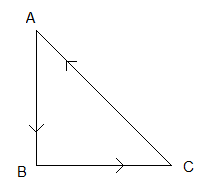
So, we have to prove the \[\overrightarrow {BC} \] and \[\overrightarrow {CA} \] are perpendicular.
That is,
\[\overrightarrow {BC} \cdot \overrightarrow {CA} = \left( {2\widehat i - \widehat {1j} + 1\widehat k} \right) \cdot \left( { - 1\widehat i + 3\widehat j + 5\widehat k} \right)\]
Multiplying the vectors we get,
$ \Rightarrow \left( {2 \times \left( { - 1} \right)} \right) + \left( {\left( { - 1} \right) \times 3} \right) + \left( {1 \times 5} \right)$
Simplifying the terms
$ \Rightarrow \left( { - 2} \right) + \left( { - 3} \right) + \left( 5 \right)$
Add and subtracting the terms,
$ \Rightarrow - 5 + 5 = 0$
Hence, \[\overrightarrow {BC} \cdot \overrightarrow {CA} = 0\]
$\therefore $ \[\overrightarrow {BC} \] is perpendicular to \[\overrightarrow {CA} \]
Hence, $\vartriangle ABC$ is a right angled triangle.
Complete step-by-step solution:
Given three points:
$A\left( {2\widehat i - \widehat j + \widehat k} \right)$
\[B\left( {\widehat i - 3\widehat j - 5\widehat k} \right)\] and
\[C\left( {3\widehat i - 4\widehat j - 4\widehat k} \right)\]
Let us represent each of the given vector in the form of vector variables \[\overrightarrow {OA} ,\overrightarrow {OB} \] and \[\overrightarrow {OC} \]
\[\overrightarrow {OA} \]$ = 2\widehat i - \widehat j + \widehat k$
\[\overrightarrow {OB} \]\[ = \widehat i - 3\widehat j - 5\widehat k\]
\[\overrightarrow {OC} \]\[ = 3\widehat i - 4\widehat j - 4\widehat k\]
Now, let us take a triangle of vertices \[A,B\] and \[C\].
Vectors, \[\overrightarrow {AB} ,\overrightarrow {BC} \]and \[\overrightarrow {AC} \] represents the side of \[\vartriangle ABC\].
Now, we are finding the vector representation of each side of the triangle.
\[\overrightarrow {AB} \]\[ = \overrightarrow {OB} - \overrightarrow {OA} \]
Substituting the values of the vectors, we get;
$\Rightarrow$\[\overrightarrow {AB} = \left( {\widehat i - 3\widehat j - 5\widehat k} \right) - \left( {2\widehat i - \widehat j + \widehat k} \right)\]
Solving the brackets, we get;
$\Rightarrow$\[\overrightarrow {AB} = \widehat i - 3\widehat j - 5\widehat k - 2\widehat i + \widehat j - \widehat k\]
Now, by subtracting the similar terms, we get;
$\Rightarrow$\[\overrightarrow {AB} = - \widehat i - 2\widehat j - 6\widehat k\]
Similarly, we find the other two vector representations of the sides in the same process.
\[\overrightarrow {BC} = \overrightarrow {OC} - \overrightarrow {OB} \]
Substituting the values of the vectors, we get;
$\Rightarrow$\[\overrightarrow {BC} \]\[ = \left( {3\widehat i - 4\widehat j - 4\widehat k} \right) - \left( {\widehat i - 3\widehat j - 5\widehat k} \right)\]
Solving the brackets, we get;
$\Rightarrow$\[\overrightarrow {BC} = 3\widehat i - 4\widehat j - 4\widehat k - \widehat i + 3\widehat j + 5\widehat k\]
Now, by subtracting the similar terms, we get;
$\Rightarrow$\[\overrightarrow {BC} = 2\widehat i - \widehat j + \widehat k\]
Now, finding the last representation in the vector form, we get;
\[\overrightarrow {AC} = \overrightarrow {OC} - \overrightarrow {OA} \]
Substituting the values of the vectors, we get;
$\Rightarrow$\[\overrightarrow {AC} \]\[ = \left( {3\widehat i - 4\widehat j - 4\widehat k} \right) - \left( {2\widehat i - \widehat j + \widehat k} \right)\]
Solving the brackets, we get;
$\Rightarrow$\[\overrightarrow {AC} = 3\widehat i - 4\widehat j - 4\widehat k - 2\widehat i + \widehat j - \widehat k\]
Now, by subtracting the similar terms, we get;
$\Rightarrow$\[\overrightarrow {AC} = - \widehat i + 3\widehat j + 5\widehat k\]
Now, we find the magnitude of each vector to know if they satisfy the Pythagoras theorem:
$\Rightarrow$\[\left| {\overrightarrow {AB} } \right| = \sqrt {{{\left( { - 1} \right)}^2} + {{\left( { - 2} \right)}^2} + {{\left( { - 6} \right)}^2}} \]
Now, squaring all the terms, we get;
$\Rightarrow$\[\left| {\overrightarrow {AB} } \right| = \sqrt {1 + 4 + 36} \]
Adding all the terms, we get;
$\Rightarrow$\[\left| {\overrightarrow {AB} } \right| = \sqrt {41} \]
Similarly, we find the magnitude of the other two vectors.
$\Rightarrow$\[\left| {\overrightarrow {BC} } \right| = \sqrt {{{\left( 2 \right)}^2} + {{\left( { - 1} \right)}^2} + {{\left( 1 \right)}^2}} \]
Now, squaring all the terms, we get;
$\Rightarrow$\[\left| {\overrightarrow {BC} } \right| = \sqrt {4 + 1 + 1} \]
Adding all the terms, we get;
$\Rightarrow$\[\left| {\overrightarrow {BC} } \right| = \sqrt 6 \]
Similarly, we find the other term magnitude as well;
$\Rightarrow$\[\left| {\overrightarrow {AC} } \right| = \sqrt {{{\left( { - 1} \right)}^2} + {{\left( 3 \right)}^2} + {{\left( 5 \right)}^2}} \]
Now, squaring all the terms, we get;
$\Rightarrow$\[\left| {\overrightarrow {AC} } \right| = \sqrt {1 + 9 + 25} \]
Adding all the terms, we get;
$\Rightarrow$\[\left| {\overrightarrow {AC} } \right| = \sqrt {35} \]
Now, we got the magnitudes of all the sides of the triangle. Squaring every side to know the magnitude while in Pythagoras theorem, we get;
$\Rightarrow$\[{\left| {\overrightarrow {AB} } \right|^2}\]\[ = {\left( {\sqrt {41} } \right)^2}\]
Squaring the right-hand side, we get;
\[ \Rightarrow {\left| {\overrightarrow {AB} } \right|^2} = 41\]
Now, moving on to the other sides,
$\Rightarrow$\[{\left| {\overrightarrow {BC} } \right|^2} = {\left( {\sqrt 6 } \right)^2}\]
Squaring the right-hand side, we get;
\[ \Rightarrow {\left| {\overrightarrow {BC} } \right|^2} = 6\]
The other side, we get;
$\Rightarrow$\[{\left| {\overrightarrow {AC} } \right|^2} = {\left( {\sqrt {35} } \right)^2}\]
Squaring the right-hand side, we get;
\[ \Rightarrow {\left| {\overrightarrow {AC} } \right|^2} = 35\]
Substituting them in the formula of Pythagoras theorem, we get;
$\Rightarrow$\[{\left| {\overrightarrow {AC} } \right|^2} + {\left| {\overrightarrow {BC} } \right|^2} = {\left| {\overrightarrow {AB} } \right|^2}\]
\[ \Rightarrow 35 + 6 = 41\]
The Pythagoras theorem is satisfied. Therefore, the lines are perpendicular to each other which makes the triangle a right-angled triangle.
Hence proved.
Note: We can also solve the problem in another way,
Since, we know that two vectors are perpendicular to each other,
That is, have an angle of ${90^ \circ }$ between them, if their scalar product is zero.
Hence from the above solution,
\[\overrightarrow {AB} = - \widehat i - 2\widehat j - 6\widehat k\]
\[\overrightarrow {BC} = 2\widehat i - \widehat j + \widehat k\]
\[\overrightarrow {CA} = - \widehat i + 3\widehat j + 5\widehat k\]
So, we have to prove the \[\overrightarrow {BC} \] and \[\overrightarrow {CA} \] are perpendicular.
That is,
\[\overrightarrow {BC} \cdot \overrightarrow {CA} = \left( {2\widehat i - \widehat {1j} + 1\widehat k} \right) \cdot \left( { - 1\widehat i + 3\widehat j + 5\widehat k} \right)\]
Multiplying the vectors we get,
$ \Rightarrow \left( {2 \times \left( { - 1} \right)} \right) + \left( {\left( { - 1} \right) \times 3} \right) + \left( {1 \times 5} \right)$
Simplifying the terms
$ \Rightarrow \left( { - 2} \right) + \left( { - 3} \right) + \left( 5 \right)$
Add and subtracting the terms,
$ \Rightarrow - 5 + 5 = 0$
Hence, \[\overrightarrow {BC} \cdot \overrightarrow {CA} = 0\]
$\therefore $ \[\overrightarrow {BC} \] is perpendicular to \[\overrightarrow {CA} \]
Hence, $\vartriangle ABC$ is a right angled triangle.
Recently Updated Pages
Master Class 12 Economics: Engaging Questions & Answers for Success

Master Class 12 Physics: Engaging Questions & Answers for Success
Master Class 12 English: Engaging Questions & Answers for Success
Master Class 12 Social Science: Engaging Questions & Answers for Success
Master Class 12 Maths: Engaging Questions & Answers for Success
Master Class 12 Business Studies: Engaging Questions & Answers for Success
Trending doubts
Which are the Top 10 Largest Countries of the World?
What are the major means of transport Explain each class 12 social science CBSE
Draw a labelled sketch of the human eye class 12 physics CBSE
Differentiate between insitu conservation and exsitu class 12 biology CBSE
Draw a neat and well labeled diagram of TS of ovary class 12 biology CBSE
Give 10 examples of unisexual and bisexual flowers