




Show that the points (-4,-7), (-1,2), (8,5) and (5,-4) taken in order are a rhombus. And find its area.
Answer
 Verified
635.4k+ views
Hint: For solving this question first we will plot the given points on the x-y plane and then plot the quadrilateral by joining them in the given order. After that, we will find the length of each side and the length of diagonals by using the distance formula. Then, we will consider one of the body diagonal and find the area of the quadrilateral by adding the area of the two triangles and equate it to the value of $\dfrac{1}{2}\times \left( \text{product of its diagonals} \right)$ to prove the desired result.
Area of rhombus $=\dfrac{1}{2}\times $ product of its diagonals.
Complete Step-by-Step solution:
Given:
We have four points (-4,-7), (-1,2), (8,5) and (5,-4). And we have to prove that when we consider these points in order then they make a rhombus.
Now, let point A (-4,-7), point B (-1,2), point C (8,5) and point D (5,-4). So, we have to prove that ABCD is a rhombus. First, we will plot the figure of quadrilateral ABCD on the x-y plane. The plot is given below:
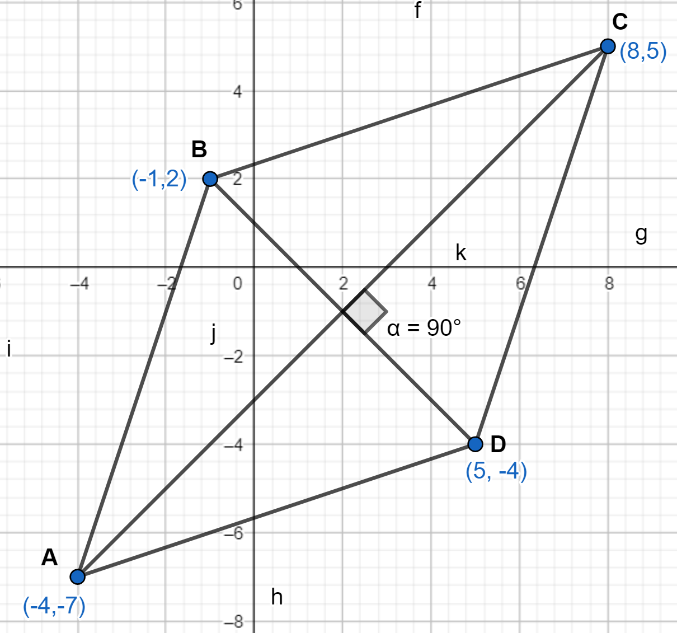
In the above figure, AC and BD are the diagonals of the quadrilateral ABCD.
Now, before we proceed we should know the following three formulas:
1. Distance between point $A\equiv \left( {{x}_{1}},{{y}_{1}} \right)$ and $B\equiv \left( {{x}_{2}},{{y}_{2}} \right)$ can be calculated by the distance formula as $AB=\sqrt{{{\left( {{x}_{2}}-{{x}_{1}} \right)}^{2}}+{{\left( {{y}_{2}}-{{y}_{1}} \right)}^{2}}}$ .
2. If points $A\equiv \left( {{x}_{1}},{{y}_{1}} \right)$ , $B\equiv \left( {{x}_{2}},{{y}_{2}} \right)$ and $C\equiv \left( {{x}_{3}},{{y}_{3}} \right)$ forms a $\Delta ABC$ then, area of the $\Delta ABC$ is given by the value of $\dfrac{1}{2}\left| {{x}_{1}}\left( {{y}_{2}}-{{y}_{3}} \right)+{{x}_{2}}\left( {{y}_{3}}-{{y}_{1}} \right)+{{x}_{3}}\left( {{y}_{1}}-{{y}_{2}} \right) \right|$ .
3. If area of any quadrilateral is equal to the $\dfrac{1}{2}\times \left( \text{product of its diagonals} \right)$ and length of sides are equal then that quadrilateral will be a rhombus.
Now, we come back to our question where we have the quadrilateral ABCD. Where $A\equiv \left( -4,-7 \right)$ , $B\equiv \left( -1,2 \right)$ , $C\equiv \left( 8,5 \right)$ and $D\equiv \left( 5,-4 \right)$ so, we use the distance formula to find the length of AB, BC, CD, DA, BD and AC. Then,
$\begin{align}
& AB=\sqrt{{{\left( -1+4 \right)}^{2}}+{{\left( 2+7 \right)}^{2}}} \\
& \Rightarrow AB=\sqrt{{{3}^{2}}+{{9}^{2}}} \\
& \Rightarrow AB=\sqrt{9+81} \\
& \Rightarrow AB=\sqrt{90} \\
& \Rightarrow AB=3\sqrt{10} \\
& BC=\sqrt{{{\left( 8+1 \right)}^{2}}+{{\left( 5-2 \right)}^{2}}} \\
& \Rightarrow BC=\sqrt{{{9}^{2}}+{{3}^{2}}} \\
& \Rightarrow BC=\sqrt{81+9} \\
& \Rightarrow BC=\sqrt{90} \\
& \Rightarrow BC=3\sqrt{10} \\
& CD=\sqrt{{{\left( 5-8 \right)}^{2}}+{{\left( -4-5 \right)}^{2}}} \\
& \Rightarrow CD=\sqrt{{{\left( -3 \right)}^{2}}+{{\left( -9 \right)}^{2}}} \\
& \Rightarrow CD=\sqrt{9+81} \\
& \Rightarrow CD=\sqrt{90} \\
& \Rightarrow CD=3\sqrt{10} \\
& DA=\sqrt{{{\left( -4-5 \right)}^{2}}+{{\left( -7+4 \right)}^{2}}} \\
& \Rightarrow DA=\sqrt{{{\left( -9 \right)}^{2}}+{{\left( -3 \right)}^{2}}} \\
& \Rightarrow DA=\sqrt{81+9} \\
& \Rightarrow DA=\sqrt{90} \\
& \Rightarrow DA=3\sqrt{10} \\
\end{align}$
$\begin{align}
& BD=\sqrt{{{\left( 5+1 \right)}^{2}}+{{\left( -4-2 \right)}^{2}}} \\
& \Rightarrow BD=\sqrt{{{6}^{2}}+{{\left( -6 \right)}^{2}}} \\
& \Rightarrow BD=\sqrt{36+36} \\
& \Rightarrow BD=\sqrt{72} \\
& \Rightarrow BD=6\sqrt{2}.......................\left( 1 \right) \\
& AC=\sqrt{{{\left( 8+4 \right)}^{2}}+{{\left( 5+7 \right)}^{2}}} \\
& \Rightarrow BD=\sqrt{{{12}^{2}}+{{12}^{2}}} \\
& \Rightarrow BD=\sqrt{144+144} \\
& \Rightarrow BD=\sqrt{288} \\
& \Rightarrow BD=12\sqrt{2}.......................\left( 2 \right) \\
\end{align}$
Now, from the above result, we conclude that the length of each side AB, BC, CD and DA of the quadrilateral is equal to $3\sqrt{10}$ units and all sides are of equal length.
Now, take a look at the following figure and consider $\Delta ABC$ , $\Delta ADC$ and use the formula mentioned in the second point to find their areas.
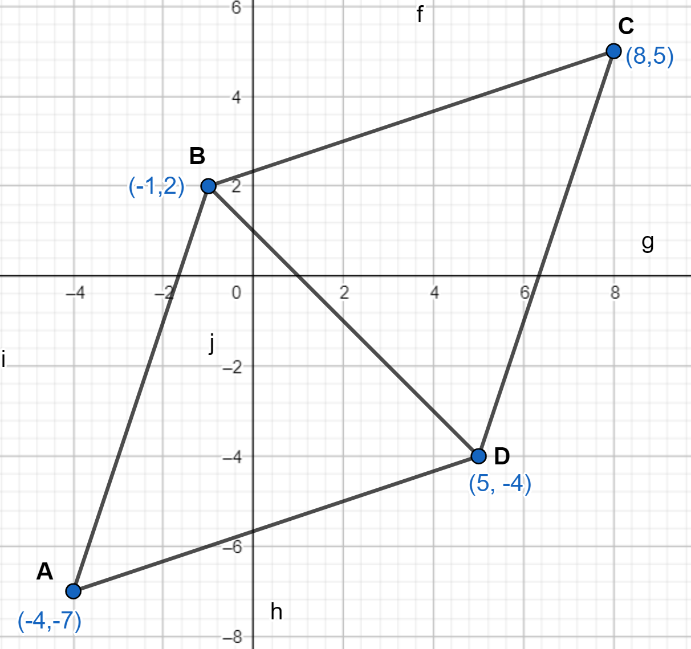
In the above figure points $A\equiv \left( -4,-7 \right)$ , $B\equiv \left( -1,2 \right)$ , $C\equiv \left( 8,5 \right)$ and $D\equiv \left( 5,-4 \right)$ . Then,
Area of $\Delta ABC=\dfrac{1}{2}\left| -4\left( 2-5 \right)-1\left( 5+7 \right)+8\left( -7-2 \right) \right|=\dfrac{1}{2}\left| 12-12-72 \right|=\dfrac{\left| -72 \right|}{2}=\dfrac{72}{2}=36$ .
Area of $\Delta ADC=\dfrac{1}{2}\left| -4\left( -4-5 \right)+5\left( 5+7 \right)+8\left( -7+4 \right) \right|=\dfrac{1}{2}\left| 36+60-24 \right|=\dfrac{\left| 72 \right|}{2}=36$ .
Now, we can write that the area of quadrilateral ABCD will be equal to the sum of the areas of the $\Delta ABC$ and $\Delta ADC$ . Then,
Area of the quadrilateral ABCD $=36+36=72...............\left( 3 \right)$
Now, from the equation (1) length of diagonal $BD=6\sqrt{2}$ and the equation (2) length of the diagonal $AC=12\sqrt{2}$ . Then,
$\begin{align}
& \dfrac{1}{2}\times \left( \text{product of its diagonals} \right)=\dfrac{1}{2}\times 6\sqrt{2}\times 12\sqrt{2} \\
& \Rightarrow \dfrac{1}{2}\times \left( \text{product of its diagonals} \right)=72 \\
\end{align}$
Now, on comparing the above result with the equation (3) we conclude that the area of the quadrilateral ABCD is equal to the $\dfrac{1}{2}\times \left( \text{product of its diagonals} \right)$ and as we have proved above that length of each side of quadrilateral ABCD is equal. Thus, from the property mentioned in the third point above we conclude that ABCD is a rhombus.
Hence Proved.
Note: Here, the student should first try to understand what is asked in the problem and then proceed in the proper direction. We could have proved that quadrilateral ABCD is a rhombus by another way also as if the diagonals are perpendicular then the product of their slopes will be -1 and they should also bisect each other. Moreover, the student should avoid calculation mistakes while solving to prove the result quickly.
Area of rhombus $=\dfrac{1}{2}\times $ product of its diagonals.
Complete Step-by-Step solution:
Given:
We have four points (-4,-7), (-1,2), (8,5) and (5,-4). And we have to prove that when we consider these points in order then they make a rhombus.
Now, let point A (-4,-7), point B (-1,2), point C (8,5) and point D (5,-4). So, we have to prove that ABCD is a rhombus. First, we will plot the figure of quadrilateral ABCD on the x-y plane. The plot is given below:
In the above figure, AC and BD are the diagonals of the quadrilateral ABCD.
Now, before we proceed we should know the following three formulas:
1. Distance between point $A\equiv \left( {{x}_{1}},{{y}_{1}} \right)$ and $B\equiv \left( {{x}_{2}},{{y}_{2}} \right)$ can be calculated by the distance formula as $AB=\sqrt{{{\left( {{x}_{2}}-{{x}_{1}} \right)}^{2}}+{{\left( {{y}_{2}}-{{y}_{1}} \right)}^{2}}}$ .
2. If points $A\equiv \left( {{x}_{1}},{{y}_{1}} \right)$ , $B\equiv \left( {{x}_{2}},{{y}_{2}} \right)$ and $C\equiv \left( {{x}_{3}},{{y}_{3}} \right)$ forms a $\Delta ABC$ then, area of the $\Delta ABC$ is given by the value of $\dfrac{1}{2}\left| {{x}_{1}}\left( {{y}_{2}}-{{y}_{3}} \right)+{{x}_{2}}\left( {{y}_{3}}-{{y}_{1}} \right)+{{x}_{3}}\left( {{y}_{1}}-{{y}_{2}} \right) \right|$ .
3. If area of any quadrilateral is equal to the $\dfrac{1}{2}\times \left( \text{product of its diagonals} \right)$ and length of sides are equal then that quadrilateral will be a rhombus.
Now, we come back to our question where we have the quadrilateral ABCD. Where $A\equiv \left( -4,-7 \right)$ , $B\equiv \left( -1,2 \right)$ , $C\equiv \left( 8,5 \right)$ and $D\equiv \left( 5,-4 \right)$ so, we use the distance formula to find the length of AB, BC, CD, DA, BD and AC. Then,
$\begin{align}
& AB=\sqrt{{{\left( -1+4 \right)}^{2}}+{{\left( 2+7 \right)}^{2}}} \\
& \Rightarrow AB=\sqrt{{{3}^{2}}+{{9}^{2}}} \\
& \Rightarrow AB=\sqrt{9+81} \\
& \Rightarrow AB=\sqrt{90} \\
& \Rightarrow AB=3\sqrt{10} \\
& BC=\sqrt{{{\left( 8+1 \right)}^{2}}+{{\left( 5-2 \right)}^{2}}} \\
& \Rightarrow BC=\sqrt{{{9}^{2}}+{{3}^{2}}} \\
& \Rightarrow BC=\sqrt{81+9} \\
& \Rightarrow BC=\sqrt{90} \\
& \Rightarrow BC=3\sqrt{10} \\
& CD=\sqrt{{{\left( 5-8 \right)}^{2}}+{{\left( -4-5 \right)}^{2}}} \\
& \Rightarrow CD=\sqrt{{{\left( -3 \right)}^{2}}+{{\left( -9 \right)}^{2}}} \\
& \Rightarrow CD=\sqrt{9+81} \\
& \Rightarrow CD=\sqrt{90} \\
& \Rightarrow CD=3\sqrt{10} \\
& DA=\sqrt{{{\left( -4-5 \right)}^{2}}+{{\left( -7+4 \right)}^{2}}} \\
& \Rightarrow DA=\sqrt{{{\left( -9 \right)}^{2}}+{{\left( -3 \right)}^{2}}} \\
& \Rightarrow DA=\sqrt{81+9} \\
& \Rightarrow DA=\sqrt{90} \\
& \Rightarrow DA=3\sqrt{10} \\
\end{align}$
$\begin{align}
& BD=\sqrt{{{\left( 5+1 \right)}^{2}}+{{\left( -4-2 \right)}^{2}}} \\
& \Rightarrow BD=\sqrt{{{6}^{2}}+{{\left( -6 \right)}^{2}}} \\
& \Rightarrow BD=\sqrt{36+36} \\
& \Rightarrow BD=\sqrt{72} \\
& \Rightarrow BD=6\sqrt{2}.......................\left( 1 \right) \\
& AC=\sqrt{{{\left( 8+4 \right)}^{2}}+{{\left( 5+7 \right)}^{2}}} \\
& \Rightarrow BD=\sqrt{{{12}^{2}}+{{12}^{2}}} \\
& \Rightarrow BD=\sqrt{144+144} \\
& \Rightarrow BD=\sqrt{288} \\
& \Rightarrow BD=12\sqrt{2}.......................\left( 2 \right) \\
\end{align}$
Now, from the above result, we conclude that the length of each side AB, BC, CD and DA of the quadrilateral is equal to $3\sqrt{10}$ units and all sides are of equal length.
Now, take a look at the following figure and consider $\Delta ABC$ , $\Delta ADC$ and use the formula mentioned in the second point to find their areas.
In the above figure points $A\equiv \left( -4,-7 \right)$ , $B\equiv \left( -1,2 \right)$ , $C\equiv \left( 8,5 \right)$ and $D\equiv \left( 5,-4 \right)$ . Then,
Area of $\Delta ABC=\dfrac{1}{2}\left| -4\left( 2-5 \right)-1\left( 5+7 \right)+8\left( -7-2 \right) \right|=\dfrac{1}{2}\left| 12-12-72 \right|=\dfrac{\left| -72 \right|}{2}=\dfrac{72}{2}=36$ .
Area of $\Delta ADC=\dfrac{1}{2}\left| -4\left( -4-5 \right)+5\left( 5+7 \right)+8\left( -7+4 \right) \right|=\dfrac{1}{2}\left| 36+60-24 \right|=\dfrac{\left| 72 \right|}{2}=36$ .
Now, we can write that the area of quadrilateral ABCD will be equal to the sum of the areas of the $\Delta ABC$ and $\Delta ADC$ . Then,
Area of the quadrilateral ABCD $=36+36=72...............\left( 3 \right)$
Now, from the equation (1) length of diagonal $BD=6\sqrt{2}$ and the equation (2) length of the diagonal $AC=12\sqrt{2}$ . Then,
$\begin{align}
& \dfrac{1}{2}\times \left( \text{product of its diagonals} \right)=\dfrac{1}{2}\times 6\sqrt{2}\times 12\sqrt{2} \\
& \Rightarrow \dfrac{1}{2}\times \left( \text{product of its diagonals} \right)=72 \\
\end{align}$
Now, on comparing the above result with the equation (3) we conclude that the area of the quadrilateral ABCD is equal to the $\dfrac{1}{2}\times \left( \text{product of its diagonals} \right)$ and as we have proved above that length of each side of quadrilateral ABCD is equal. Thus, from the property mentioned in the third point above we conclude that ABCD is a rhombus.
Hence Proved.
Note: Here, the student should first try to understand what is asked in the problem and then proceed in the proper direction. We could have proved that quadrilateral ABCD is a rhombus by another way also as if the diagonals are perpendicular then the product of their slopes will be -1 and they should also bisect each other. Moreover, the student should avoid calculation mistakes while solving to prove the result quickly.
Recently Updated Pages
Master Class 12 Business Studies: Engaging Questions & Answers for Success

Master Class 12 Biology: Engaging Questions & Answers for Success
Master Class 12 Chemistry: Engaging Questions & Answers for Success
Class 12 Question and Answer - Your Ultimate Solutions Guide
Master Class 11 Social Science: Engaging Questions & Answers for Success
Master Class 11 English: Engaging Questions & Answers for Success
Trending doubts
Explain the Treaty of Vienna of 1815 class 10 social science CBSE
Who Won 36 Oscar Awards? Record Holder Revealed
What is the median of the first 10 natural numbers class 10 maths CBSE
Why is it 530 pm in india when it is 1200 afternoon class 10 social science CBSE
Why is there a time difference of about 5 hours between class 10 social science CBSE
What is the full form of POSCO class 10 social science CBSE