



Show that the points (1, 2), (2, 1) and (-2, 5) are collinear.
Answer
 Verified
652.8k+ views
Hint: To solve this problem, a distance formula between two points will be used. The distance formula between two points $\left( {{x_1},\;{y_1}} \right)\;and\;\left( {{x_2},\;{y_2}} \right)$ is-
$\mathrm d=\sqrt{\left({\mathrm x}_2-{\mathrm x}_1\right)^2+\left({\mathrm y}_2-{\mathrm y}_1\right)^2}$
Let the points be A(1, 2), B(2, 1) and C(-2, 5).
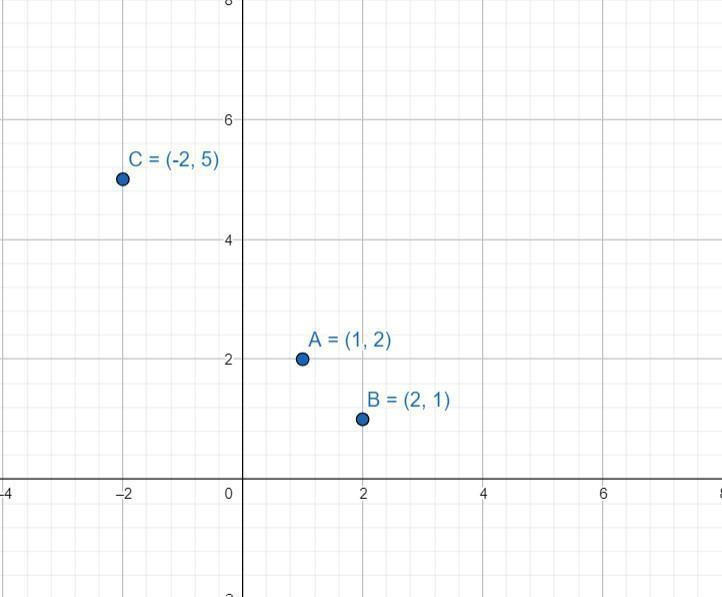
For these points to be collinear, it is sufficient to prove that BA + AC = BC. By applying distance formula in these three points-
$\begin{align}
&BA = \sqrt {{{\left( {2 - 1} \right)}^2} + {{\left( {1 - 2} \right)}^2}} \\
&= \sqrt {{1^2} + {{\left( { - 1} \right)}^2}} = \sqrt 2 \\
&AC = \sqrt {{{\left( {1 - \left( { - 2} \right)} \right)}^2} + {{\left( {2 - 5} \right)}^2}} \\
&= \sqrt {{3^2} + {{\left( { - 3} \right)}^2}} = \sqrt {18} = 3\sqrt 2 \\
&BC = \sqrt {{{\left( {2 - \left( { - 2} \right)} \right)}^2} + {{\left( {1 - 5} \right)}^2}} \\
&= \sqrt {{4^2} + {{\left( { - 4} \right)}^2}} = \sqrt {32} = 4\sqrt 2 \\
&BA + AC = \sqrt 2 + 3\sqrt 2 = 4\sqrt 2 = BC \\
\end{align} $
Hence, the three points A, B, C are collinear. Hence, proved.
Note: The points can also be proved collinear using the triangle formula. We can prove the area of the triangle formed by these three points to be zero, which means they are collinear. The area of triangle formed by three points $\left( {{{\text{x}}_1},\;{{\text{y}}_1}} \right),\left( {{{\text{x}}_2},\;{{\text{y}}_2}} \right)\;and\;\left( {{{\text{x}}_3},\;{{\text{y}}_3}} \right)$ is-
${{\text{x}}_1}\left( {{{\text{y}}_2} - {{\text{y}}_3}} \right) + {{\text{x}}_2}\left( {{{\text{y}}_3} - {{\text{y}}_1}} \right) + {{\text{x}}_3}\left( {{{\text{y}}_1} - {{\text{y}}_2}} \right)$
Applying this formula-
=1(1 - 5) + 2(5 - 2) - 2(2 - 1)
= -4 + 6 - 2
= 0
Hence, proved.
$\mathrm d=\sqrt{\left({\mathrm x}_2-{\mathrm x}_1\right)^2+\left({\mathrm y}_2-{\mathrm y}_1\right)^2}$
Let the points be A(1, 2), B(2, 1) and C(-2, 5).
For these points to be collinear, it is sufficient to prove that BA + AC = BC. By applying distance formula in these three points-
$\begin{align}
&BA = \sqrt {{{\left( {2 - 1} \right)}^2} + {{\left( {1 - 2} \right)}^2}} \\
&= \sqrt {{1^2} + {{\left( { - 1} \right)}^2}} = \sqrt 2 \\
&AC = \sqrt {{{\left( {1 - \left( { - 2} \right)} \right)}^2} + {{\left( {2 - 5} \right)}^2}} \\
&= \sqrt {{3^2} + {{\left( { - 3} \right)}^2}} = \sqrt {18} = 3\sqrt 2 \\
&BC = \sqrt {{{\left( {2 - \left( { - 2} \right)} \right)}^2} + {{\left( {1 - 5} \right)}^2}} \\
&= \sqrt {{4^2} + {{\left( { - 4} \right)}^2}} = \sqrt {32} = 4\sqrt 2 \\
&BA + AC = \sqrt 2 + 3\sqrt 2 = 4\sqrt 2 = BC \\
\end{align} $
Hence, the three points A, B, C are collinear. Hence, proved.
Note: The points can also be proved collinear using the triangle formula. We can prove the area of the triangle formed by these three points to be zero, which means they are collinear. The area of triangle formed by three points $\left( {{{\text{x}}_1},\;{{\text{y}}_1}} \right),\left( {{{\text{x}}_2},\;{{\text{y}}_2}} \right)\;and\;\left( {{{\text{x}}_3},\;{{\text{y}}_3}} \right)$ is-
${{\text{x}}_1}\left( {{{\text{y}}_2} - {{\text{y}}_3}} \right) + {{\text{x}}_2}\left( {{{\text{y}}_3} - {{\text{y}}_1}} \right) + {{\text{x}}_3}\left( {{{\text{y}}_1} - {{\text{y}}_2}} \right)$
Applying this formula-
=1(1 - 5) + 2(5 - 2) - 2(2 - 1)
= -4 + 6 - 2
= 0
Hence, proved.
Recently Updated Pages
Basicity of sulphurous acid and sulphuric acid are

Master Class 11 English: Engaging Questions & Answers for Success
Master Class 11 Physics: Engaging Questions & Answers for Success
Master Class 11 Computer Science: Engaging Questions & Answers for Success
Master Class 11 Chemistry: Engaging Questions & Answers for Success
Master Class 11 Social Science: Engaging Questions & Answers for Success
Trending doubts
Difference Between Prokaryotic Cells and Eukaryotic Cells
Two of the body parts which do not appear in MRI are class 11 biology CBSE
One Metric ton is equal to kg A 10000 B 1000 C 100 class 11 physics CBSE
10 examples of friction in our daily life
Draw a diagram of nephron and explain its structur class 11 biology CBSE
What will happen if the mucus is not secreted by the class 11 biology CBSE