




Show that the function $g\left( x \right)=\cos x$ is differentiable at any $a\in \mathbb{R}$ and $g'\left( a \right)=-\sin a.$ In general, $g'\left( x \right)=-\sin x$.
Answer
 Verified
629.1k+ views
Hint: To check the differentiability of a function, we will find the derivative of the function. To find the derivative of any function $f\left( x \right)$, we will use the first principle of derivative.
Complete step-by-step answer:
In this question, we are given a function; \[g\left( x \right)=\sin x\].
Since we have to check for the differentiability of this function, we have to first find its derivative. To find the derivative of the function $g\left( x \right)$, we will differentiate $g\left( x \right)$ using the first principle of derivative.
According to first principle, we can find derivative $g'\left( x \right)$ of the function$g\left( x \right)$ using the formula;
$g'\left( x \right)=\underset{h\to 0}{\mathop{\lim }}\,\dfrac{g\left( x+h \right)-g\left( x \right)}{h}.........\left( I \right)$
Substituting $g\left( x \right)=\cos x$ and $g\left( x+h \right)=\cos \left( x+h \right)$ in the formula $\left( I \right)$, we get;
\[g'\left( x \right)=\underset{h\to 0}{\mathop{\lim }}\,\dfrac{\cos \left( x+h \right)-\cos x}{h}.........\left( II \right)\]
In trigonometry, we have a formula; $\cos \left( x+h \right)=\cos x\cos h-\sin x\sin h$
Substituting this formula i.e. $\cos \left( x+h \right)=\cos x\cos h-\sin x\sin h$ in $\left( II \right)$, we get;
\[\begin{align}
& \Rightarrow g'\left( x \right)=\underset{h\to 0}{\mathop{\lim }}\,\dfrac{\cos x\cos h-\sin x\sin h-\cos x}{h} \\
& \Rightarrow g'\left( x \right)=\underset{h\to 0}{\mathop{\lim }}\,\dfrac{\cos x\cos h-\cos x}{h}-\dfrac{\sin x\sin h}{h} \\
\end{align}\]
Since the limit can be distributed over subtraction of the two functions, we can write;
\[\Rightarrow g'\left( x \right)=\underset{h\to 0}{\mathop{\lim }}\,\dfrac{\cos x\left( \cos h-1 \right)}{h}-\underset{h\to 0}{\mathop{\lim }}\,\sin x\dfrac{\sin h}{h}\]
Since the limit is applied on $h$, we can take the functions of$x$out of the individual limits.
$\Rightarrow g'\left( x \right)=\cos x\underset{h\to 0}{\mathop{\lim }}\,\dfrac{\cos h-1}{h}-\sin x\underset{h\to 0}{\mathop{\lim }}\,\dfrac{\sin h}{h}........\left( III \right)$
We have two formulas of limit, $\underset{h\to 0}{\mathop{\lim }}\,\dfrac{\cos h-1}{h}=0$ and $\underset{h\to 0}{\mathop{\lim }}\,\dfrac{\sin h}{h}=1$ .
Substituting $\underset{h\to 0}{\mathop{\lim }}\,\dfrac{\cos h-1}{h}=0$ and $\underset{h\to 0}{\mathop{\lim }}\,\dfrac{\sin h}{h}=1$in equation $\left( III \right)$, we get;
$\begin{align}
& \Rightarrow g'\left( x \right)=\cos x\left( 0 \right)-\sin x\left( 1 \right) \\
& \Rightarrow g'\left( x \right)=0-\sin x \\
& \Rightarrow g'\left( x \right)=-\sin x \\
\end{align}$
It will be easier to check the differentiability of $g\left( x \right)$ if we draw the graph of $g'\left( x \right)=\left( -\sin x \right)$.
Plotting the graph of $g'\left( x \right)=\left( -\sin x \right)$;
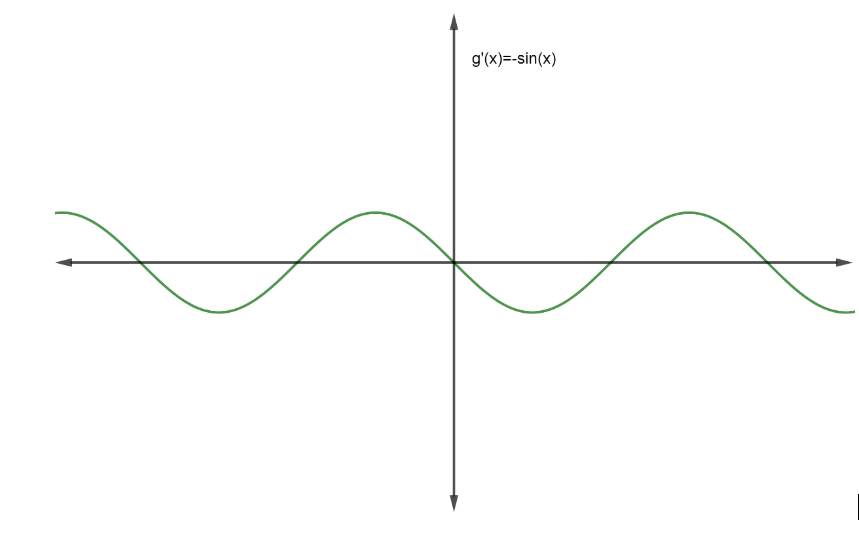
Since the graph of $g'\left( x \right)$ is continuous $\forall x\in \mathbb{R}.$, we can say $g\left( x \right)$ is differentiable$\forall x\in \mathbb{R}.$.
Also, $g'\left( x \right)=-\sin x$. Hence, substituting $x=a$ in $g'\left( x \right)=-\sin x$, we obtain;
$\text{g}'\left( a \right)=-\sin a$
Note: The question can be done directly if one has remembered that the derivatives of $g\left( x \right)=\cos x$ instead of applying the first principle and to finding the value of $g'\left( x \right)$ which may make this question a time taking one.
Complete step-by-step answer:
In this question, we are given a function; \[g\left( x \right)=\sin x\].
Since we have to check for the differentiability of this function, we have to first find its derivative. To find the derivative of the function $g\left( x \right)$, we will differentiate $g\left( x \right)$ using the first principle of derivative.
According to first principle, we can find derivative $g'\left( x \right)$ of the function$g\left( x \right)$ using the formula;
$g'\left( x \right)=\underset{h\to 0}{\mathop{\lim }}\,\dfrac{g\left( x+h \right)-g\left( x \right)}{h}.........\left( I \right)$
Substituting $g\left( x \right)=\cos x$ and $g\left( x+h \right)=\cos \left( x+h \right)$ in the formula $\left( I \right)$, we get;
\[g'\left( x \right)=\underset{h\to 0}{\mathop{\lim }}\,\dfrac{\cos \left( x+h \right)-\cos x}{h}.........\left( II \right)\]
In trigonometry, we have a formula; $\cos \left( x+h \right)=\cos x\cos h-\sin x\sin h$
Substituting this formula i.e. $\cos \left( x+h \right)=\cos x\cos h-\sin x\sin h$ in $\left( II \right)$, we get;
\[\begin{align}
& \Rightarrow g'\left( x \right)=\underset{h\to 0}{\mathop{\lim }}\,\dfrac{\cos x\cos h-\sin x\sin h-\cos x}{h} \\
& \Rightarrow g'\left( x \right)=\underset{h\to 0}{\mathop{\lim }}\,\dfrac{\cos x\cos h-\cos x}{h}-\dfrac{\sin x\sin h}{h} \\
\end{align}\]
Since the limit can be distributed over subtraction of the two functions, we can write;
\[\Rightarrow g'\left( x \right)=\underset{h\to 0}{\mathop{\lim }}\,\dfrac{\cos x\left( \cos h-1 \right)}{h}-\underset{h\to 0}{\mathop{\lim }}\,\sin x\dfrac{\sin h}{h}\]
Since the limit is applied on $h$, we can take the functions of$x$out of the individual limits.
$\Rightarrow g'\left( x \right)=\cos x\underset{h\to 0}{\mathop{\lim }}\,\dfrac{\cos h-1}{h}-\sin x\underset{h\to 0}{\mathop{\lim }}\,\dfrac{\sin h}{h}........\left( III \right)$
We have two formulas of limit, $\underset{h\to 0}{\mathop{\lim }}\,\dfrac{\cos h-1}{h}=0$ and $\underset{h\to 0}{\mathop{\lim }}\,\dfrac{\sin h}{h}=1$ .
Substituting $\underset{h\to 0}{\mathop{\lim }}\,\dfrac{\cos h-1}{h}=0$ and $\underset{h\to 0}{\mathop{\lim }}\,\dfrac{\sin h}{h}=1$in equation $\left( III \right)$, we get;
$\begin{align}
& \Rightarrow g'\left( x \right)=\cos x\left( 0 \right)-\sin x\left( 1 \right) \\
& \Rightarrow g'\left( x \right)=0-\sin x \\
& \Rightarrow g'\left( x \right)=-\sin x \\
\end{align}$
It will be easier to check the differentiability of $g\left( x \right)$ if we draw the graph of $g'\left( x \right)=\left( -\sin x \right)$.
Plotting the graph of $g'\left( x \right)=\left( -\sin x \right)$;
Since the graph of $g'\left( x \right)$ is continuous $\forall x\in \mathbb{R}.$, we can say $g\left( x \right)$ is differentiable$\forall x\in \mathbb{R}.$.
Also, $g'\left( x \right)=-\sin x$. Hence, substituting $x=a$ in $g'\left( x \right)=-\sin x$, we obtain;
$\text{g}'\left( a \right)=-\sin a$
Note: The question can be done directly if one has remembered that the derivatives of $g\left( x \right)=\cos x$ instead of applying the first principle and to finding the value of $g'\left( x \right)$ which may make this question a time taking one.
Recently Updated Pages
Basicity of sulphurous acid and sulphuric acid are

Master Class 11 Business Studies: Engaging Questions & Answers for Success
Master Class 11 Computer Science: Engaging Questions & Answers for Success
Master Class 11 Economics: Engaging Questions & Answers for Success
Master Class 11 Social Science: Engaging Questions & Answers for Success
Master Class 11 English: Engaging Questions & Answers for Success
Trending doubts
One Metric ton is equal to kg A 10000 B 1000 C 100 class 11 physics CBSE
The largest wind power cluster is located in the state class 11 social science CBSE
Explain zero factorial class 11 maths CBSE
State and prove Bernoullis theorem class 11 physics CBSE
Which among the following are examples of coming together class 11 social science CBSE
Can anyone list 10 advantages and disadvantages of friction