




Show that the function $f\left( x \right)=\sin x$ is differentiable at any $a\in \mathbb{R}$ and $f'\left( a \right)=\cos a.$ In general, $f'\left( x \right)=\cos x$ for $x\in \mathbb{R}$.
Answer
 Verified
627.3k+ views
Hint: To check the differentiability, we will find the derivative of the function. To find the derivative of the function $f\left( x \right)$ , we will use the first principle of derivative and then use the information provided about the function in the question.
Complete step-by-step answer:
It is given in the question, a function \[f\left( x \right)=\sin x\].
Since we have to check for differentiability of this function, we have to first find its derivative. To find the derivative, we use first principle from which the derivative $f'\left( x \right)$ of a function $f\left( x \right)$ is given by;
$f'\left( x \right)=\underset{h\to 0}{\mathop{\lim }}\,\dfrac{f\left( x+h \right)-f\left( x \right)}{h}$
For \[f\left( x \right)=\sin x\] and \[f\left( x+h \right)=\sin \left( x+h \right)\], we get;
$\Rightarrow f'\left( x \right)=\underset{h\to 0}{\mathop{\lim }}\,\dfrac{\sin \left( x+h \right)-\sin x}{h}.........\left( I \right)$
We have a formula, $\sin \left( x+h \right)=\sin x\cos h+\cos x\sin h.........\left( II \right)$
Substituting $\sin \left( x+h \right)=\sin x\cos h+\cos x\sin h$ from equation $\left( II \right)$ in equation $\left( I \right)$, we get;
\[\Rightarrow f'\left( x \right)=\underset{h\to 0}{\mathop{\lim }}\,\dfrac{\sin x\cos h+\cos x\sin h-\sin x}{h}\]
Since limit can be distributed over addition of two functions, we can write;
\[\begin{align}
& \Rightarrow f'\left( x \right)=\underset{h\to 0}{\mathop{\lim }}\,\dfrac{\left( \sin x\cos h-\sin x \right)}{h}+\underset{h\to 0}{\mathop{\lim }}\,\dfrac{\cos x-\sin h}{h} \\
& \Rightarrow f'\left( x \right)=\underset{h\to 0}{\mathop{\lim }}\,\dfrac{\left( \sin x \right)\left( \cos h-1 \right)}{h}+\underset{h\to 0}{\mathop{\lim }}\,\cos x\dfrac{\sin h}{h} \\
\end{align}\]
Since the limit is applied with respect to $h$, the functions having $x$ can be taken out of the limit.
$\Rightarrow f'\left( x \right)=\sin x\underset{h\to 0}{\mathop{\lim }}\,\dfrac{\left( \cos h-1 \right)}{h}+\cos x\underset{h\to 0}{\mathop{\lim }}\,\dfrac{\sin h}{h}........\left( III \right)$
Also, we have to formulas of limit; $\underset{h\to 0}{\mathop{\lim }}\,\dfrac{\left( \cos h-1 \right)}{h}=0$ and $\underset{h\to 0}{\mathop{\lim }}\,\dfrac{\sin h}{h}=1$.
Substituting $\underset{h\to 0}{\mathop{\lim }}\,\dfrac{\left( \cos h-1 \right)}{h}=0$ and $\underset{h\to 0}{\mathop{\lim }}\,\dfrac{\sin h}{h}=1$ in equation $\left( III \right)$, we get;
$\begin{align}
& \Rightarrow f'\left( x \right)=\sin x\left( 0 \right)+\cos x\left( 1 \right) \\
& \Rightarrow f'\left( x \right)=0+\cos x \\
& \Rightarrow f'\left( x \right)=\cos x \\
\end{align}$
It will be easier to check the differentiability at all the points in the domain of the function i.e. $x\in R$ if we draw the graph of $f'\left( x \right)$ i.e. $\cos x$.
Plotting the graph of $f'\left( x \right)=\cos x$;
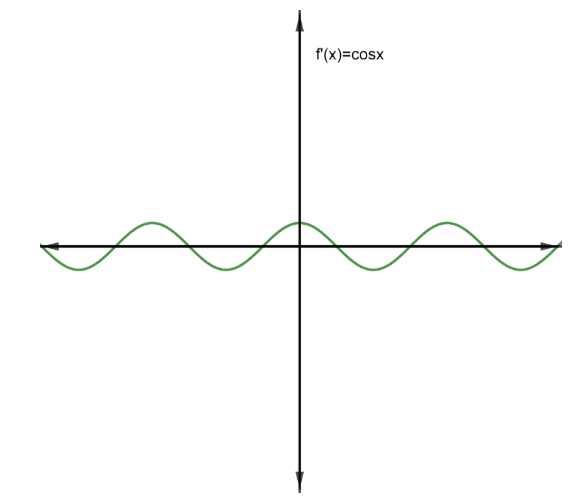
Since the graph of $f'\left( x \right)$ is continuous everywhere, we can say $f\left( x \right)$ is differentiable $\forall x\in \mathbb{R}.$.
Also, in $f'\left( x \right)=\cos x$, if we substitute $x=a$, then we get;
$f'\left( a \right)=\cos a$
Note: The question can be done directly if one had remembered that the derivative of $\sin x$ is $\cos x$ instead of calculating the derivative using the first principle of derivative which actually makes the question a time taking one.
Complete step-by-step answer:
It is given in the question, a function \[f\left( x \right)=\sin x\].
Since we have to check for differentiability of this function, we have to first find its derivative. To find the derivative, we use first principle from which the derivative $f'\left( x \right)$ of a function $f\left( x \right)$ is given by;
$f'\left( x \right)=\underset{h\to 0}{\mathop{\lim }}\,\dfrac{f\left( x+h \right)-f\left( x \right)}{h}$
For \[f\left( x \right)=\sin x\] and \[f\left( x+h \right)=\sin \left( x+h \right)\], we get;
$\Rightarrow f'\left( x \right)=\underset{h\to 0}{\mathop{\lim }}\,\dfrac{\sin \left( x+h \right)-\sin x}{h}.........\left( I \right)$
We have a formula, $\sin \left( x+h \right)=\sin x\cos h+\cos x\sin h.........\left( II \right)$
Substituting $\sin \left( x+h \right)=\sin x\cos h+\cos x\sin h$ from equation $\left( II \right)$ in equation $\left( I \right)$, we get;
\[\Rightarrow f'\left( x \right)=\underset{h\to 0}{\mathop{\lim }}\,\dfrac{\sin x\cos h+\cos x\sin h-\sin x}{h}\]
Since limit can be distributed over addition of two functions, we can write;
\[\begin{align}
& \Rightarrow f'\left( x \right)=\underset{h\to 0}{\mathop{\lim }}\,\dfrac{\left( \sin x\cos h-\sin x \right)}{h}+\underset{h\to 0}{\mathop{\lim }}\,\dfrac{\cos x-\sin h}{h} \\
& \Rightarrow f'\left( x \right)=\underset{h\to 0}{\mathop{\lim }}\,\dfrac{\left( \sin x \right)\left( \cos h-1 \right)}{h}+\underset{h\to 0}{\mathop{\lim }}\,\cos x\dfrac{\sin h}{h} \\
\end{align}\]
Since the limit is applied with respect to $h$, the functions having $x$ can be taken out of the limit.
$\Rightarrow f'\left( x \right)=\sin x\underset{h\to 0}{\mathop{\lim }}\,\dfrac{\left( \cos h-1 \right)}{h}+\cos x\underset{h\to 0}{\mathop{\lim }}\,\dfrac{\sin h}{h}........\left( III \right)$
Also, we have to formulas of limit; $\underset{h\to 0}{\mathop{\lim }}\,\dfrac{\left( \cos h-1 \right)}{h}=0$ and $\underset{h\to 0}{\mathop{\lim }}\,\dfrac{\sin h}{h}=1$.
Substituting $\underset{h\to 0}{\mathop{\lim }}\,\dfrac{\left( \cos h-1 \right)}{h}=0$ and $\underset{h\to 0}{\mathop{\lim }}\,\dfrac{\sin h}{h}=1$ in equation $\left( III \right)$, we get;
$\begin{align}
& \Rightarrow f'\left( x \right)=\sin x\left( 0 \right)+\cos x\left( 1 \right) \\
& \Rightarrow f'\left( x \right)=0+\cos x \\
& \Rightarrow f'\left( x \right)=\cos x \\
\end{align}$
It will be easier to check the differentiability at all the points in the domain of the function i.e. $x\in R$ if we draw the graph of $f'\left( x \right)$ i.e. $\cos x$.
Plotting the graph of $f'\left( x \right)=\cos x$;
Since the graph of $f'\left( x \right)$ is continuous everywhere, we can say $f\left( x \right)$ is differentiable $\forall x\in \mathbb{R}.$.
Also, in $f'\left( x \right)=\cos x$, if we substitute $x=a$, then we get;
$f'\left( a \right)=\cos a$
Note: The question can be done directly if one had remembered that the derivative of $\sin x$ is $\cos x$ instead of calculating the derivative using the first principle of derivative which actually makes the question a time taking one.
Recently Updated Pages
Basicity of sulphurous acid and sulphuric acid are

Master Class 11 Business Studies: Engaging Questions & Answers for Success
Master Class 11 Computer Science: Engaging Questions & Answers for Success
Master Class 11 Economics: Engaging Questions & Answers for Success
Master Class 11 Social Science: Engaging Questions & Answers for Success
Master Class 11 English: Engaging Questions & Answers for Success
Trending doubts
One Metric ton is equal to kg A 10000 B 1000 C 100 class 11 physics CBSE
Explain zero factorial class 11 maths CBSE
State and prove Bernoullis theorem class 11 physics CBSE
What steps did the French revolutionaries take to create class 11 social science CBSE
The transition element that has lowest enthalpy of class 11 chemistry CBSE
Can anyone list 10 advantages and disadvantages of friction