




Show that if \[f{\rm{ }}:{\rm{ }}A \to B\] and \[g{\rm{ }}:{\rm{ }}B \to C\] are one-one then \[g \circ f{\rm{ }}:{\rm{ }}A \to C\] is also one-one.
Answer
 Verified
594.6k+ views
Hint: If f(x) = f(y) implies x=y, then f is one-to-one mapped, or f is 1-1 is the way used to prove the given statement. Here using the given condition of function g and f we define the functional values and then using the definition of composition we will prove the result.
Complete step-by-step answer:
It is given that, \[f{\rm{ }}:{\rm{ }}A \to B\] and \[g{\rm{ }}:{\rm{ }}B \to C\] are one-one.
From the condition\[f{\rm{ }}:{\rm{ }}A \to B\] is one-one, we have
\[f({x_1}) = f({x_2}) \Rightarrow {x_1} = {x_2}\]
From the condition\[g{\rm{ }}:{\rm{ }}B \to C\] is one – one, we get,
\[g({x_1}) = g({x_2}) \Rightarrow {x_1} = {x_2}\]
“If \[g \circ f{\rm{ }}:{\rm{ }}A \to C\] is also one-one then for \[gof({x_1}) = gof({x_2})\] we will get,\[{x_1} = {x_2}\]”
Let us consider \[gof({x_1}) = gof({x_2})\]
Then using the definition of composition we get,
\[g(f({x_1})) = g(f({x_2}))\]
Given that, \[g{\rm{ }}:{\rm{ }}B \to C\] is one – one using the condition of one-one function, we get,
\[g(f({x_1})) = g(f({x_2}))\]\[ \Rightarrow f({x_1}) = f({x_2})\].
Since\[f{\rm{ }}:{\rm{ }}A \to B\] is one-one using the condition of one-one function, we get,
\[f({x_1}) = f({x_2}) \Rightarrow {x_1} = {x_2}\]
Thus from consideration we have got,
\[gof({x_1}) = gof({x_2})\]\[ \Rightarrow {x_1} = {x_2}\].
Hence for the function\[g \circ f{\rm{ }}:{\rm{ }}A \to C\] , if \[gof({x_1}) = gof({x_2})\] then \[{x_1} = {x_2}\].
Hence by definition of one-one we say that \[g \circ f{\rm{ }}:{\rm{ }}A \to C\] is one-one.
Therefore, if \[f{\rm{ }}:{\rm{ }}A \to B\] and \[g{\rm{ }}:{\rm{ }}B \to C\] are one-one then \[g \circ f{\rm{ }}:{\rm{ }}A \to C\] is also one-one.
Additional information:
One - one function basically denotes the mapping of two sets. A function g is one-one if every element of the range of g corresponds to exactly one element of the domain of g. One-to-one is also written as 1-1. A function \[f()\] is a method, which relates elements/values of one variable to the elements/values of another variable, in such a way that the elements of the first variable identically determine the elements of the second variable.
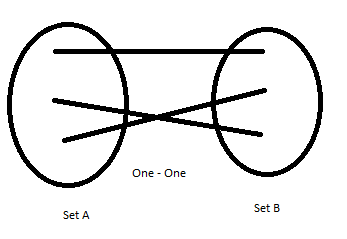
It could be defined as each element of Set A has a unique element on Set B.
In brief, let us consider ‘f’ is a function whose domain is set A. The function is said to be injective if for all x and y in A,
Whenever\[f\left( x \right) = f\left( y \right)\] , then \[x = y\]
And equivalently, if \[x{\rm{ }} \ne {\rm{ }}y\] , then \[f\left( x \right){\rm{ }} \ne {\rm{ }}f\left( y \right)\] .
Formally, it is stated as, if \[f\left( x \right) = f\left( y \right)\] implies \[x = y\], then f is one-to-one mapped, or f is 1-1.
Note: \(g \circ f\) is the composition of function g and f which is defined as follows,
\(g \circ f(x) = g(f(x))\) Here the function g is operated first and the function f is operated next.
Complete step-by-step answer:
It is given that, \[f{\rm{ }}:{\rm{ }}A \to B\] and \[g{\rm{ }}:{\rm{ }}B \to C\] are one-one.
From the condition\[f{\rm{ }}:{\rm{ }}A \to B\] is one-one, we have
\[f({x_1}) = f({x_2}) \Rightarrow {x_1} = {x_2}\]
From the condition\[g{\rm{ }}:{\rm{ }}B \to C\] is one – one, we get,
\[g({x_1}) = g({x_2}) \Rightarrow {x_1} = {x_2}\]
“If \[g \circ f{\rm{ }}:{\rm{ }}A \to C\] is also one-one then for \[gof({x_1}) = gof({x_2})\] we will get,\[{x_1} = {x_2}\]”
Let us consider \[gof({x_1}) = gof({x_2})\]
Then using the definition of composition we get,
\[g(f({x_1})) = g(f({x_2}))\]
Given that, \[g{\rm{ }}:{\rm{ }}B \to C\] is one – one using the condition of one-one function, we get,
\[g(f({x_1})) = g(f({x_2}))\]\[ \Rightarrow f({x_1}) = f({x_2})\].
Since\[f{\rm{ }}:{\rm{ }}A \to B\] is one-one using the condition of one-one function, we get,
\[f({x_1}) = f({x_2}) \Rightarrow {x_1} = {x_2}\]
Thus from consideration we have got,
\[gof({x_1}) = gof({x_2})\]\[ \Rightarrow {x_1} = {x_2}\].
Hence for the function\[g \circ f{\rm{ }}:{\rm{ }}A \to C\] , if \[gof({x_1}) = gof({x_2})\] then \[{x_1} = {x_2}\].
Hence by definition of one-one we say that \[g \circ f{\rm{ }}:{\rm{ }}A \to C\] is one-one.
Therefore, if \[f{\rm{ }}:{\rm{ }}A \to B\] and \[g{\rm{ }}:{\rm{ }}B \to C\] are one-one then \[g \circ f{\rm{ }}:{\rm{ }}A \to C\] is also one-one.
Additional information:
One - one function basically denotes the mapping of two sets. A function g is one-one if every element of the range of g corresponds to exactly one element of the domain of g. One-to-one is also written as 1-1. A function \[f()\] is a method, which relates elements/values of one variable to the elements/values of another variable, in such a way that the elements of the first variable identically determine the elements of the second variable.
It could be defined as each element of Set A has a unique element on Set B.
In brief, let us consider ‘f’ is a function whose domain is set A. The function is said to be injective if for all x and y in A,
Whenever\[f\left( x \right) = f\left( y \right)\] , then \[x = y\]
And equivalently, if \[x{\rm{ }} \ne {\rm{ }}y\] , then \[f\left( x \right){\rm{ }} \ne {\rm{ }}f\left( y \right)\] .
Formally, it is stated as, if \[f\left( x \right) = f\left( y \right)\] implies \[x = y\], then f is one-to-one mapped, or f is 1-1.
Note: \(g \circ f\) is the composition of function g and f which is defined as follows,
\(g \circ f(x) = g(f(x))\) Here the function g is operated first and the function f is operated next.
Recently Updated Pages
Master Class 12 English: Engaging Questions & Answers for Success

Master Class 12 Social Science: Engaging Questions & Answers for Success
Master Class 12 Maths: Engaging Questions & Answers for Success
Master Class 12 Economics: Engaging Questions & Answers for Success
Master Class 12 Physics: Engaging Questions & Answers for Success
Master Class 12 Business Studies: Engaging Questions & Answers for Success
Trending doubts
Which are the Top 10 Largest Countries of the World?
What are the major means of transport Explain each class 12 social science CBSE
Draw a labelled sketch of the human eye class 12 physics CBSE
Differentiate between insitu conservation and exsitu class 12 biology CBSE
Draw a neat and well labeled diagram of TS of ovary class 12 biology CBSE
RNA and DNA are chiral molecules their chirality is class 12 chemistry CBSE