




Show that every equiangular triangle is equilateral.
Answer
 Verified
615.6k+ views
Hint: Firstly, we will construct a triangle whose angle equals to ${{60}^{\circ }}$ . after that, in triangle ABC, using the property of triangle which states that sides opposites to equal angles are equal, we will show that pairs of sides of the triangle are equal. Hence, we will show that ABC is an equilateral triangle.
Complete step-by-step solution:
Let, there be triangle ABC whose angles are equal to ${{60}^{\circ }}$.
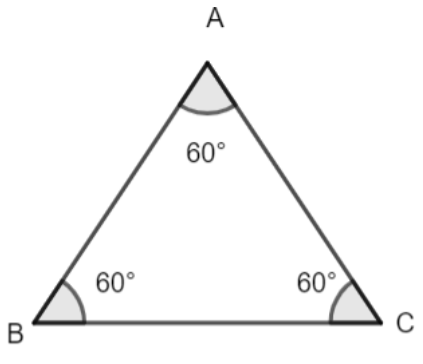
Now, in triangle ABC, we have
$\angle B=\angle C$, as given in the question.
We know that there is a proven statement for general triangles that sides opposite to equal angles are also equal.
As the side opposite to $\angle B$ is AC and the side opposite to $\angle C$ is AB.
Then, we can say that
$AC = AB$.............( i )
Similarly, we can see from the figure that,
$\angle A=\angle C$
As the side opposite to $\angle A$ is BC and the side opposite to $\angle C$ is AB.
Using the same statement we used for the above equation, we can say that
$BC = AB$ …………..( ii )
From equation ( i ) and equation ( ii ), we can say that
$AB = BC = AC$
Also, we know that all sides of the equilateral triangle are equal.
Hence, we can say that every equiangular triangle is equilateral.
Note: Always remember that equiangular means angles of the same measure of a polygon. Also, vice versa of statement sides opposite to equal angles are also equal is true. To prove for all sides of the triangle equal, we need to prove at least two pairs of sides equal. Do not forget to draw a diagram and label it correctly.
Complete step-by-step solution:
Let, there be triangle ABC whose angles are equal to ${{60}^{\circ }}$.
Now, in triangle ABC, we have
$\angle B=\angle C$, as given in the question.
We know that there is a proven statement for general triangles that sides opposite to equal angles are also equal.
As the side opposite to $\angle B$ is AC and the side opposite to $\angle C$ is AB.
Then, we can say that
$AC = AB$.............( i )
Similarly, we can see from the figure that,
$\angle A=\angle C$
As the side opposite to $\angle A$ is BC and the side opposite to $\angle C$ is AB.
Using the same statement we used for the above equation, we can say that
$BC = AB$ …………..( ii )
From equation ( i ) and equation ( ii ), we can say that
$AB = BC = AC$
Also, we know that all sides of the equilateral triangle are equal.
Hence, we can say that every equiangular triangle is equilateral.
Note: Always remember that equiangular means angles of the same measure of a polygon. Also, vice versa of statement sides opposite to equal angles are also equal is true. To prove for all sides of the triangle equal, we need to prove at least two pairs of sides equal. Do not forget to draw a diagram and label it correctly.
Recently Updated Pages
Master Class 11 English: Engaging Questions & Answers for Success

Master Class 11 Social Science: Engaging Questions & Answers for Success
Master Class 11 Maths: Engaging Questions & Answers for Success
Master Class 11 Biology: Engaging Questions & Answers for Success
Master Class 11 Physics: Engaging Questions & Answers for Success
Master Class 11 Chemistry: Engaging Questions & Answers for Success
Trending doubts
Explain the Treaty of Vienna of 1815 class 10 social science CBSE
What is the full form of POSCO class 10 social science CBSE
Define Potential, Developed, Stock and Reserved resources
The diagonals of a rhombus are 10cm and 24cm Find the class 10 maths CBSE
Fill the blanks with proper collective nouns 1 A of class 10 english CBSE
What planets have no moons Which one has only one moon class 10 physics CBSE