




Show that $\cos {{32}^{\circ }}\cos {{58}^{\circ }}-\sin {{32}^{\circ }}\sin {{58}^{\circ }}=0$ \[\]
Answer
 Verified
574.8k+ views
Hint: We recall the definitions of sine and cosine trigonometric ratios. We use the relation of complementary angles between sine and cosine $\sin \theta =\cos \left( {{90}^{\circ }}-\theta \right)$ and $\cos \theta =\sin \left( {{90}^{\circ }}-\theta \right)$ (also known as reduction formula) to convert cosine into sine or to convert sine into cosine to prove the given statement.\[\]
Complete step by step answer:
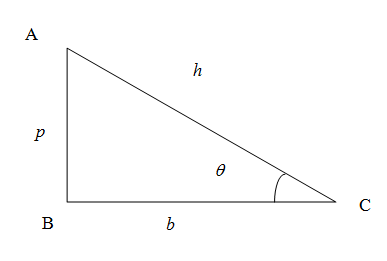
We know that in right angled triangle (Here ABC) the side opposite to right angle(Here $\angle B$) is called hypotenuse denoted as $AC=h$, the vertical side is called perpendicular denoted as $AB=p$ and the horizontal side is called the base denoted as $BC=b$.\[\]
We know from the trigonometric ratios in a right angled triangle the sine of any angle is given by the ratio of side opposite to the angle to the hypotenuse. In the figure the sine of the angle $\angle C=\theta $ is given by
\[\sin \theta =\dfrac{p}{h}\]
Similarly the cosine of an angle is the ratio of side adjacent to the angle (excluding hypotenuse) to the hypotenuse. So we have cosine of angle $\theta $
\[\cos \theta =\dfrac{b}{h}\]
We know that the sum of angles in a triangle is ${{180}^{\circ }}$. So we have in triangle ABC
\[\begin{align}
& \angle A+\angle B+\angle C={{180}^{\circ }} \\
& \Rightarrow \angle A+\angle C={{90}^{\circ }}\left( \because \angle B={{90}^{\circ }} \right) \\
& \Rightarrow \angle A={{90}^{\circ }}-\angle C={{90}^{\circ }}-\theta \\
\end{align}\]
Let see the sine and cosines of angles $\angle A,\angle C$ .We have,
\[\begin{align}
& \sin C=\sin \theta =\dfrac{p}{h},\cos C=\cos \theta =\dfrac{b}{h} \\
& \sin A=\sin \left( {{90}^{\circ }}-\theta \right)=\dfrac{b}{h},\cos A=\cos \left( {{90}^{\circ }}-\theta \right)=\dfrac{p}{h} \\
\end{align}\]
So we have,
\[\begin{align}
& \cos \left( {{90}^{\circ }}-\theta \right)=\sin \theta \\
& \sin \left( {{90}^{\circ }}-\theta \right)=\cos \theta \\
\end{align}\]
The above identity is true for all acute angles $\theta $ and is called reduction formula of sine and cosine or reflection identity about $\dfrac{\pi }{4}$ because the complementary angles $\theta ,{{90}^{\circ }}-\theta $ reflect each other about the angle $\dfrac{\pi }{4}$. We are given in the question the following statement to prove,
\[\cos {{32}^{\circ }}\cos {{58}^{\circ }}-\sin {{32}^{\circ }}\sin {{58}^{\circ }}=0\]
We see the trigonometric expressions in sine and cosine has angles $\theta ={{32}^{\circ }},{{58}^{\circ }}$. We add both the angles to find ${{32}^{\circ }}+{{58}^{\circ }}={{90}^{\circ }}$. So they are complementary angles. We use the reduction formula of sine and cosine taking $\theta ={{32}^{\circ }}$ to have,
\[\begin{align}
& \cos {{58}^{\circ }}=\cos \left( {{90}^{\circ }}-{{32}^{\circ }} \right)=\sin {{32}^{\circ }} \\
& \sin {{58}^{\circ }}=\sin \left( {{90}^{\circ }}-{{32}^{\circ }} \right)=\cos {{32}^{\circ }} \\
\end{align}\]
We use the above obtained values in the left hand side of statement to have,
\[\begin{align}
& \cos {{32}^{\circ }}\cos {{58}^{\circ }}-\sin {{32}^{\circ }}\sin {{58}^{\circ }} \\
& =\cos {{32}^{\circ }}\sin {{32}^{\circ }}-\sin {{32}^{\circ }}\cos {{32}^{\circ }}\left( \because \cos 58{}^{\circ }=\sin {{32}^{\circ }},\sin {{58}^{\circ }}=\cos {{32}^{\circ }} \right) \\
& =0 \\
\end{align}\]
Hence the statement is proved. \[\]
Note: We note that we have taken the smaller angle ${{32}^{\circ }}$ as $\theta $. for the reduction formula. We can also solve by taking the larger angle ${{58}^{\circ }}$ as $\theta .$ We must be careful of the difference between reduction formulas and shift by ${{90}^{\circ }}$ formulas which is given by $\sin \left( \theta \pm {{90}^{\circ }} \right)=\pm \cos \theta $ and $\cos \left( \theta \pm {{90}^{\circ }} \right)=\mp \sin \theta $.
Complete step by step answer:
We know that in right angled triangle (Here ABC) the side opposite to right angle(Here $\angle B$) is called hypotenuse denoted as $AC=h$, the vertical side is called perpendicular denoted as $AB=p$ and the horizontal side is called the base denoted as $BC=b$.\[\]
We know from the trigonometric ratios in a right angled triangle the sine of any angle is given by the ratio of side opposite to the angle to the hypotenuse. In the figure the sine of the angle $\angle C=\theta $ is given by
\[\sin \theta =\dfrac{p}{h}\]
Similarly the cosine of an angle is the ratio of side adjacent to the angle (excluding hypotenuse) to the hypotenuse. So we have cosine of angle $\theta $
\[\cos \theta =\dfrac{b}{h}\]
We know that the sum of angles in a triangle is ${{180}^{\circ }}$. So we have in triangle ABC
\[\begin{align}
& \angle A+\angle B+\angle C={{180}^{\circ }} \\
& \Rightarrow \angle A+\angle C={{90}^{\circ }}\left( \because \angle B={{90}^{\circ }} \right) \\
& \Rightarrow \angle A={{90}^{\circ }}-\angle C={{90}^{\circ }}-\theta \\
\end{align}\]
Let see the sine and cosines of angles $\angle A,\angle C$ .We have,
\[\begin{align}
& \sin C=\sin \theta =\dfrac{p}{h},\cos C=\cos \theta =\dfrac{b}{h} \\
& \sin A=\sin \left( {{90}^{\circ }}-\theta \right)=\dfrac{b}{h},\cos A=\cos \left( {{90}^{\circ }}-\theta \right)=\dfrac{p}{h} \\
\end{align}\]
So we have,
\[\begin{align}
& \cos \left( {{90}^{\circ }}-\theta \right)=\sin \theta \\
& \sin \left( {{90}^{\circ }}-\theta \right)=\cos \theta \\
\end{align}\]
The above identity is true for all acute angles $\theta $ and is called reduction formula of sine and cosine or reflection identity about $\dfrac{\pi }{4}$ because the complementary angles $\theta ,{{90}^{\circ }}-\theta $ reflect each other about the angle $\dfrac{\pi }{4}$. We are given in the question the following statement to prove,
\[\cos {{32}^{\circ }}\cos {{58}^{\circ }}-\sin {{32}^{\circ }}\sin {{58}^{\circ }}=0\]
We see the trigonometric expressions in sine and cosine has angles $\theta ={{32}^{\circ }},{{58}^{\circ }}$. We add both the angles to find ${{32}^{\circ }}+{{58}^{\circ }}={{90}^{\circ }}$. So they are complementary angles. We use the reduction formula of sine and cosine taking $\theta ={{32}^{\circ }}$ to have,
\[\begin{align}
& \cos {{58}^{\circ }}=\cos \left( {{90}^{\circ }}-{{32}^{\circ }} \right)=\sin {{32}^{\circ }} \\
& \sin {{58}^{\circ }}=\sin \left( {{90}^{\circ }}-{{32}^{\circ }} \right)=\cos {{32}^{\circ }} \\
\end{align}\]
We use the above obtained values in the left hand side of statement to have,
\[\begin{align}
& \cos {{32}^{\circ }}\cos {{58}^{\circ }}-\sin {{32}^{\circ }}\sin {{58}^{\circ }} \\
& =\cos {{32}^{\circ }}\sin {{32}^{\circ }}-\sin {{32}^{\circ }}\cos {{32}^{\circ }}\left( \because \cos 58{}^{\circ }=\sin {{32}^{\circ }},\sin {{58}^{\circ }}=\cos {{32}^{\circ }} \right) \\
& =0 \\
\end{align}\]
Hence the statement is proved. \[\]
Note: We note that we have taken the smaller angle ${{32}^{\circ }}$ as $\theta $. for the reduction formula. We can also solve by taking the larger angle ${{58}^{\circ }}$ as $\theta .$ We must be careful of the difference between reduction formulas and shift by ${{90}^{\circ }}$ formulas which is given by $\sin \left( \theta \pm {{90}^{\circ }} \right)=\pm \cos \theta $ and $\cos \left( \theta \pm {{90}^{\circ }} \right)=\mp \sin \theta $.
Recently Updated Pages
Master Class 10 Computer Science: Engaging Questions & Answers for Success

Master Class 10 General Knowledge: Engaging Questions & Answers for Success
Master Class 10 English: Engaging Questions & Answers for Success
Master Class 10 Social Science: Engaging Questions & Answers for Success
Master Class 10 Maths: Engaging Questions & Answers for Success
Master Class 10 Science: Engaging Questions & Answers for Success
Trending doubts
What is the median of the first 10 natural numbers class 10 maths CBSE
The draft of the Preamble of the Indian Constitution class 10 social science CBSE
Which women's tennis player has 24 Grand Slam singles titles?
Who gave "Inqilab Zindabad" slogan?
Why is there a time difference of about 5 hours between class 10 social science CBSE
Who is the Brand Ambassador of Incredible India?