




Show that a median of a triangle divides it into two triangles of equal area.
Answer
 Verified
559.6k+ views
Hint: To prove, we draw a median to the given triangle. We use the definition of median. Then we’ll have two triangles with a common vertex and bases of equal length. Find the area of one triangle and show it is equal to the other.
Complete Step-by-Step solution:
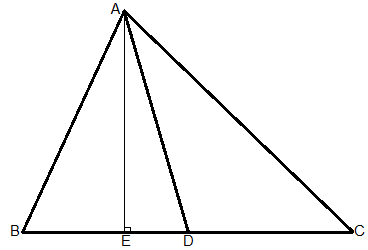
Let ABC be a triangle.
Let AD be one of its medians.
∆ABD and ∆ADC have the vertex A in common.
Hence, the bases BD and DC are equal (as AD is the median).
Now, draw a line AE perpendicular to BC, AE ⊥ BC.
We know the area of a triangle with base b and height h is = $\dfrac{1}{2} \times {\text{b}} \times {\text{h}}$
Now area of triangle ∆ABD = $\dfrac{1}{2} \times {\text{base}}$× altitude of ∆ABD
= $\dfrac{1}{2} \times {\text{BD}} \times {\text{AE}}$
= $\dfrac{1}{2} \times {\text{DC}} \times {\text{AE}}$ --- (Since BD = DC)
But DC and AE are the base and altitude of ∆ACD respectively.
Area of ∆ACD = $\dfrac{1}{2}$× base DC × altitude of ∆ACD
= $\dfrac{1}{2} \times {\text{DC}} \times {\text{AE}}$
Hence, area of (∆ABD) = area of (∆ACD)
Hence the median of a triangle divides it into two triangles of equal areas.
Note – The key in such problems is to draw a figure and include a median in it. This makes the figure into two triangles with a common vertex and equal bases.
Finding the area of one triangle and using the condition of equal bases gives us the proof.
(In geometry, a median of a triangle is a line segment joining a vertex to the midpoint of the opposite side, thus bisecting that side.)
Complete Step-by-Step solution:
Let ABC be a triangle.
Let AD be one of its medians.
∆ABD and ∆ADC have the vertex A in common.
Hence, the bases BD and DC are equal (as AD is the median).
Now, draw a line AE perpendicular to BC, AE ⊥ BC.
We know the area of a triangle with base b and height h is = $\dfrac{1}{2} \times {\text{b}} \times {\text{h}}$
Now area of triangle ∆ABD = $\dfrac{1}{2} \times {\text{base}}$× altitude of ∆ABD
= $\dfrac{1}{2} \times {\text{BD}} \times {\text{AE}}$
= $\dfrac{1}{2} \times {\text{DC}} \times {\text{AE}}$ --- (Since BD = DC)
But DC and AE are the base and altitude of ∆ACD respectively.
Area of ∆ACD = $\dfrac{1}{2}$× base DC × altitude of ∆ACD
= $\dfrac{1}{2} \times {\text{DC}} \times {\text{AE}}$
Hence, area of (∆ABD) = area of (∆ACD)
Hence the median of a triangle divides it into two triangles of equal areas.
Note – The key in such problems is to draw a figure and include a median in it. This makes the figure into two triangles with a common vertex and equal bases.
Finding the area of one triangle and using the condition of equal bases gives us the proof.
(In geometry, a median of a triangle is a line segment joining a vertex to the midpoint of the opposite side, thus bisecting that side.)
Recently Updated Pages
Master Class 11 English: Engaging Questions & Answers for Success

Master Class 11 Social Science: Engaging Questions & Answers for Success
Master Class 11 Maths: Engaging Questions & Answers for Success
Master Class 11 Biology: Engaging Questions & Answers for Success
Master Class 11 Physics: Engaging Questions & Answers for Success
Master Class 11 Chemistry: Engaging Questions & Answers for Success
Trending doubts
Explain the Treaty of Vienna of 1815 class 10 social science CBSE
First Cotton Mill of India
In which year voting age was reduced from 21 to 18?
What planets have no moons Which one has only one moon class 10 physics CBSE
What is the full form of POSCO class 10 social science CBSE
10 examples of evaporation in daily life with explanations