




Show that \[A( - 3,2)\], \[B( - 5, - 5)\], \[C(2, - 3)\] and \[D(4,4)\] are the vertices of a rhombus.
Answer
 Verified
573.6k+ views
Hint: We will prove that given points are vertices of a rhombus using the distance formula. We will find the distance \[AB\], \[BC\], \[CD\] and \[DA\], if all these lengths are equal then the given points will form a rhombus if all the sides of a rhombus are equal.
Formula Used:
We will use the formula to find the distance between two given points \[({x_1},{y_1})\] and \[({x_2},{y_2})\]which is given by \[d = \sqrt {{{\left( {{x_2} - {x_1}} \right)}^2} + {{\left( {{y_2} - {y_1}} \right)}^2}} \].
Complete step-by-step answer:
We have to show that given points \[A( - 3,2)\], \[B( - 5, - 5)\], \[C(2, - 3)\] and \[D(4,4)\] are the vertices of a rhombus.
Let the point \[A( - 3,2)\], \[B( - 5, - 5)\], \[C(2, - 3)\] and \[D(4,4)\] be the vertices of a quadrilateral \[ABCD\].
Let’s draw the diagram showing all the given points.
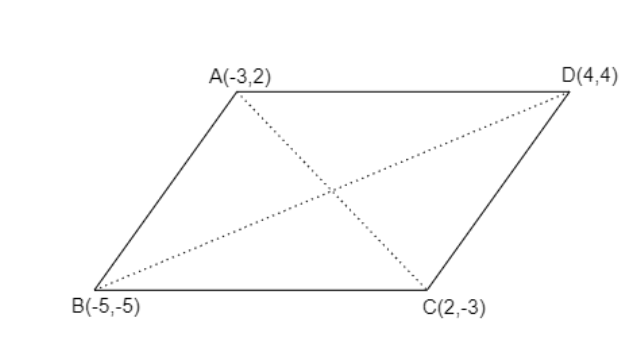
As we know that the length of all the sides of a rhombus is equal and the length of its diagonal are not equal.
We will find the length of each side to prove that points \[A( - 3,2)\], \[B( - 5, - 5)\], \[C(2, - 3)\] and \[D(4,4)\] are the vertices of a rhombus.
Now, we will find the distance \[AB\] using the distance formula.
We have \[A( - 3,2)\] and \[B( - 5, - 5)\].Therefore, using the distance formula we get
\[ \Rightarrow AB = \sqrt {{{\left( {\left( { - 5} \right) - ( - 3)} \right)}^2} + {{\left( {\left( { - 5} \right) - \left( 2 \right)} \right)}^2}} \]
Subtracting the terms in the bracket, we get
\[ \Rightarrow AB = \sqrt {{{\left( { - 2} \right)}^2} + {{\left( { - 7} \right)}^2}} \]
On solving,
\[ \Rightarrow AB = \sqrt {4 + 49} \]
On further simplification we get
\[ \Rightarrow AB = \sqrt {53} \]
Now, we will find the distance \[BC\] using the distance formula.
We have \[B( - 5, - 5)\] and \[C(2, - 3)\].Therefore, using the distance formula we get
\[ \Rightarrow BC = \sqrt {{{\left( {\left( 2 \right) - ( - 5)} \right)}^2} + {{\left( {\left( { - 3} \right) - \left( { - 5} \right)} \right)}^2}} \]
Subtracting the terms in the bracket, we get
\[ \Rightarrow BC = \sqrt {{{\left( 7 \right)}^2} + {{\left( 2 \right)}^2}} \]
On solving,
\[ \Rightarrow BC = \sqrt {49 + 4} \]
On further simplification we get
\[ \Rightarrow BC = \sqrt {53} \]
Now, we will find the distance \[CD\] using the distance formula.
We have \[C(2, - 3)\] and \[D(4,4)\].Therefore, using the distance formula we get
\[ \Rightarrow CD = \sqrt {{{\left( {\left( 4 \right) - (2)} \right)}^2} + {{\left( {\left( 4 \right) - \left( { - 3} \right)} \right)}^2}} \]
Subtracting the terms in the bracket, we get
\[ \Rightarrow CD = \sqrt {{{\left( 2 \right)}^2} + {{\left( 7 \right)}^2}} \]
On solving,
\[ \Rightarrow CD = \sqrt {4 + 49} \]
On further simplification we get
\[ \Rightarrow CD = \sqrt {53} \]
Now, we will find the distance \[DA\] using the distance formula.
We have \[D(4,4)\] and \[A( - 3,2)\].Therefore, using the distance formula we get
\[ \Rightarrow DA = \sqrt {{{\left( {\left( { - 3} \right) - (4)} \right)}^2} + {{\left( {\left( 2 \right) - \left( 4 \right)} \right)}^2}} \]
Subtracting the terms in the bracket, we get
\[ \Rightarrow DA = \sqrt {{{\left( { - 7} \right)}^2} + {{\left( { - 2} \right)}^2}} \]
On solving,
\[ \Rightarrow DA = \sqrt {49 + 4} \]
On further simplification we get
\[ \Rightarrow DA = \sqrt {53} \]
Also, we have length of diagonal \[AC\] as
\[ \Rightarrow AC = \sqrt {{{\left( {\left( 2 \right) - ( - 3)} \right)}^2} + {{\left( {\left( { - 3} \right) - \left( 2 \right)} \right)}^2}} \]
Subtracting the terms in the bracket, we get
\[ \Rightarrow AC = \sqrt {{{\left( 5 \right)}^2} + {{\left( { - 5} \right)}^2}} \]
On solving,
\[ \Rightarrow AC = \sqrt {25 + 25} \]
On further simplification we get
\[ \Rightarrow AC = \sqrt {50} \]
Now, we have length of diagonal \[BD\] as
\[ \Rightarrow BD = \sqrt {{{\left( {\left( 4 \right) - ( - 5)} \right)}^2} + {{\left( {\left( 4 \right) - \left( { - 5} \right)} \right)}^2}} \]
Subtracting the terms in the bracket, we get
\[ \Rightarrow BD = \sqrt {{{\left( 9 \right)}^2} + {{\left( 9 \right)}^2}} \]
On solving,
\[ \Rightarrow BD = \sqrt {81 + 81} \]
On further simplification we get
\[ \Rightarrow BD = \sqrt {162} \]
Therefore, we can see that \[AB = BC = CD = DA\] and \[AC \ne BD\] i.e., length of all the sides is equal and diagonals are not equal.
Hence, points \[A( - 3,2)\], \[B( - 5, - 5)\], \[C(2, - 3)\] and \[D(4,4)\] are the vertices of a rhombus.
Note: We can also prove that the given points are vertices of a rhombus by first finding the midpoint of both the diagonals \[AC\] and \[BD\] using the midpoint formula. If the midpoint of both the diagonals lies on the same point then it forms a parallelogram. Then we will find the length of opposite sides, if the length of opposite sides is equal then it is a rhombus.
Formula Used:
We will use the formula to find the distance between two given points \[({x_1},{y_1})\] and \[({x_2},{y_2})\]which is given by \[d = \sqrt {{{\left( {{x_2} - {x_1}} \right)}^2} + {{\left( {{y_2} - {y_1}} \right)}^2}} \].
Complete step-by-step answer:
We have to show that given points \[A( - 3,2)\], \[B( - 5, - 5)\], \[C(2, - 3)\] and \[D(4,4)\] are the vertices of a rhombus.
Let the point \[A( - 3,2)\], \[B( - 5, - 5)\], \[C(2, - 3)\] and \[D(4,4)\] be the vertices of a quadrilateral \[ABCD\].
Let’s draw the diagram showing all the given points.
As we know that the length of all the sides of a rhombus is equal and the length of its diagonal are not equal.
We will find the length of each side to prove that points \[A( - 3,2)\], \[B( - 5, - 5)\], \[C(2, - 3)\] and \[D(4,4)\] are the vertices of a rhombus.
Now, we will find the distance \[AB\] using the distance formula.
We have \[A( - 3,2)\] and \[B( - 5, - 5)\].Therefore, using the distance formula we get
\[ \Rightarrow AB = \sqrt {{{\left( {\left( { - 5} \right) - ( - 3)} \right)}^2} + {{\left( {\left( { - 5} \right) - \left( 2 \right)} \right)}^2}} \]
Subtracting the terms in the bracket, we get
\[ \Rightarrow AB = \sqrt {{{\left( { - 2} \right)}^2} + {{\left( { - 7} \right)}^2}} \]
On solving,
\[ \Rightarrow AB = \sqrt {4 + 49} \]
On further simplification we get
\[ \Rightarrow AB = \sqrt {53} \]
Now, we will find the distance \[BC\] using the distance formula.
We have \[B( - 5, - 5)\] and \[C(2, - 3)\].Therefore, using the distance formula we get
\[ \Rightarrow BC = \sqrt {{{\left( {\left( 2 \right) - ( - 5)} \right)}^2} + {{\left( {\left( { - 3} \right) - \left( { - 5} \right)} \right)}^2}} \]
Subtracting the terms in the bracket, we get
\[ \Rightarrow BC = \sqrt {{{\left( 7 \right)}^2} + {{\left( 2 \right)}^2}} \]
On solving,
\[ \Rightarrow BC = \sqrt {49 + 4} \]
On further simplification we get
\[ \Rightarrow BC = \sqrt {53} \]
Now, we will find the distance \[CD\] using the distance formula.
We have \[C(2, - 3)\] and \[D(4,4)\].Therefore, using the distance formula we get
\[ \Rightarrow CD = \sqrt {{{\left( {\left( 4 \right) - (2)} \right)}^2} + {{\left( {\left( 4 \right) - \left( { - 3} \right)} \right)}^2}} \]
Subtracting the terms in the bracket, we get
\[ \Rightarrow CD = \sqrt {{{\left( 2 \right)}^2} + {{\left( 7 \right)}^2}} \]
On solving,
\[ \Rightarrow CD = \sqrt {4 + 49} \]
On further simplification we get
\[ \Rightarrow CD = \sqrt {53} \]
Now, we will find the distance \[DA\] using the distance formula.
We have \[D(4,4)\] and \[A( - 3,2)\].Therefore, using the distance formula we get
\[ \Rightarrow DA = \sqrt {{{\left( {\left( { - 3} \right) - (4)} \right)}^2} + {{\left( {\left( 2 \right) - \left( 4 \right)} \right)}^2}} \]
Subtracting the terms in the bracket, we get
\[ \Rightarrow DA = \sqrt {{{\left( { - 7} \right)}^2} + {{\left( { - 2} \right)}^2}} \]
On solving,
\[ \Rightarrow DA = \sqrt {49 + 4} \]
On further simplification we get
\[ \Rightarrow DA = \sqrt {53} \]
Also, we have length of diagonal \[AC\] as
\[ \Rightarrow AC = \sqrt {{{\left( {\left( 2 \right) - ( - 3)} \right)}^2} + {{\left( {\left( { - 3} \right) - \left( 2 \right)} \right)}^2}} \]
Subtracting the terms in the bracket, we get
\[ \Rightarrow AC = \sqrt {{{\left( 5 \right)}^2} + {{\left( { - 5} \right)}^2}} \]
On solving,
\[ \Rightarrow AC = \sqrt {25 + 25} \]
On further simplification we get
\[ \Rightarrow AC = \sqrt {50} \]
Now, we have length of diagonal \[BD\] as
\[ \Rightarrow BD = \sqrt {{{\left( {\left( 4 \right) - ( - 5)} \right)}^2} + {{\left( {\left( 4 \right) - \left( { - 5} \right)} \right)}^2}} \]
Subtracting the terms in the bracket, we get
\[ \Rightarrow BD = \sqrt {{{\left( 9 \right)}^2} + {{\left( 9 \right)}^2}} \]
On solving,
\[ \Rightarrow BD = \sqrt {81 + 81} \]
On further simplification we get
\[ \Rightarrow BD = \sqrt {162} \]
Therefore, we can see that \[AB = BC = CD = DA\] and \[AC \ne BD\] i.e., length of all the sides is equal and diagonals are not equal.
Hence, points \[A( - 3,2)\], \[B( - 5, - 5)\], \[C(2, - 3)\] and \[D(4,4)\] are the vertices of a rhombus.
Note: We can also prove that the given points are vertices of a rhombus by first finding the midpoint of both the diagonals \[AC\] and \[BD\] using the midpoint formula. If the midpoint of both the diagonals lies on the same point then it forms a parallelogram. Then we will find the length of opposite sides, if the length of opposite sides is equal then it is a rhombus.
Recently Updated Pages
Which will be the least stable resonating structure class 11 chemistry CBSE

How many 5 digit telephone numbers can be construc-class-11-maths-CBSE
How do you find the angle of the resultant vector class 11 physics CBSE
Draw labelled diagram of the following i Gram seed class 11 biology CBSE
1 Quintal is equal to a 110 kg b 10 kg c 100kg d 1000 class 11 physics CBSE
What is the need and importance of classification class 11 biology CBSE
Trending doubts
Find the value of the expression given below sin 30circ class 11 maths CBSE
One Metric ton is equal to kg A 10000 B 1000 C 100 class 11 physics CBSE
10 examples of friction in our daily life
Draw a diagram of a plant cell and label at least eight class 11 biology CBSE
Difference between physical and chemical change class 11 chemistry CBSE
Proton was discovered by A Thomson B Rutherford C Chadwick class 11 chemistry CBSE