



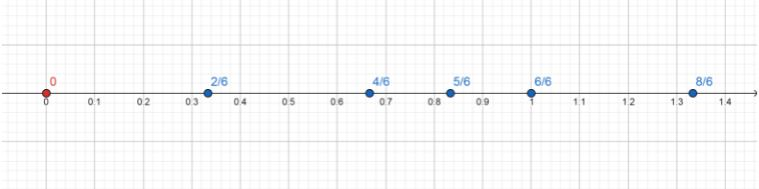
Show \[\dfrac{2}{6},\dfrac{4}{6},\dfrac{8}{6},\dfrac{5}{6}\] and \[\dfrac{6}{6}\] on the number line. Also arrange them in ascending order.
Answer
 Verified
483.3k+ views
Hint: In the above question, we are given five rational numbers or fractions which are \[\dfrac{2}{6},\dfrac{4}{6},\dfrac{8}{6},\dfrac{5}{6}\] and \[\dfrac{6}{6}\] . We have to show them on the number line and we also have to arrange these rational numbers in the ascending order, i.e. in an order from the lowest to the highest rational number. In order to approach the solution, first we can find their values where they lie on the number line.
Complete step by step answer:
Given rational numbers are \[\dfrac{2}{6},\dfrac{4}{6},\dfrac{8}{6},\dfrac{5}{6}\] and \[\dfrac{6}{6}\]. We have to show these rational numbers on the number line as well as arrange them in an ascending order. First, let us arrange these rational numbers in an ascending order. Since, we can see that the denominators are same in all the five numbers, therefore we can easily arrange these rational numbers in an ascending order according to the ascending order of their numerators.Since,
\[ \Rightarrow 2 < 4 < 5 < 6 < 8\]
Therefore, dividing them by \[6\] gives us the following ascending order:
\[ \Rightarrow \dfrac{2}{6} < \dfrac{4}{6} < \dfrac{5}{6} < \dfrac{6}{6} < \dfrac{8}{6}\]
That is the required ascending order of the given rational numbers.
Now, calculating the values of the lowest and highest rational number, we can write,
\[ \Rightarrow \dfrac{2}{6} = \dfrac{1}{3}\]
\[ \Rightarrow \dfrac{2}{6} = 0.33\]
And,
\[ \Rightarrow \dfrac{8}{6} = \dfrac{4}{3}\]
\[ \Rightarrow \dfrac{8}{6} = 1.33\]
Also,
\[ \Rightarrow \dfrac{6}{6} = 1\]
Therefore, we can say that all the five numbers lie between the interval \[\left( {0,2} \right)\].Now, draw a straight line and label it at three points as \[0,1,2\]. Since the denominator is six, therefore divide one unit on the number line into 6 equal parts.Now we can count the parts and label the rational numbers \[\dfrac{2}{6},\dfrac{4}{6},\dfrac{8}{6},\dfrac{5}{6}\] and \[\dfrac{6}{6}\]
Note: A number line is a method for graphically showing some numbers. It is defined as the pictorial representation of numbers such as fractions, integers and whole numbers, etc laid out evenly on a straight and horizontal line. A number line can also be used as a tool for comparing and ordering different numbers and for also performing operations such as addition and subtraction. Similarly we can also show radicals on a number line.
Complete step by step answer:
Given rational numbers are \[\dfrac{2}{6},\dfrac{4}{6},\dfrac{8}{6},\dfrac{5}{6}\] and \[\dfrac{6}{6}\]. We have to show these rational numbers on the number line as well as arrange them in an ascending order. First, let us arrange these rational numbers in an ascending order. Since, we can see that the denominators are same in all the five numbers, therefore we can easily arrange these rational numbers in an ascending order according to the ascending order of their numerators.Since,
\[ \Rightarrow 2 < 4 < 5 < 6 < 8\]
Therefore, dividing them by \[6\] gives us the following ascending order:
\[ \Rightarrow \dfrac{2}{6} < \dfrac{4}{6} < \dfrac{5}{6} < \dfrac{6}{6} < \dfrac{8}{6}\]
That is the required ascending order of the given rational numbers.
Now, calculating the values of the lowest and highest rational number, we can write,
\[ \Rightarrow \dfrac{2}{6} = \dfrac{1}{3}\]
\[ \Rightarrow \dfrac{2}{6} = 0.33\]
And,
\[ \Rightarrow \dfrac{8}{6} = \dfrac{4}{3}\]
\[ \Rightarrow \dfrac{8}{6} = 1.33\]
Also,
\[ \Rightarrow \dfrac{6}{6} = 1\]
Therefore, we can say that all the five numbers lie between the interval \[\left( {0,2} \right)\].Now, draw a straight line and label it at three points as \[0,1,2\]. Since the denominator is six, therefore divide one unit on the number line into 6 equal parts.Now we can count the parts and label the rational numbers \[\dfrac{2}{6},\dfrac{4}{6},\dfrac{8}{6},\dfrac{5}{6}\] and \[\dfrac{6}{6}\]
Note: A number line is a method for graphically showing some numbers. It is defined as the pictorial representation of numbers such as fractions, integers and whole numbers, etc laid out evenly on a straight and horizontal line. A number line can also be used as a tool for comparing and ordering different numbers and for also performing operations such as addition and subtraction. Similarly we can also show radicals on a number line.
Recently Updated Pages
Master Class 8 Social Science: Engaging Questions & Answers for Success

Master Class 8 English: Engaging Questions & Answers for Success
Class 8 Question and Answer - Your Ultimate Solutions Guide
Master Class 8 Maths: Engaging Questions & Answers for Success
Master Class 8 Science: Engaging Questions & Answers for Success
Master Class 9 General Knowledge: Engaging Questions & Answers for Success
Trending doubts
What is BLO What is the full form of BLO class 8 social science CBSE
Citizens of India can vote at the age of A 18 years class 8 social science CBSE
Full form of STD, ISD and PCO
Advantages and disadvantages of science
Right to vote is a AFundamental Right BFundamental class 8 social science CBSE
What are the 12 elements of nature class 8 chemistry CBSE