




Ship A is sailing towards the north east with velocity $\vec v = 30\hat i + 50\hat jkm/hr$ where $\hat i$ points east $\hat j$ and north. Ship B is at a distance of 80 km east and 150 km north of ship A and is sailing towards west at 10 km/hr. A will be at minimum distance from B in
(A) $4.2$ hours
(B) $2.2$ hours
(C) $3.2$ hours
(D) $2.6$ hours
Answer
 Verified
584.4k+ views
Hint: We know that the relation between time, velocity and displacement is given as
Time $ = \dfrac{{displacement}}{{velocity}}$
And the above expression is also applicable for relative motion like relative velocity, relative displacement etc. But time does not depend on frame of reference.
Complete step by step answer:
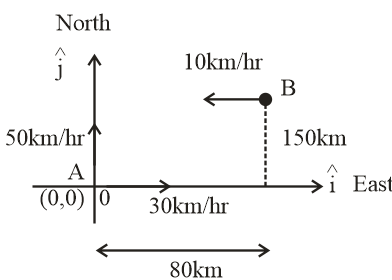
Given that initial positions of ship A & B is
${\vec r_A} = 0\hat i + 0\hat j$ …..(1)
${\vec r_B} = (80\hat i + 150\hat j)km$ ….(2)
So, the relative position of B with respect to A
${\vec r_{BA}} = (80\hat i + 150\hat j)km$ …..(3)
Also, given that the velocity of ship A & B is
${\vec v_A} = (30\hat i + 50\hat j)km/hr$
${\vec v_B} = - 10\hat ikm/hr$
So, relative velocity of B with respect to A is
${\vec v_{BA}} = - 10\hat i - (30\hat i + 50\hat j)$
$ = - 10\hat i - 30\hat i - 50\hat j$
${\vec v_{BA}} = - 40\hat i - 60\hat j$ …..(4)
And magnitude of ${\vec v_{AB}}$ is given as
\[|{\vec v_{BA}}| = \sqrt {{{(40)}^2} + {{(50)}^2}} \]
$\sqrt {1600 + 2500} $
$|{\vec v_{BA}}| = \sqrt {4100} $ …..(5)
We know that
Time t $ = \dfrac{{displacement(\vec r)}}{{velocity(\vec v)}}$
In relative motion
$t = \dfrac{{{{\vec r}_{BA}}}}{{{{\vec v}_{BA}}}}$
On multiplying ${\vec v_{BA}} \Rightarrow t = \dfrac{{{{\vec r}_{BA}} \cdot {{\vec v}_{BA}}}}{{{{\vec v}_{BA}} \cdot {{\vec v}_{BA}}}}$
$t = \dfrac{{{{\vec r}_{BA}} \cdot {{\vec v}_{BA}}}}{{|{{\vec v}_{BA}}{|^2}}}$
So, from equation 3, 4 & 5
$t = \dfrac{{(80\hat i + 150\hat j) \cdot ( - 40\hat i - 50\hat j)}}{{{{(\sqrt {4100} )}^2}}}$
$t = \dfrac{{[ - (80 \times 40)] + [ - (150 \times 50)]}}{{4100}}$
$t = \dfrac{{ - 3200 - 7500}}{{4100}} = \dfrac{{ - 10700}}{{4100}}$
Time never be –ve, hence
$t = \dfrac{{10700}}{{4100}} = \dfrac{{107}}{{41}} = 2.6$ hours
$t = 2.6$ hours
So, the correct answer is “Option D”.
Note:
Relative motion is a concept which makes numerical problems easy. We can apply the above formulae only when there is no acceleration given to particles. Time does not depend on frame of reference.
Time $ = \dfrac{{displacement}}{{velocity}}$
And the above expression is also applicable for relative motion like relative velocity, relative displacement etc. But time does not depend on frame of reference.
Complete step by step answer:
Given that initial positions of ship A & B is
${\vec r_A} = 0\hat i + 0\hat j$ …..(1)
${\vec r_B} = (80\hat i + 150\hat j)km$ ….(2)
So, the relative position of B with respect to A
${\vec r_{BA}} = (80\hat i + 150\hat j)km$ …..(3)
Also, given that the velocity of ship A & B is
${\vec v_A} = (30\hat i + 50\hat j)km/hr$
${\vec v_B} = - 10\hat ikm/hr$
So, relative velocity of B with respect to A is
${\vec v_{BA}} = - 10\hat i - (30\hat i + 50\hat j)$
$ = - 10\hat i - 30\hat i - 50\hat j$
${\vec v_{BA}} = - 40\hat i - 60\hat j$ …..(4)
And magnitude of ${\vec v_{AB}}$ is given as
\[|{\vec v_{BA}}| = \sqrt {{{(40)}^2} + {{(50)}^2}} \]
$\sqrt {1600 + 2500} $
$|{\vec v_{BA}}| = \sqrt {4100} $ …..(5)
We know that
Time t $ = \dfrac{{displacement(\vec r)}}{{velocity(\vec v)}}$
In relative motion
$t = \dfrac{{{{\vec r}_{BA}}}}{{{{\vec v}_{BA}}}}$
On multiplying ${\vec v_{BA}} \Rightarrow t = \dfrac{{{{\vec r}_{BA}} \cdot {{\vec v}_{BA}}}}{{{{\vec v}_{BA}} \cdot {{\vec v}_{BA}}}}$
$t = \dfrac{{{{\vec r}_{BA}} \cdot {{\vec v}_{BA}}}}{{|{{\vec v}_{BA}}{|^2}}}$
So, from equation 3, 4 & 5
$t = \dfrac{{(80\hat i + 150\hat j) \cdot ( - 40\hat i - 50\hat j)}}{{{{(\sqrt {4100} )}^2}}}$
$t = \dfrac{{[ - (80 \times 40)] + [ - (150 \times 50)]}}{{4100}}$
$t = \dfrac{{ - 3200 - 7500}}{{4100}} = \dfrac{{ - 10700}}{{4100}}$
Time never be –ve, hence
$t = \dfrac{{10700}}{{4100}} = \dfrac{{107}}{{41}} = 2.6$ hours
$t = 2.6$ hours
So, the correct answer is “Option D”.
Note:
Relative motion is a concept which makes numerical problems easy. We can apply the above formulae only when there is no acceleration given to particles. Time does not depend on frame of reference.
Recently Updated Pages
Master Class 11 Computer Science: Engaging Questions & Answers for Success

Master Class 11 Business Studies: Engaging Questions & Answers for Success
Master Class 11 Economics: Engaging Questions & Answers for Success
Master Class 11 English: Engaging Questions & Answers for Success
Master Class 11 Maths: Engaging Questions & Answers for Success
Master Class 11 Biology: Engaging Questions & Answers for Success
Trending doubts
One Metric ton is equal to kg A 10000 B 1000 C 100 class 11 physics CBSE
There are 720 permutations of the digits 1 2 3 4 5 class 11 maths CBSE
Discuss the various forms of bacteria class 11 biology CBSE
Draw a diagram of a plant cell and label at least eight class 11 biology CBSE
State the laws of reflection of light
Explain zero factorial class 11 maths CBSE