




Shape of graph between speed and kinetic energy of a body is-
(A). Hyperbola
(B). Straight Line
(C). Parabola
(D). Circle
Answer
 Verified
602.7k+ views
Hint: Using the formula for kinetic energy, we determine the relationship between Kinetic energy and speed and analyse the dependent and independent variables out of the two. On the basis of whether the relationship is linear or polynomial we draw a graph and describe its characteristics.
Complete answer:
Speed is the distance travelled by a body in unit time. It’s SI unit is\[{\text{m}}/{\text{s}}\;\] .
\[\text{S = }\dfrac{\text{d}}{\text{t}}\]
Where d= distance traveled by a body in given time
t= time taken
Kinetic energy is the energy possessed by a body due to its motion. It can also be defined as the work required to accelerate a body from its rest position to given velocity. It’s SI unit is joules \[\text{(J)}\].
Kinetic Energy is given by-
\[\text{K = }\dfrac{\text{1}}{\text{2}}\text{m}{{\text{v}}^{\text{2}}}\] - (1)
Velocity varies continuously with time. eq (1) tells us about the relationship between Kinetic energy and speed. From this we can conclude that-
\[\text{K}\propto {{\text{v}}^{\text{2}}}\]
Here, \[\text{(}\dfrac{\text{1}}{\text{2}}\text{m)}\] is a constant.
The graph for a square relationship is a parabola. Eq of Parabola is-
\[{{\text{x}}^{\text{2}}}\text{ = 4ay}\] - (2)
Eq (1) is comparable to eq (2) and the graph will be-
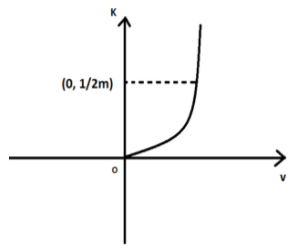
As the square of a variable cannot have negative values, the graph on the negative x-axis is absent.
As there is no intercept, the vertex of the parabola is at origin. Comparing eq (1) and eq (2), we get, \[\text{a = }\dfrac{\text{2}}{\text{m}}\] .Therefore the focus of parabola is at $(0, \dfrac{2}{m})$
Hence, the correct option is (C). Parabola
Note:
Here Kinetic Energy K , is the dependent variable and speed,is the independent variable. Therefore, by convention,K is taken along the y-axis and v is taken along the x-axis. Different parabolas can be formed depending on the axis of symmetry; here the axis of symmetry is the y-axis.
Complete answer:
Speed is the distance travelled by a body in unit time. It’s SI unit is\[{\text{m}}/{\text{s}}\;\] .
\[\text{S = }\dfrac{\text{d}}{\text{t}}\]
Where d= distance traveled by a body in given time
t= time taken
Kinetic energy is the energy possessed by a body due to its motion. It can also be defined as the work required to accelerate a body from its rest position to given velocity. It’s SI unit is joules \[\text{(J)}\].
Kinetic Energy is given by-
\[\text{K = }\dfrac{\text{1}}{\text{2}}\text{m}{{\text{v}}^{\text{2}}}\] - (1)
Velocity varies continuously with time. eq (1) tells us about the relationship between Kinetic energy and speed. From this we can conclude that-
\[\text{K}\propto {{\text{v}}^{\text{2}}}\]
Here, \[\text{(}\dfrac{\text{1}}{\text{2}}\text{m)}\] is a constant.
The graph for a square relationship is a parabola. Eq of Parabola is-
\[{{\text{x}}^{\text{2}}}\text{ = 4ay}\] - (2)
Eq (1) is comparable to eq (2) and the graph will be-
As the square of a variable cannot have negative values, the graph on the negative x-axis is absent.
As there is no intercept, the vertex of the parabola is at origin. Comparing eq (1) and eq (2), we get, \[\text{a = }\dfrac{\text{2}}{\text{m}}\] .Therefore the focus of parabola is at $(0, \dfrac{2}{m})$
Hence, the correct option is (C). Parabola
Note:
Here Kinetic Energy K , is the dependent variable and speed,is the independent variable. Therefore, by convention,K is taken along the y-axis and v is taken along the x-axis. Different parabolas can be formed depending on the axis of symmetry; here the axis of symmetry is the y-axis.
Recently Updated Pages
Master Class 11 Social Science: Engaging Questions & Answers for Success

Master Class 11 Chemistry: Engaging Questions & Answers for Success
Master Class 9 General Knowledge: Engaging Questions & Answers for Success
Master Class 9 Maths: Engaging Questions & Answers for Success
Master Class 9 Science: Engaging Questions & Answers for Success
Master Class 9 English: Engaging Questions & Answers for Success
Trending doubts
One Metric ton is equal to kg A 10000 B 1000 C 100 class 11 physics CBSE
Difference Between Prokaryotic Cells and Eukaryotic Cells
Two of the body parts which do not appear in MRI are class 11 biology CBSE
1 ton equals to A 100 kg B 1000 kg C 10 kg D 10000 class 11 physics CBSE
Explain zero factorial class 11 maths CBSE
10 examples of friction in our daily life