



Shade \[\dfrac{1}{2}\] of the circles.
Answer
 Verified
574.5k+ views
Hint: First of all, count the total number of circles in the box. Now, calculate \[\dfrac{1}{2}\] of the total number of circles. At last, shade \[\dfrac{1}{2}\] of the total number of circles. The shaded diagram is the required diagram.
Complete step-by-step answer:
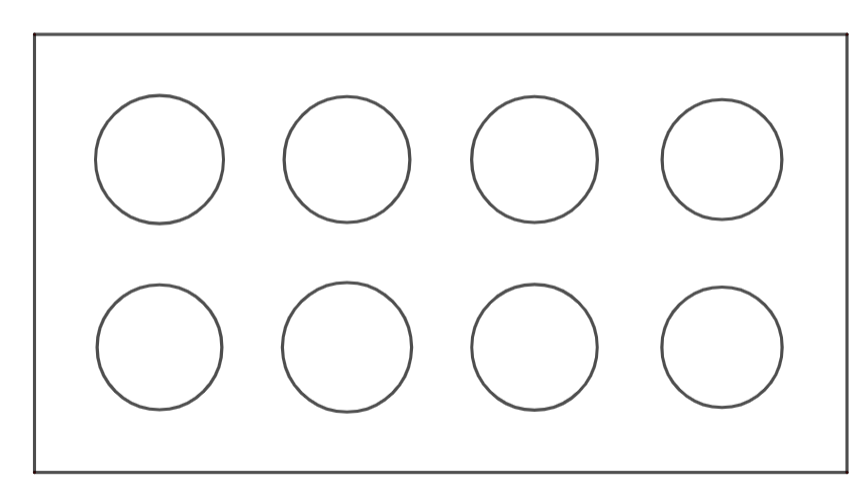
According to the question, we are given a figure in which we have a box and there are circles inside that box.
We are asked to shade \[\dfrac{1}{2}\] of the circles. That is, we shade half of the total the number of the circles in the box.
First of all, we require the total number of circles available inside the box.
Now, from the given diagram, we can observe that
The number of circles in the first row = 4 ………………………………………..(1)
The number of circles in the second row = 4 ……………………………………………….(2)
The total number of circles in the box = The number of circles in the first row + The number of circles in the second row ……………………………………………..(3)
Now, from equation (1), equation (2), and equation (3), we get
The total number of circles in the box = \[4+4\] = 8 ………………………………………(4)
The number of circles to shade = \[\dfrac{1}{2}\times \] The total number of circles in the box …………………………………………..(5)
From equation (4) and equation (5), we get
The number of circles to shade = \[\dfrac{1}{2}\times 8=4\] ……………………………………………………..(6)
Now, on shading 4 circles in the given diagram, we get
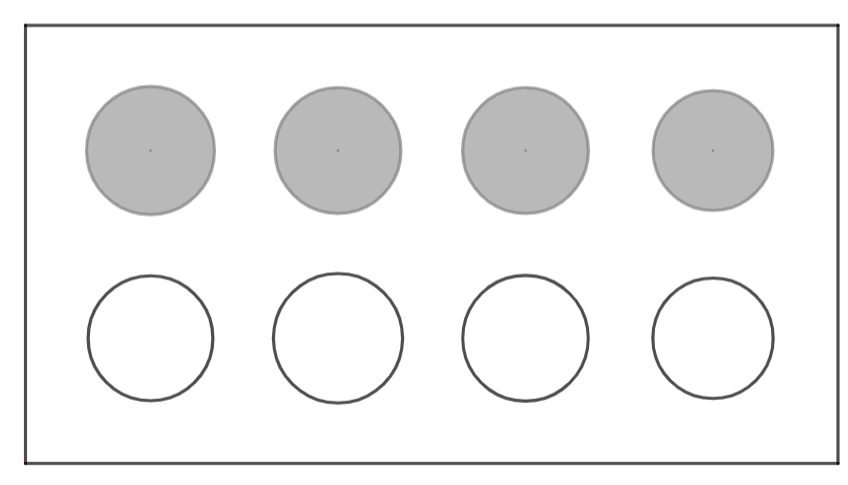
The above diagram is the required figure.
Hence, \[\dfrac{1}{2}\] of the circles are shaded.
Note: In this question, one might shade \[\dfrac{1}{2}\] fractional part of every circle. This is not the correct approach because we are asked to shade half of the total number of the circles inside the box. Therefore, take this point into consideration.
Complete step-by-step answer:
According to the question, we are given a figure in which we have a box and there are circles inside that box.
We are asked to shade \[\dfrac{1}{2}\] of the circles. That is, we shade half of the total the number of the circles in the box.
First of all, we require the total number of circles available inside the box.
Now, from the given diagram, we can observe that
The number of circles in the first row = 4 ………………………………………..(1)
The number of circles in the second row = 4 ……………………………………………….(2)
The total number of circles in the box = The number of circles in the first row + The number of circles in the second row ……………………………………………..(3)
Now, from equation (1), equation (2), and equation (3), we get
The total number of circles in the box = \[4+4\] = 8 ………………………………………(4)
The number of circles to shade = \[\dfrac{1}{2}\times \] The total number of circles in the box …………………………………………..(5)
From equation (4) and equation (5), we get
The number of circles to shade = \[\dfrac{1}{2}\times 8=4\] ……………………………………………………..(6)
Now, on shading 4 circles in the given diagram, we get
The above diagram is the required figure.
Hence, \[\dfrac{1}{2}\] of the circles are shaded.
Note: In this question, one might shade \[\dfrac{1}{2}\] fractional part of every circle. This is not the correct approach because we are asked to shade half of the total number of the circles inside the box. Therefore, take this point into consideration.

Recently Updated Pages
Master Class 7 English: Engaging Questions & Answers for Success

Master Class 7 Maths: Engaging Questions & Answers for Success
Master Class 7 Science: Engaging Questions & Answers for Success
Class 7 Question and Answer - Your Ultimate Solutions Guide
Master Class 9 General Knowledge: Engaging Questions & Answers for Success
Master Class 9 Social Science: Engaging Questions & Answers for Success
Trending doubts
The value of 6 more than 7 is A 1 B 1 C 13 D 13 class 7 maths CBSE
Convert 200 Million dollars in rupees class 7 maths CBSE
List of coprime numbers from 1 to 100 class 7 maths CBSE
AIM To prepare stained temporary mount of onion peel class 7 biology CBSE
The plural of Chief is Chieves A True B False class 7 english CBSE
Write a letter to the editor of the national daily class 7 english CBSE