




What is sericulture? Explain the life-cycle of silk worms.
Answer
 Verified
543k+ views
Hint: Sericulture or silk farming consists of cultivating silkworms to produce silk. Although there are several commercial species of silkworms, the Bombyx mori is the most widely used and most studied silkworm. Silk is believed to have been produced in China as early as the Neolithic. In countries such as Brazil, China, France, India, Italy, Japan, Korea and Russia, sericulture has become an important cottage industry.
Complete answer:
Sericulture is the process of growing silkworms and extracting silk from them. Silkworm caterpillars (also known as “Bombyx mori”) are the most commonly used silkworm species in sericulture. Other types of silkworms (such as Eri, Muga and Tasar) have also been bred for the production of “wild silk”. Sericulture is a very important national industry in many countries. India and China are the main silk producers in the world.
For mulberry silk production, the sericulture process follows three main steps:
Moriculture: Mulberry leaf cultivation.
Silkworm rearing: promoting growth of silkworms.
Silk reeling: extract silk from silkworm cocoons.
Life cycle of silk worm:
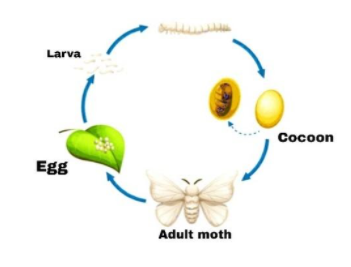
When the female lays eggs, the life cycle of the silkworm moth begins. Caterpillars or larvae hatch from silk moth eggs. Silkworms feed on mulberry leaves and pupate. In the pupal stage, a weave is netted around by the silkworm to hold and support itself. After that, the silkworm swings its head, which spins a fiber made of a protein and becomes a silk fibre. Several caterpillars form a protective layer around the pupae, and this covering is called a cocoon. Silk thread (yarn) is obtained from the cocoons of silkworm moths.
Note:
Silkworms feed on mulberry leaves and, after the fourth molt, climb up the branches near them and spin their silk cocoons. Silk is a continuous filament containing silk fibroin, secreted by the two salivary glands in the head of each worm, and a gum called sericin that binds the silk together. The sericin is removed by putting the cocoon in hot water, thus loosening the silk threads and preparing them for winding. This is called the degumming process.
Complete answer:
Sericulture is the process of growing silkworms and extracting silk from them. Silkworm caterpillars (also known as “Bombyx mori”) are the most commonly used silkworm species in sericulture. Other types of silkworms (such as Eri, Muga and Tasar) have also been bred for the production of “wild silk”. Sericulture is a very important national industry in many countries. India and China are the main silk producers in the world.
For mulberry silk production, the sericulture process follows three main steps:
Moriculture: Mulberry leaf cultivation.
Silkworm rearing: promoting growth of silkworms.
Silk reeling: extract silk from silkworm cocoons.
Life cycle of silk worm:
When the female lays eggs, the life cycle of the silkworm moth begins. Caterpillars or larvae hatch from silk moth eggs. Silkworms feed on mulberry leaves and pupate. In the pupal stage, a weave is netted around by the silkworm to hold and support itself. After that, the silkworm swings its head, which spins a fiber made of a protein and becomes a silk fibre. Several caterpillars form a protective layer around the pupae, and this covering is called a cocoon. Silk thread (yarn) is obtained from the cocoons of silkworm moths.
Note:
Silkworms feed on mulberry leaves and, after the fourth molt, climb up the branches near them and spin their silk cocoons. Silk is a continuous filament containing silk fibroin, secreted by the two salivary glands in the head of each worm, and a gum called sericin that binds the silk together. The sericin is removed by putting the cocoon in hot water, thus loosening the silk threads and preparing them for winding. This is called the degumming process.
Recently Updated Pages
Master Class 12 Business Studies: Engaging Questions & Answers for Success

Master Class 12 Chemistry: Engaging Questions & Answers for Success
Master Class 12 Biology: Engaging Questions & Answers for Success
Class 12 Question and Answer - Your Ultimate Solutions Guide
Master Class 11 English: Engaging Questions & Answers for Success
Master Class 11 Social Science: Engaging Questions & Answers for Success
Trending doubts
Which are the Top 10 Largest Countries of the World?
Draw a labelled sketch of the human eye class 12 physics CBSE
Differentiate between homogeneous and heterogeneous class 12 chemistry CBSE
Differentiate between Pyramid of energy and pyramid class 12 biology CBSE
Why is the cell called the structural and functional class 12 biology CBSE
Draw the diagram of the pyramid of energy Explain In class 12 biology CBSE