




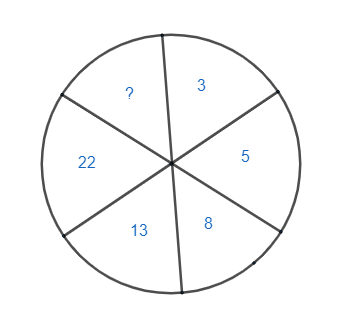
Select the missing number from the given responses.
(a) 1
(b) 26
(c) 39
(d) 45
Answer
 Verified
528k+ views
Hint: The given circular chart has a sequence of numbers. We have to find a particular pattern or sequence that the numbers follow and based on the pattern we need to find which number comes last after the number 22.
Complete step by step solution:
In the question we are given the sequence of numbers 3,5,8,13,22 and the next number after this is asked to be found out by us. By direct inspection, we are unable to find any pattern in the given sequence of numbers. Hence, let us take the differences between these numbers and find the sequence of the differences between the numbers.
We note the sequences of differences as $\left( 5-3 \right),\left( 8-5 \right),\left( 13-8 \right),\left( 22-13 \right)$ which after simplification, yields 2,3,5, and 9. Again, we are not able to find any patterns or sequences from this so we will again take the differences of these numbers.
We note the sequence of second differences as $\left( 3-2 \right),\left( 5-3 \right),\left( 9-5 \right)$ which after simplification, yields 1,2 and 4. Hence we have found a pattern here which is ${{2}^{0}},{{2}^{1}},{{2}^{2}}$ . Therefore, the next would be ${{2}^{3}}$ which is 8. Hence by back substitution the last number of the first differences sequence will be $9+8$ which is 17. Hence the last number of the original sequence will be $22+17$ which is equal to 39.
So, the correct answer is “Option (c)”.
Note: Once we find some pattern in the second differences or any further differences sequence, one must not forget to back substitute appropriately so that we can obtain the last term of the original sequence using the differences.
Complete step by step solution:
In the question we are given the sequence of numbers 3,5,8,13,22 and the next number after this is asked to be found out by us. By direct inspection, we are unable to find any pattern in the given sequence of numbers. Hence, let us take the differences between these numbers and find the sequence of the differences between the numbers.
We note the sequences of differences as $\left( 5-3 \right),\left( 8-5 \right),\left( 13-8 \right),\left( 22-13 \right)$ which after simplification, yields 2,3,5, and 9. Again, we are not able to find any patterns or sequences from this so we will again take the differences of these numbers.
We note the sequence of second differences as $\left( 3-2 \right),\left( 5-3 \right),\left( 9-5 \right)$ which after simplification, yields 1,2 and 4. Hence we have found a pattern here which is ${{2}^{0}},{{2}^{1}},{{2}^{2}}$ . Therefore, the next would be ${{2}^{3}}$ which is 8. Hence by back substitution the last number of the first differences sequence will be $9+8$ which is 17. Hence the last number of the original sequence will be $22+17$ which is equal to 39.
So, the correct answer is “Option (c)”.
Note: Once we find some pattern in the second differences or any further differences sequence, one must not forget to back substitute appropriately so that we can obtain the last term of the original sequence using the differences.
Recently Updated Pages
Master Class 10 Computer Science: Engaging Questions & Answers for Success

Master Class 10 General Knowledge: Engaging Questions & Answers for Success
Master Class 10 English: Engaging Questions & Answers for Success
Master Class 10 Social Science: Engaging Questions & Answers for Success
Master Class 10 Maths: Engaging Questions & Answers for Success
Master Class 10 Science: Engaging Questions & Answers for Success
Trending doubts
What is the median of the first 10 natural numbers class 10 maths CBSE
Which women's tennis player has 24 Grand Slam singles titles?
Who is the Brand Ambassador of Incredible India?
Why is there a time difference of about 5 hours between class 10 social science CBSE
Write a letter to the principal requesting him to grant class 10 english CBSE
A moving boat is observed from the top of a 150 m high class 10 maths CBSE