




Select the correct statements about diborane :
(a) $ {B_2}{H_6} $ has three centred bound
(b) each boron atom lies in $ s{p^3} $ hybrid state
(c) $ {H_b} $ . . . . . B . . . . . . $ {H_b} $ bond angle is $ {122^o} $
(d) All hydrogens in $ {B_2}{H_6} $ lie the same.
Answer
 Verified
589.5k+ views
Hint :The chemical compound diborane, sometimes known as diborane, has the formula $ {B_2}{H_6} $ and is made up of boron and hydrogen. It's a colourless, pyrophoric gas with an odiferous sweet odour. Diborane is a common boron compound with a wide range of uses. Its electronic structure has gotten a lot of interest. It has a number of derivatives that are valuable reagents.
Complete Step By Step Answer:
The Diborane molecule is made up of four hydrogen atoms and two boron atoms that are all in the same plane. Two splitting hydrogen atoms are thought to exist between these planes. The boron atom possesses four hybrid orbitals and is known to be $ s{p^3} $ hybridised. Three of the four hybrid orbitals have one electron apiece, with the fourth orbital being an empty orbital. The two hybrid orbital electrons in each boron atom make two bonds with the 1s hydrogen atoms. The two boron atoms remaining with each unpaired electron orbital and empty orbital create two bridgings (B–H–B) bonds with the two 1s hydrogen atoms, which is also known as the banana bond.
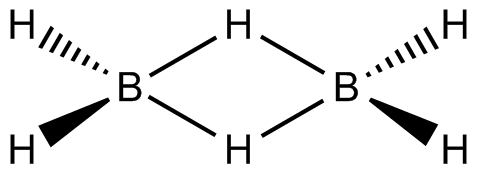
The links between boron and the terminal hydrogen atoms are described by molecular orbital theory as standard 2-center 2-electron covalent bonds. The connection between the boron atoms and the bridging hydrogen atoms, on the other hand, is not the same as in hydrocarbon molecules. Each boron bonds to the terminal hydrogen atoms with two electrons and has one valence electron left over for further bonding. Each of the bridging hydrogen atoms contributes one electron. Four electrons make two 3-center 2-electron bonds that hold the $ {B_2}{H_2} $ ring together. A "banana bond" is a term used to describe this form of relationship.
Hence options A B C are correct.
Note :
Because the 12 valence electrons can only form 6 typical 2-centre 2-electron bonds, which are inadequate to bind all 8 atoms, diborane has traditionally been classified as electron-deficient. The more accurate description utilising 3-centre bonds, on the other hand, reveals that diborane is really electron-precise, with just enough valence electrons to cover the 6 bonding molecular orbitals.
Complete Step By Step Answer:
The Diborane molecule is made up of four hydrogen atoms and two boron atoms that are all in the same plane. Two splitting hydrogen atoms are thought to exist between these planes. The boron atom possesses four hybrid orbitals and is known to be $ s{p^3} $ hybridised. Three of the four hybrid orbitals have one electron apiece, with the fourth orbital being an empty orbital. The two hybrid orbital electrons in each boron atom make two bonds with the 1s hydrogen atoms. The two boron atoms remaining with each unpaired electron orbital and empty orbital create two bridgings (B–H–B) bonds with the two 1s hydrogen atoms, which is also known as the banana bond.
The links between boron and the terminal hydrogen atoms are described by molecular orbital theory as standard 2-center 2-electron covalent bonds. The connection between the boron atoms and the bridging hydrogen atoms, on the other hand, is not the same as in hydrocarbon molecules. Each boron bonds to the terminal hydrogen atoms with two electrons and has one valence electron left over for further bonding. Each of the bridging hydrogen atoms contributes one electron. Four electrons make two 3-center 2-electron bonds that hold the $ {B_2}{H_2} $ ring together. A "banana bond" is a term used to describe this form of relationship.
Hence options A B C are correct.
Note :
Because the 12 valence electrons can only form 6 typical 2-centre 2-electron bonds, which are inadequate to bind all 8 atoms, diborane has traditionally been classified as electron-deficient. The more accurate description utilising 3-centre bonds, on the other hand, reveals that diborane is really electron-precise, with just enough valence electrons to cover the 6 bonding molecular orbitals.
Recently Updated Pages
Which will be the least stable resonating structure class 11 chemistry CBSE

How many 5 digit telephone numbers can be construc-class-11-maths-CBSE
How do you find the angle of the resultant vector class 11 physics CBSE
Draw labelled diagram of the following i Gram seed class 11 biology CBSE
1 Quintal is equal to a 110 kg b 10 kg c 100kg d 1000 class 11 physics CBSE
What is the need and importance of classification class 11 biology CBSE
Trending doubts
Find the value of the expression given below sin 30circ class 11 maths CBSE
One Metric ton is equal to kg A 10000 B 1000 C 100 class 11 physics CBSE
10 examples of friction in our daily life
Draw a diagram of a plant cell and label at least eight class 11 biology CBSE
Difference between physical and chemical change class 11 chemistry CBSE
Proton was discovered by A Thomson B Rutherford C Chadwick class 11 chemistry CBSE