




Select the correct option: Who gave the lamellar or sandwich model of the cell membrane?
(a)Singer and Nicolson
(b)Danielli and Davson
(c)J. Robertson
(d)None of these
Answer
 Verified
621.6k+ views
Hint: The model was the primary plan to describe membrane structure in terms of molecules and to relate the structure to biological and chemical properties. Under the presence of clear electron micrographs of membranes became available, they seemed to support their model, showing a three-layered structure.
Complete answer:
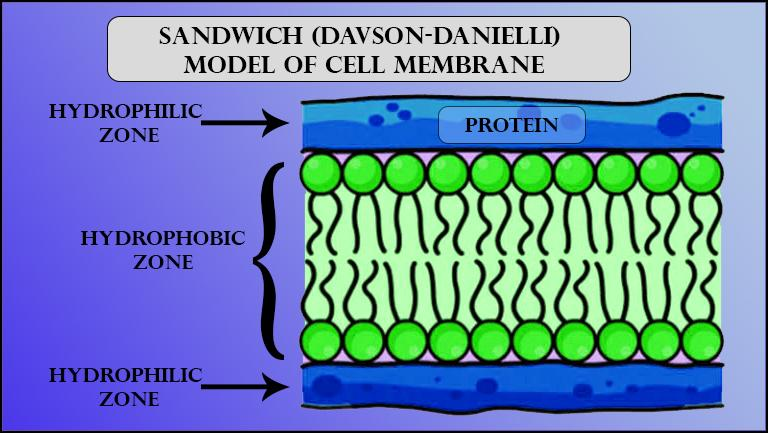
According to Danielli and Davson sandwich model of the cell membrane:
-A phospholipid bilayer surrounded by two layers of proteins, on the inner and outer surfaces.
-The polar or hydrophilic heads of phospholipids are oriented towards the protein layers forming a hydrophilic zone.
-The nonpolar or hydrophobic tails of phospholipids are oriented in between polar heads forming a hydrophobic zone.
Additional Information: -Polar molecules are usually hydrophilic which may mix or dissolve in water, while non-polar molecules are hydrophobic the opposite.
-Phospholipids form bilayers in water due to the presence of amphipathic properties of phospholipid molecules.
-It is an extraordinary molecule since the: Phospholipid head that is choline, a phosphate group and glycerol is hydrophilic which means attracting water while the phospholipid tail or fatty acid is hydrophobic that repels water.
-Substances being hydrophilic and hydrophobic simultaneously are called an amphipathic substance.
-The amphipathic properties of phospholipids are cause for the development of phospholipid monolayers when placed in water.
-The orientation is simple: the hydrophilic heads towards the water, hydrophobic tails away from water, these structures are called a micelle.
So, the correct answer is ‘Danielli and Davson.’
Note: Evidence for the Davson–Danielli
-It was observed that the light layer represented the phospholipid tails and the dark layers represented the phospholipid heads.
Drawback of Davson-Daniell
-The amount and type of membrane proteins show vary greatly between different cells.
-It was not understood how the proteins in the model would permit the membrane to change shape without bonds being broken.
-Membrane proteins are highly hydrophobic in nature and therefore shouldn’t be found where the model positioned them in the aqueous cytoplasm and extracellular environment.
Complete answer:
According to Danielli and Davson sandwich model of the cell membrane:
-A phospholipid bilayer surrounded by two layers of proteins, on the inner and outer surfaces.
-The polar or hydrophilic heads of phospholipids are oriented towards the protein layers forming a hydrophilic zone.
-The nonpolar or hydrophobic tails of phospholipids are oriented in between polar heads forming a hydrophobic zone.
Additional Information: -Polar molecules are usually hydrophilic which may mix or dissolve in water, while non-polar molecules are hydrophobic the opposite.
-Phospholipids form bilayers in water due to the presence of amphipathic properties of phospholipid molecules.
-It is an extraordinary molecule since the: Phospholipid head that is choline, a phosphate group and glycerol is hydrophilic which means attracting water while the phospholipid tail or fatty acid is hydrophobic that repels water.
-Substances being hydrophilic and hydrophobic simultaneously are called an amphipathic substance.
-The amphipathic properties of phospholipids are cause for the development of phospholipid monolayers when placed in water.
-The orientation is simple: the hydrophilic heads towards the water, hydrophobic tails away from water, these structures are called a micelle.
So, the correct answer is ‘Danielli and Davson.’
Note: Evidence for the Davson–Danielli
-It was observed that the light layer represented the phospholipid tails and the dark layers represented the phospholipid heads.
Drawback of Davson-Daniell
-The amount and type of membrane proteins show vary greatly between different cells.
-It was not understood how the proteins in the model would permit the membrane to change shape without bonds being broken.
-Membrane proteins are highly hydrophobic in nature and therefore shouldn’t be found where the model positioned them in the aqueous cytoplasm and extracellular environment.

Recently Updated Pages
Master Class 11 English: Engaging Questions & Answers for Success

Master Class 11 Social Science: Engaging Questions & Answers for Success
Master Class 11 Maths: Engaging Questions & Answers for Success
Master Class 11 Biology: Engaging Questions & Answers for Success
Master Class 11 Physics: Engaging Questions & Answers for Success
Master Class 11 Chemistry: Engaging Questions & Answers for Success
Trending doubts
What is BLO What is the full form of BLO class 8 social science CBSE
Citizens of India can vote at the age of A 18 years class 8 social science CBSE
Full form of STD, ISD and PCO
Advantages and disadvantages of science
What is the difference between rai and mustard see class 8 biology CBSE
What is the collective noun for soldiers class 8 english CBSE