




Select the correct option
S.No. Structure Percentage Function A Neutrophils 0.3-0.5 Phagocytotic B Basophil 0.5-1.0 Secretes histamine C Eosinophil 30-40 Defense against parasites D Monocyte 30-40 Allergic reactions
| S.No. | Structure | Percentage | Function |
| A | Neutrophils | 0.3-0.5 | Phagocytotic |
| B | Basophil | 0.5-1.0 | Secretes histamine |
| C | Eosinophil | 30-40 | Defense against parasites |
| D | Monocyte | 30-40 | Allergic reactions |
Answer
 Verified
617.1k+ views
Hint: The white blood cells are of two types based on whether they possess cytoplasmic granules or not. The correct option includes the leukocyte with cytoplasmic granules that can be only stained by basic dyes.
Complete answer:
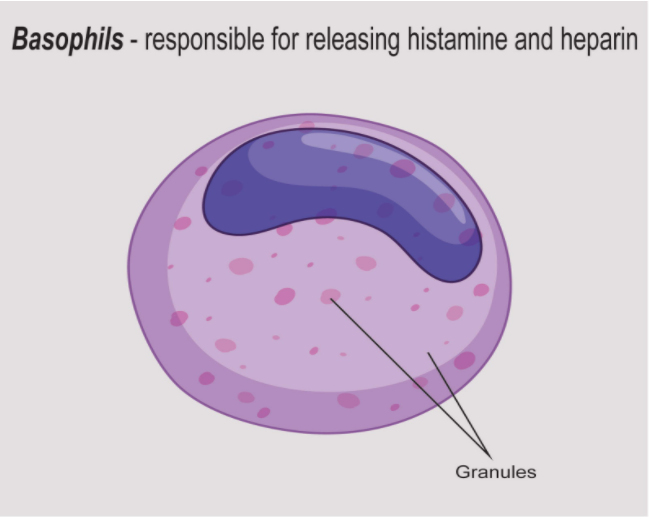
Blood cells are of two types namely red blood cells or erythrocytes and white blood cells or leukocytes. Leukocytes are further of two types- granulocytes and agranulocytes. Basophils are present the least among the various types of WBCs, it only accounts for 0.5-1.0% of total leukocyte count. They are responsible for mediating inflammatory reactions as well as allergic reactions by secreting histamine. It stains blue-purple with basic dyes.
Additional Information: -The granulocytes are the leukocytes that bear these conspicuous chemical-filled cytoplasmic granules or vesicles that become visible by staining. Neutrophils, Eosinophils, and basophils are granular leukocytes. -The agranulocytes are those in which these cytoplasmic granules are absent. Lymphocytes and monocytes belong to this category.
-Eosinophil is a bilobed spherical leukocyte that bears granules that are stained by acidic dyes and appear in the shades of red-orange. In our body, their percentage concentration is 1-3% of white blood cells. They are concerned with the detoxification of foreign substances entered into our bodies.
-Neutrophils account for the most percentage count among the granulocytes leukocytes. In total WBCs count, it is present in abundance i.e around 40-70%. Their characteristic feature includes the presence of two to the five-lobed nucleus. Its granules are slightly pink. Its functions include immediate migration to the site of infection and induce the primary response. It is phagocytic in nature.
-Monocyte is a type of agranulocytes whose concentration is around 3-9% in leukocytes. They are the largest of the leukocytes and have kidney or horse-shaped nuclei.
So, the correct option is ‘Basophils.’
Note: -The color and appearance of monocytes are due to very fine azurophilic granules, which are lysosomes. The blood transports monocytes into the tissues where they enlarge and differentiate into macrophages.
-Monocytes and granular leukocytes develop from a myeloid stem cell and lymphocytes develop from a lymphoid stem cell.
Complete answer:
Blood cells are of two types namely red blood cells or erythrocytes and white blood cells or leukocytes. Leukocytes are further of two types- granulocytes and agranulocytes. Basophils are present the least among the various types of WBCs, it only accounts for 0.5-1.0% of total leukocyte count. They are responsible for mediating inflammatory reactions as well as allergic reactions by secreting histamine. It stains blue-purple with basic dyes.
Additional Information: -The granulocytes are the leukocytes that bear these conspicuous chemical-filled cytoplasmic granules or vesicles that become visible by staining. Neutrophils, Eosinophils, and basophils are granular leukocytes. -The agranulocytes are those in which these cytoplasmic granules are absent. Lymphocytes and monocytes belong to this category.
-Eosinophil is a bilobed spherical leukocyte that bears granules that are stained by acidic dyes and appear in the shades of red-orange. In our body, their percentage concentration is 1-3% of white blood cells. They are concerned with the detoxification of foreign substances entered into our bodies.
-Neutrophils account for the most percentage count among the granulocytes leukocytes. In total WBCs count, it is present in abundance i.e around 40-70%. Their characteristic feature includes the presence of two to the five-lobed nucleus. Its granules are slightly pink. Its functions include immediate migration to the site of infection and induce the primary response. It is phagocytic in nature.
-Monocyte is a type of agranulocytes whose concentration is around 3-9% in leukocytes. They are the largest of the leukocytes and have kidney or horse-shaped nuclei.
So, the correct option is ‘Basophils.’
Note: -The color and appearance of monocytes are due to very fine azurophilic granules, which are lysosomes. The blood transports monocytes into the tissues where they enlarge and differentiate into macrophages.
-Monocytes and granular leukocytes develop from a myeloid stem cell and lymphocytes develop from a lymphoid stem cell.
Recently Updated Pages
Master Class 11 English: Engaging Questions & Answers for Success

Master Class 11 Physics: Engaging Questions & Answers for Success
Master Class 11 Computer Science: Engaging Questions & Answers for Success
Master Class 11 Chemistry: Engaging Questions & Answers for Success
Master Class 11 Social Science: Engaging Questions & Answers for Success
Master Class 11 Accountancy: Engaging Questions & Answers for Success
Trending doubts
Difference Between Prokaryotic Cells and Eukaryotic Cells
Two of the body parts which do not appear in MRI are class 11 biology CBSE
One Metric ton is equal to kg A 10000 B 1000 C 100 class 11 physics CBSE
10 examples of friction in our daily life
Draw a diagram of nephron and explain its structur class 11 biology CBSE
Draw a diagram of a plant cell and label at least eight class 11 biology CBSE