




Seeds are beset with tiger's claw in
(A)Martynia
(B)Xanthium
(C)Spear Grass
(D)Puncture Vine
Answer
 Verified
613.2k+ views
Hint: Seeds are beset with a tiger's claw in a plant which is a monotypic genus in the Martyniaceae family consisting of a single species. This plant is commonly known as an ice plant.
Complete answer:
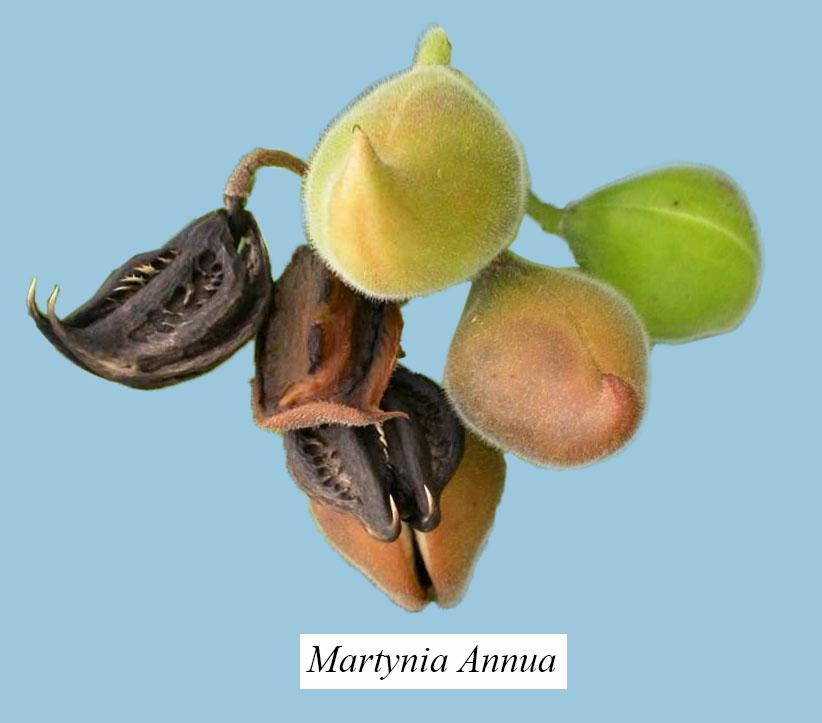
Seeds are beset with tiger's claws in Martynia. Martynia annua is also known as the tiger's claw or ice plant. It has a green color pod that is fleshy at first, but later it starts drying to a black woody capsule.
Additional Information: The plants in the Martyniaceae family are called "Devil's Claws" because of the 2-hooked form of their seed pods. The fruits of these plants are well adapted for dispersal by large mammals. This plant is provided with hook-like structures that are effective in their dispersal.
Basic Characteristics of Martynia plant - This plant is erect, somewhat shrubby, and is an annual plant, which is about 1 meter tall, covered with glandular hairs, and has ovate, mucilaginous leaves which are 8–20 centimeters wide and 6–19 centimeters long. The leaves are opposite and have red petioles. They resemble sticky rhubarb. Its flowers are somewhat pink in color and tubular and have nectar guides and purple spots. Fruits become somewhat black in color when ripe and have hooked spines at the tip, lending its name "cat's claw" or "tiger's claw". They usually stick with animal fur and eventually the seeds fall out because the fruit gets crushed by the animal's feet.
So, the correct answer is ‘Martynia’.
Note: The Martynia plant is used in many ways. It is usually used in making beads and other native ornaments. It is also used and applied for numerous supposed treatments in Ayurveda and Siddha folk medicine.
Complete answer:
Seeds are beset with tiger's claws in Martynia. Martynia annua is also known as the tiger's claw or ice plant. It has a green color pod that is fleshy at first, but later it starts drying to a black woody capsule.
Additional Information: The plants in the Martyniaceae family are called "Devil's Claws" because of the 2-hooked form of their seed pods. The fruits of these plants are well adapted for dispersal by large mammals. This plant is provided with hook-like structures that are effective in their dispersal.
Basic Characteristics of Martynia plant - This plant is erect, somewhat shrubby, and is an annual plant, which is about 1 meter tall, covered with glandular hairs, and has ovate, mucilaginous leaves which are 8–20 centimeters wide and 6–19 centimeters long. The leaves are opposite and have red petioles. They resemble sticky rhubarb. Its flowers are somewhat pink in color and tubular and have nectar guides and purple spots. Fruits become somewhat black in color when ripe and have hooked spines at the tip, lending its name "cat's claw" or "tiger's claw". They usually stick with animal fur and eventually the seeds fall out because the fruit gets crushed by the animal's feet.
So, the correct answer is ‘Martynia’.
Note: The Martynia plant is used in many ways. It is usually used in making beads and other native ornaments. It is also used and applied for numerous supposed treatments in Ayurveda and Siddha folk medicine.
Recently Updated Pages
Master Class 11 English: Engaging Questions & Answers for Success

Master Class 11 Social Science: Engaging Questions & Answers for Success
Master Class 11 Maths: Engaging Questions & Answers for Success
Master Class 11 Biology: Engaging Questions & Answers for Success
Master Class 11 Physics: Engaging Questions & Answers for Success
Master Class 11 Chemistry: Engaging Questions & Answers for Success
Trending doubts
One Metric ton is equal to kg A 10000 B 1000 C 100 class 11 physics CBSE
Difference Between Prokaryotic Cells and Eukaryotic Cells
Two of the body parts which do not appear in MRI are class 11 biology CBSE
Find the value of the expression given below sin 30circ class 11 maths CBSE
Draw a diagram of a plant cell and label at least eight class 11 biology CBSE
10 examples of friction in our daily life