




Secondary nucleus present in the middle of embryo sac is
(a) Tetraploid
(b) Triploid
(c) Diploid
(d) Haploid
Answer
 Verified
613.2k+ views
Hint: The female gametophyte is also known as megagametophyte that participates in double fertilization in angiosperms.
Complete answer: In the middle, the cell contains two polar nuclei which frequently fuse to make single diploid secondary or fusion nuclei. Thus all the cells of the embryo sac are haploid except the central cell which becomes diploid due to the fusion of polar nuclei.
Additional information: The embryo sac is an oval multicellular structure. It is covered over by a skinny membrane derived from the parent megaspore wall. 1. The typical or Polygonum type of embryo sac contains 3 micropylar, 3 chalazal, and one central. 2. The three micropylar cells are collectively known as the egg apparatus. One cell is larger and is named egg or oosphere. It carries a central or micropylar vacuole and a nucleus towards the chalazal side. 3. The remaining two cells are called synergids or help cells. Each of them bears a filiform apparatus within the micropylar region, a lateral hook, chalazal vacuole, and a central nucleus. 4. The egg or oosphere represents the single female gamete of the embryo sac. 5. The synergids support in getting nutrients from the outer nucellar cells, direct the path of the pollen tube by their secretion, and function as shock absorbers while the penetration of the pollen tube within the embryo sac. 6. The three chalazal cells of the embryo sac are called antipodal cells. They are the vegetative cells of the embryo sac which can degenerate soon or participate in absorbing nourishment from the encompassing nucellar cells. 7. The central cell is the largest cell of the embryo sac. It contains a highly vacuolated cytoplasm that is rich in reserve food and Golgi bodies. 8. In the middle, the cell contains two polar nuclei which often fuse to form a single diploid secondary or fusion nucleus.
So, the correct answer is ‘Diploid’.
Note: The male gametophytes, or microgametophytes, that participate in double fertilization are contained within pollen grains. They develop inside the microsporangia, or pollen sacs, of the anthers on the stamens.
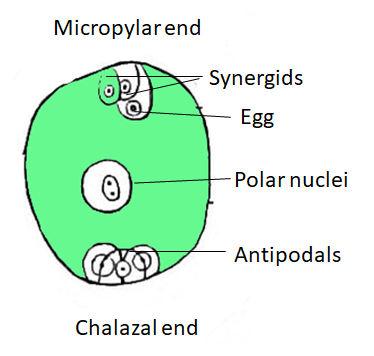
Complete answer: In the middle, the cell contains two polar nuclei which frequently fuse to make single diploid secondary or fusion nuclei. Thus all the cells of the embryo sac are haploid except the central cell which becomes diploid due to the fusion of polar nuclei.
Additional information: The embryo sac is an oval multicellular structure. It is covered over by a skinny membrane derived from the parent megaspore wall. 1. The typical or Polygonum type of embryo sac contains 3 micropylar, 3 chalazal, and one central. 2. The three micropylar cells are collectively known as the egg apparatus. One cell is larger and is named egg or oosphere. It carries a central or micropylar vacuole and a nucleus towards the chalazal side. 3. The remaining two cells are called synergids or help cells. Each of them bears a filiform apparatus within the micropylar region, a lateral hook, chalazal vacuole, and a central nucleus. 4. The egg or oosphere represents the single female gamete of the embryo sac. 5. The synergids support in getting nutrients from the outer nucellar cells, direct the path of the pollen tube by their secretion, and function as shock absorbers while the penetration of the pollen tube within the embryo sac. 6. The three chalazal cells of the embryo sac are called antipodal cells. They are the vegetative cells of the embryo sac which can degenerate soon or participate in absorbing nourishment from the encompassing nucellar cells. 7. The central cell is the largest cell of the embryo sac. It contains a highly vacuolated cytoplasm that is rich in reserve food and Golgi bodies. 8. In the middle, the cell contains two polar nuclei which often fuse to form a single diploid secondary or fusion nucleus.
So, the correct answer is ‘Diploid’.
Note: The male gametophytes, or microgametophytes, that participate in double fertilization are contained within pollen grains. They develop inside the microsporangia, or pollen sacs, of the anthers on the stamens.
Recently Updated Pages
Master Class 11 Social Science: Engaging Questions & Answers for Success

Master Class 11 Physics: Engaging Questions & Answers for Success
Master Class 11 Maths: Engaging Questions & Answers for Success
Master Class 11 Economics: Engaging Questions & Answers for Success
Master Class 11 Computer Science: Engaging Questions & Answers for Success
Master Class 11 Chemistry: Engaging Questions & Answers for Success
Trending doubts
One Metric ton is equal to kg A 10000 B 1000 C 100 class 11 physics CBSE
There are 720 permutations of the digits 1 2 3 4 5 class 11 maths CBSE
1 Quintal is equal to a 110 kg b 10 kg c 100kg d 1000 class 11 physics CBSE
State and prove Bernoullis theorem class 11 physics CBSE
Difference Between Prokaryotic Cells and Eukaryotic Cells
Discuss the various forms of bacteria class 11 biology CBSE