




Sebaceous glands produce oily secretion called ______.
Answer
 Verified
567.9k+ views
Hint: The sebaceous gland is a microscopic exocrine gland present on the skin. It opens into a hair follicle to secrete an oily or waxy matter which helps in the lubrication of hair and skin of mammals. The composition of the waxy matter varies across species.
Complete answer:
Sebum is the waxy or oily substance secreted by the sebaceous gland in humans. It is primarily composed of triglycerides (≈$41\%$), wax esters (≈$26\%$), squalene (≈$12\%$) and free fatty acids (≈$16\%$). Wax esters and squalene are the substances that are unique to sebum and are not produced anywhere else in the body. Sebum is odourless but when broken down by bacteria it can produce strong odours. Due to its unique composition, sebum seals in the moisture and prevents the skin from becoming over dry. It also has several properties, making it the body’s first defence against any kind of infection. Overproduction, however, will cause skin problems like acne, oily skin, chronic itchiness and skin irritation.
The sebum is secreted through a process called holocrine secretion. The sebaceous glands produce lipids, which remain inside the glands itself for about a week. Then, the sac erupts, allowing the sebum to flow freely into the hair follicle which then wicks the oil onto the skin to lubricate and protect it.
The release of sebum throughout the body supports the health of the skin in a number of ways:
Hydration: Sebum is essential for pliable skin. The levels of lipids, though, have to be properly balanced to prevent skin irritation.
Antibacterial protection: Lipids create a slightly acidic film cover over the skin—a pH of 4.5 to 6.0. This helps in defending the body against bacteria, viruses and other microbes.
Antifungal protection: Sebum prevents fungal infections like ringworm.
Sun protection: Squalene, a constituent of sebum, protects the skin against sunburn and other damages caused by ultraviolet (UV) rays.
Note:
Sex steroids are known to affect the rate of sebum secretion. Androgens such as testosterone have reportedly shown to stimulate sebum secretion and estrogens have been shown to inhibit the same. Besides protecting the skin, sebum also seems to support heart health since it eliminates excess lipids and cholesterol, which block arteries and thereby cause heart diseases.
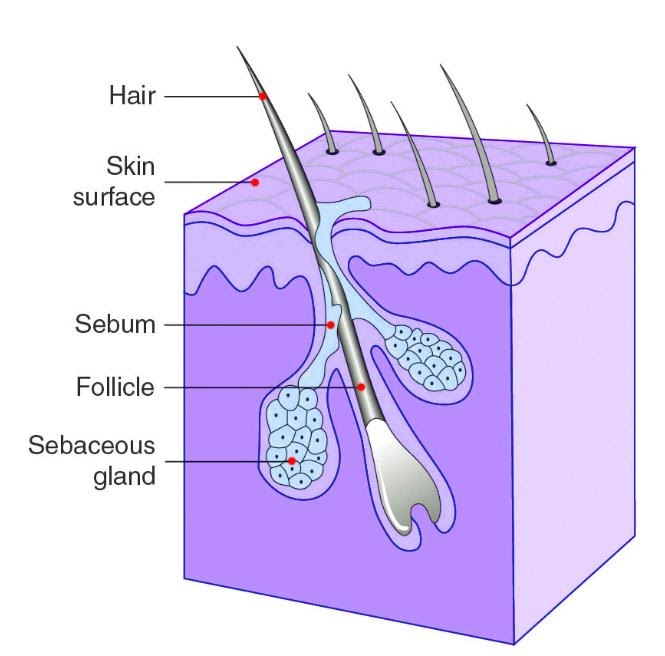
Figure: Sebaceous gland
Complete answer:
Sebum is the waxy or oily substance secreted by the sebaceous gland in humans. It is primarily composed of triglycerides (≈$41\%$), wax esters (≈$26\%$), squalene (≈$12\%$) and free fatty acids (≈$16\%$). Wax esters and squalene are the substances that are unique to sebum and are not produced anywhere else in the body. Sebum is odourless but when broken down by bacteria it can produce strong odours. Due to its unique composition, sebum seals in the moisture and prevents the skin from becoming over dry. It also has several properties, making it the body’s first defence against any kind of infection. Overproduction, however, will cause skin problems like acne, oily skin, chronic itchiness and skin irritation.
The sebum is secreted through a process called holocrine secretion. The sebaceous glands produce lipids, which remain inside the glands itself for about a week. Then, the sac erupts, allowing the sebum to flow freely into the hair follicle which then wicks the oil onto the skin to lubricate and protect it.
The release of sebum throughout the body supports the health of the skin in a number of ways:
Hydration: Sebum is essential for pliable skin. The levels of lipids, though, have to be properly balanced to prevent skin irritation.
Antibacterial protection: Lipids create a slightly acidic film cover over the skin—a pH of 4.5 to 6.0. This helps in defending the body against bacteria, viruses and other microbes.
Antifungal protection: Sebum prevents fungal infections like ringworm.
Sun protection: Squalene, a constituent of sebum, protects the skin against sunburn and other damages caused by ultraviolet (UV) rays.
Note:
Sex steroids are known to affect the rate of sebum secretion. Androgens such as testosterone have reportedly shown to stimulate sebum secretion and estrogens have been shown to inhibit the same. Besides protecting the skin, sebum also seems to support heart health since it eliminates excess lipids and cholesterol, which block arteries and thereby cause heart diseases.
Figure: Sebaceous gland
Recently Updated Pages
The given figure shows two endocrine glands marked class 11 biology NEET_UG

Match columnI with columnII and select the correct class 11 biology NEET
Match column I with column II and select the correct class 11 biology NEET_UG
Which floral family has left 9 right + 1 arrangement class 11 biology NEET_UG
Which is not a variety of sheep A Lohi B Beetal C Nellore class 11 biology NEET_UG
Match column I with column II and select the correct class 11 biology NEET_UG
Trending doubts
Difference Between Prokaryotic Cells and Eukaryotic Cells
One Metric ton is equal to kg A 10000 B 1000 C 100 class 11 physics CBSE
Two of the body parts which do not appear in MRI are class 11 biology CBSE
10 examples of friction in our daily life
Draw a diagram of nephron and explain its structur class 11 biology CBSE
Draw a diagram of a plant cell and label at least eight class 11 biology CBSE