




What is Saytzeff (Zaitser) rule? Explain elimination reaction in 2-bromopentane.
Answer
 Verified
602.1k+ views
Hint:You can use the Saytzeff (Zaitser) rule to determine the major product in the dehydrohalogenation reaction. You can carry out the dehydrohalogenation reaction when you heat an alkyl halide with alcoholic potassium hydroxide.
Complete answer:
When an alkyl halide is heated with aqueous potassium hydroxide solution, it undergoes substitution reaction to form an alcohol.
When an alkyl halide is heated with alcoholic potassium hydroxide solution, it undergoes elimination reaction to form an alkene.
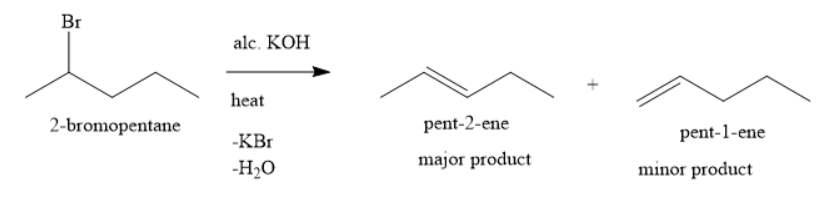
When you heat 2-bromopentane with alcoholic potassium hydroxide, you get a mixture of pent-1-ene and pent-2-ene. In this mixture of alkenes, one is the major product and the other is a minor product. You can identify the major product by applying the Saytzeff (Zaitser) rule. According to this rule, when you carry out the dehydrohalogenation reaction, the major product will be the more substituted alkene and the minor product will be less substituted carbon atom. Here more substituted alkenes means that the alkene, in which more number of alkyl groups are attached to the doubly bonded carbon atom and the less substituted alkenes means that the alkene, in which less number of alkyl groups are attached to the doubly bonded carbon atom.
Among pent-2-ene and pent-1-ene, the more substituted alkene is pent-2-ene. In pent-2-ene, each doubly bonded carbon atom has one alkyl substituent each. In pent-1-ene, one doubly bonded carbon atom has one alkyl substituent whereas other doubly bonded carbon atoms have zero alkyl substituent.
Pent-2-ene being the more substituted alkene is the major product whereas pent-1-ene being the less substituted alkene is the minor product.
Note:
If you use a bulky base, or if you have a bulky leaving group, then the elimination will take place according to Hofmann’s rule. Less substituted alkene will be the major product and more substituted alkene will be the minor product.
Complete answer:
When an alkyl halide is heated with aqueous potassium hydroxide solution, it undergoes substitution reaction to form an alcohol.
When an alkyl halide is heated with alcoholic potassium hydroxide solution, it undergoes elimination reaction to form an alkene.
When you heat 2-bromopentane with alcoholic potassium hydroxide, you get a mixture of pent-1-ene and pent-2-ene. In this mixture of alkenes, one is the major product and the other is a minor product. You can identify the major product by applying the Saytzeff (Zaitser) rule. According to this rule, when you carry out the dehydrohalogenation reaction, the major product will be the more substituted alkene and the minor product will be less substituted carbon atom. Here more substituted alkenes means that the alkene, in which more number of alkyl groups are attached to the doubly bonded carbon atom and the less substituted alkenes means that the alkene, in which less number of alkyl groups are attached to the doubly bonded carbon atom.
Among pent-2-ene and pent-1-ene, the more substituted alkene is pent-2-ene. In pent-2-ene, each doubly bonded carbon atom has one alkyl substituent each. In pent-1-ene, one doubly bonded carbon atom has one alkyl substituent whereas other doubly bonded carbon atoms have zero alkyl substituent.
Pent-2-ene being the more substituted alkene is the major product whereas pent-1-ene being the less substituted alkene is the minor product.
Note:
If you use a bulky base, or if you have a bulky leaving group, then the elimination will take place according to Hofmann’s rule. Less substituted alkene will be the major product and more substituted alkene will be the minor product.
Recently Updated Pages
Master Class 12 Economics: Engaging Questions & Answers for Success

Master Class 12 English: Engaging Questions & Answers for Success
Master Class 12 Social Science: Engaging Questions & Answers for Success
Master Class 12 Maths: Engaging Questions & Answers for Success
Master Class 12 Physics: Engaging Questions & Answers for Success
Master Class 9 General Knowledge: Engaging Questions & Answers for Success
Trending doubts
One Metric ton is equal to kg A 10000 B 1000 C 100 class 11 physics CBSE
Difference Between Prokaryotic Cells and Eukaryotic Cells
Two of the body parts which do not appear in MRI are class 11 biology CBSE
Find the value of the expression given below sin 30circ class 11 maths CBSE
1 ton equals to A 100 kg B 1000 kg C 10 kg D 10000 class 11 physics CBSE
Draw a diagram of nephron and explain its structur class 11 biology CBSE