



How do you round $3.86$ to the nearest tenth?
Answer
 Verified
478.8k+ views
Hint: Here we can note that the given is a decimal number and we need to round the given decimal number to the nearest tenth. Since we are asked to round off to the nearest tenth, we need to just look at the digit at the hundredth place and we need to come to a decision.
Complete step-by-step answer:
The given decimal number is $3.86$
We can note that the given decimal number contains two parts. They are the integer part $3$ to the left of the decimal point and the fractional part $86$ to the right of the decimal point.
When we are asked to round off the decimal numbers containing two fractional parts, we need to just make the two digits of the fractional part into one digit.
We need to just follow the two steps in rounding off the given decimal number $3.86$
a) We need to look at the last digit in the fractional part of the given number and if the last digit is less than $5$ , then we need to just remove the last digit of the fractional part.
b) Again we shall look at the last digit of the fractional part of the given decimal number and if the last digit is greater than or equal to $5$ , then we shall remove the second digit by adding $1$ to the first digit of the fractional part.
Now, we shall consider the given decimal number $3.86$
We need to look at the last digit of the fractional part. It is $6$ and hence the last digit of the fractional part is greater than $5$ .
So we need to just remove the last digit of the fractional part by adding $1$ to the first digit of the fractional part.
That is, we shall remove the digit $6$ by adding $1$ to $8$ of the fractional part.
Hence, we got $3.9$ and it is the required answer.
Note: Rounding a decimal number and an integer are different. So, we shall analyze whether the given number is decimal or not.
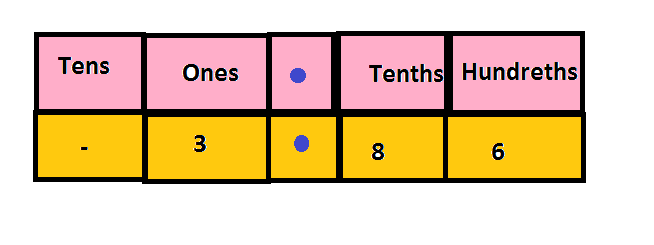
Before getting into the solution, we should be clear about the place value of the given decimal number. The place value of the given decimal number is given above. Now, we shall look at the digit at the hundredths place. If the digit is less than $5$, we need to just remove it. If the digit is greater than or equal to $5$, then we need to remove it by adding $1$ to the digits at the tenths.
Complete step-by-step answer:
The given decimal number is $3.86$
We can note that the given decimal number contains two parts. They are the integer part $3$ to the left of the decimal point and the fractional part $86$ to the right of the decimal point.
When we are asked to round off the decimal numbers containing two fractional parts, we need to just make the two digits of the fractional part into one digit.
We need to just follow the two steps in rounding off the given decimal number $3.86$
a) We need to look at the last digit in the fractional part of the given number and if the last digit is less than $5$ , then we need to just remove the last digit of the fractional part.
b) Again we shall look at the last digit of the fractional part of the given decimal number and if the last digit is greater than or equal to $5$ , then we shall remove the second digit by adding $1$ to the first digit of the fractional part.
Now, we shall consider the given decimal number $3.86$
We need to look at the last digit of the fractional part. It is $6$ and hence the last digit of the fractional part is greater than $5$ .
So we need to just remove the last digit of the fractional part by adding $1$ to the first digit of the fractional part.
That is, we shall remove the digit $6$ by adding $1$ to $8$ of the fractional part.
Hence, we got $3.9$ and it is the required answer.
Note: Rounding a decimal number and an integer are different. So, we shall analyze whether the given number is decimal or not.
Before getting into the solution, we should be clear about the place value of the given decimal number. The place value of the given decimal number is given above. Now, we shall look at the digit at the hundredths place. If the digit is less than $5$, we need to just remove it. If the digit is greater than or equal to $5$, then we need to remove it by adding $1$ to the digits at the tenths.

Recently Updated Pages
Master Class 7 English: Engaging Questions & Answers for Success

Master Class 7 Maths: Engaging Questions & Answers for Success
Master Class 7 Science: Engaging Questions & Answers for Success
Class 7 Question and Answer - Your Ultimate Solutions Guide
Master Class 9 General Knowledge: Engaging Questions & Answers for Success
Master Class 9 Social Science: Engaging Questions & Answers for Success
Trending doubts
The value of 6 more than 7 is A 1 B 1 C 13 D 13 class 7 maths CBSE
Convert 200 Million dollars in rupees class 7 maths CBSE
List of coprime numbers from 1 to 100 class 7 maths CBSE
AIM To prepare stained temporary mount of onion peel class 7 biology CBSE
The plural of Chief is Chieves A True B False class 7 english CBSE
Write a letter to the editor of the national daily class 7 english CBSE