




Roof of the third ventricle is:
A. Hypothalamus
B. Epithalamus
C. Corpus striatum
D. Pallium
Answer
 Verified
642k+ views
Hint: Cavities of the brain are known as ventricles filled with cerebrospinal fluid (CSF). CSF formation is by secretion of plasma.
Complete answer
A. Hypothalamus:
(i) It is a part of the forebrain. It lies at the base of thalamus. A cross like structure is found on anterior surface by hypothalamus called optic chiasma. It carries optic impulses revived from eyes to the cerebral hemisphere Animals become blind if this part is destroyed by chance.
(ii) Pituitary body is attached to the middle part of the hypothalamus by an infundibulum.
(iii) Hypothalamus controls centers for hunger, thirst, fatigue, sleep, sweating body temperature and emotions.
B. Epithalamus: Diencephalon encloses a slit-like cavity, the third ventricle. The thin roof of this cavity is known as the epithalamus, the thick right and left sides as the thalamic, and the floor as the epithalamus. Epithalamus is not formed of nervous tissue. It consists of pia mater only.
C. Corpus striatum: The basal ganglia consists of two main structures, the corpus striatum and red nucleus. They maintain muscle tone.
D. Pallium: It refers to the layers of grey and white matter that cover the upper surface of the cerebrum in vertebrates.
Hence the correct answer is option B, Epithalamus.
Note: Brain of a human is divided into three parts: forebrain, midbrain and Hindbrain.
(i) Forebrain: It forms the greater part of the brain. It consists of three regions.
(a) Cerebrum (Cerebral hemisphere)
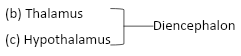
(ii) Each cerebral hemisphere encloses a cavity called lateral ventricle. The lateral ventricles, also called first and second ventricles, also called first and second ventricles, are closed in front but open behind into the third ventricle of diencephalon by a common aperture called foramen of Monro.
Complete answer
A. Hypothalamus:
(i) It is a part of the forebrain. It lies at the base of thalamus. A cross like structure is found on anterior surface by hypothalamus called optic chiasma. It carries optic impulses revived from eyes to the cerebral hemisphere Animals become blind if this part is destroyed by chance.
(ii) Pituitary body is attached to the middle part of the hypothalamus by an infundibulum.
(iii) Hypothalamus controls centers for hunger, thirst, fatigue, sleep, sweating body temperature and emotions.
B. Epithalamus: Diencephalon encloses a slit-like cavity, the third ventricle. The thin roof of this cavity is known as the epithalamus, the thick right and left sides as the thalamic, and the floor as the epithalamus. Epithalamus is not formed of nervous tissue. It consists of pia mater only.
C. Corpus striatum: The basal ganglia consists of two main structures, the corpus striatum and red nucleus. They maintain muscle tone.
D. Pallium: It refers to the layers of grey and white matter that cover the upper surface of the cerebrum in vertebrates.
Hence the correct answer is option B, Epithalamus.
Note: Brain of a human is divided into three parts: forebrain, midbrain and Hindbrain.
(i) Forebrain: It forms the greater part of the brain. It consists of three regions.
(a) Cerebrum (Cerebral hemisphere)
(ii) Each cerebral hemisphere encloses a cavity called lateral ventricle. The lateral ventricles, also called first and second ventricles, also called first and second ventricles, are closed in front but open behind into the third ventricle of diencephalon by a common aperture called foramen of Monro.
Recently Updated Pages
Basicity of sulphurous acid and sulphuric acid are

Master Class 11 English: Engaging Questions & Answers for Success
Master Class 11 Physics: Engaging Questions & Answers for Success
Master Class 11 Computer Science: Engaging Questions & Answers for Success
Master Class 11 Chemistry: Engaging Questions & Answers for Success
Master Class 11 Social Science: Engaging Questions & Answers for Success
Trending doubts
Draw a diagram of a plant cell and label at least eight class 11 biology CBSE
Proton was discovered by A Thomson B Rutherford C Chadwick class 11 chemistry CBSE
What is the purity of pure gold in carat class 11 chemistry CBSE
Can anyone list 10 advantages and disadvantages of friction
Lysosomes are known as suicidal bags of cell why class 11 biology CBSE
Derive the equation of motion by the calculus method class 11 physics CBSE