




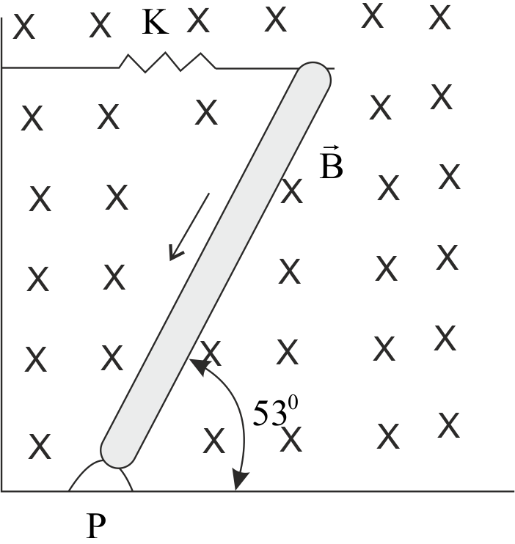
When the rod is in equilibrium and makes an angle of $ {53^ \circ } $ with the floor,is the spring stretched or compressed?
Answer
 Verified
558k+ views
Hint: It is given that the rod is under the influence of spring force and is said to be subtending an angle of $ {53^ \circ } $ from the ground. When there’s a torque acting on the rod in clockwise direction find out what will happen to the rod and the effect of spring on the rod.
Complete step by step solution
The rod is said to be under the influence of the constant magnetic field of intensity B. This causes the rod to rotate along the anti-clockwise direction with an angular velocity .Now, the emf induced on the rod is given as ,
$ \Rightarrow e = Blv $
Now, torque of the rod can be calculated by assuming an infinitesimal element at a distance of r away from point p on the rod. The torque rotates the rod about the point , therefore this torque is equal to the torque exerted by the magnetic field on the rod.
This is given as ,
$ \Rightarrow \tau = \int\limits_0^l {r \times i \times dr \times B} $
Where r is the distance between the torque acting point and the infinitesimal element, B is the magnitude of the magnetic field and i is the induced current due to magnetic field. On solving, we get the value as,
$ \Rightarrow \tau = \dfrac{{iB{l^2}}}{2} $
As the torque on point P is towards the clockwise direction, the rod rotates in the same way causing the spring to extend. The torque acting on the rod influenced by the spring is said to be in anticlockwise direction thus facilitating the extension.
Hence, the rod expands.
Note:
A conductor under the influence of a magnetic field will experience a torque that will align the current loop with the magnetic field. Torque exerted by magnetic force is given as the product of magnetic field intensity , the current flowing through the coil/rod and the length of the rod.
Complete step by step solution
The rod is said to be under the influence of the constant magnetic field of intensity B. This causes the rod to rotate along the anti-clockwise direction with an angular velocity .Now, the emf induced on the rod is given as ,
$ \Rightarrow e = Blv $
Now, torque of the rod can be calculated by assuming an infinitesimal element at a distance of r away from point p on the rod. The torque rotates the rod about the point , therefore this torque is equal to the torque exerted by the magnetic field on the rod.
This is given as ,
$ \Rightarrow \tau = \int\limits_0^l {r \times i \times dr \times B} $
Where r is the distance between the torque acting point and the infinitesimal element, B is the magnitude of the magnetic field and i is the induced current due to magnetic field. On solving, we get the value as,
$ \Rightarrow \tau = \dfrac{{iB{l^2}}}{2} $
As the torque on point P is towards the clockwise direction, the rod rotates in the same way causing the spring to extend. The torque acting on the rod influenced by the spring is said to be in anticlockwise direction thus facilitating the extension.
Hence, the rod expands.
Note:
A conductor under the influence of a magnetic field will experience a torque that will align the current loop with the magnetic field. Torque exerted by magnetic force is given as the product of magnetic field intensity , the current flowing through the coil/rod and the length of the rod.
Recently Updated Pages
Master Class 11 Computer Science: Engaging Questions & Answers for Success

Master Class 11 Business Studies: Engaging Questions & Answers for Success
Master Class 11 Economics: Engaging Questions & Answers for Success
Master Class 11 English: Engaging Questions & Answers for Success
Master Class 11 Maths: Engaging Questions & Answers for Success
Master Class 11 Biology: Engaging Questions & Answers for Success
Trending doubts
One Metric ton is equal to kg A 10000 B 1000 C 100 class 11 physics CBSE
There are 720 permutations of the digits 1 2 3 4 5 class 11 maths CBSE
Discuss the various forms of bacteria class 11 biology CBSE
Draw a diagram of a plant cell and label at least eight class 11 biology CBSE
State the laws of reflection of light
Explain zero factorial class 11 maths CBSE