




How do rhizobium bacteria increase the fertility of soil?
Answer
 Verified
605.4k+ views
Hint:The basic biological mechanism and the early stage in the nitrogen cycle is nitrogen fixation. During this process, some bacterial species such as Rhizobium, Azotobacter, etc. convert the free nitrogen present in the atmosphere into ammonia (another source of nitrogen), and the entire process is carried out by natural phenomena.
Complete answer:
Using the following steps, symbiotic nitrogen fixation can be explained:
I. Nodule formation: This requires several interactions between the Rhizobium free-living soil and the target plant roots. On the bacterial surface, the nod factors bind to the lectin proteins found on the surface of root hair. Via the root fur, the infection thread filled with dividing Rhizobia elongates and then branches to enter various cortical cells. To develop a nodule, the affected cortical cells divide.
II. Nitrogen fixation mechanism: The nodule acts as the Nitrogen-fixation site. It contains all the bio-chemicals required, such as leghaemoglobin and nitrogenase, the enzyme complex. Nitrogenase catalyzes the conversion of dinitrogen to two molecules of ammonia in the atmosphere. Nitrogenase-generated ammonia is immediately protonated to form ammonium ion. As ammonium ion is toxic to plants, it is easily used to synthesize amino acids near the generation site. Synthesis of amino acids is carried out by three processes: catalytic amination, reductive animation, and transamination.
The nitrogen fixation by rhizobium can be explained diagrammatically as:
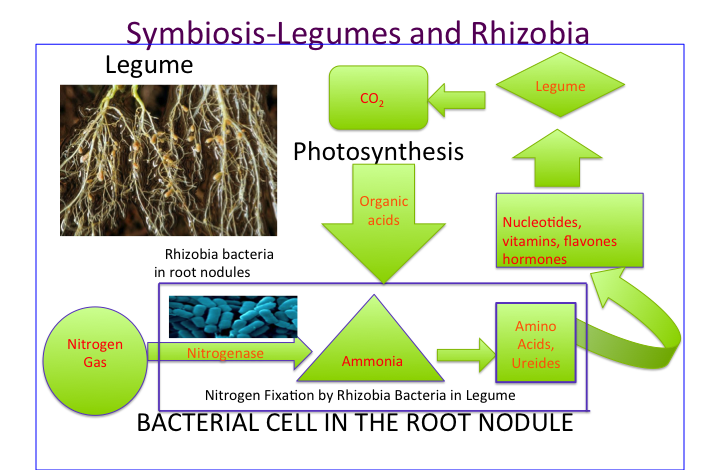
Note: In a symbiotic relationship with one another, rhizobium and leguminous plants live together. In this, all species take advantage of each other. Atmospheric nitrogen is fixed by the bacteria and made available to the plants. And on the other hand, in the form of organic acids, Rhizobium receives nutrients from the host plant.
Complete answer:
Using the following steps, symbiotic nitrogen fixation can be explained:
I. Nodule formation: This requires several interactions between the Rhizobium free-living soil and the target plant roots. On the bacterial surface, the nod factors bind to the lectin proteins found on the surface of root hair. Via the root fur, the infection thread filled with dividing Rhizobia elongates and then branches to enter various cortical cells. To develop a nodule, the affected cortical cells divide.
II. Nitrogen fixation mechanism: The nodule acts as the Nitrogen-fixation site. It contains all the bio-chemicals required, such as leghaemoglobin and nitrogenase, the enzyme complex. Nitrogenase catalyzes the conversion of dinitrogen to two molecules of ammonia in the atmosphere. Nitrogenase-generated ammonia is immediately protonated to form ammonium ion. As ammonium ion is toxic to plants, it is easily used to synthesize amino acids near the generation site. Synthesis of amino acids is carried out by three processes: catalytic amination, reductive animation, and transamination.
The nitrogen fixation by rhizobium can be explained diagrammatically as:
Note: In a symbiotic relationship with one another, rhizobium and leguminous plants live together. In this, all species take advantage of each other. Atmospheric nitrogen is fixed by the bacteria and made available to the plants. And on the other hand, in the form of organic acids, Rhizobium receives nutrients from the host plant.
Recently Updated Pages
Master Class 12 Business Studies: Engaging Questions & Answers for Success

Master Class 12 Chemistry: Engaging Questions & Answers for Success
Master Class 12 Biology: Engaging Questions & Answers for Success
Class 12 Question and Answer - Your Ultimate Solutions Guide
Master Class 9 General Knowledge: Engaging Questions & Answers for Success
Master Class 9 Maths: Engaging Questions & Answers for Success
Trending doubts
Which are the Top 10 Largest Countries of the World?
Draw a labelled sketch of the human eye class 12 physics CBSE
Name the crygenes that control cotton bollworm and class 12 biology CBSE
Differentiate between homogeneous and heterogeneous class 12 chemistry CBSE
In a transcription unit the promoter is said to be class 12 biology CBSE
Sulphuric acid is known as the king of acids State class 12 chemistry CBSE