




Resultant of two vectors $\vec A = 3\hat i + 4\hat j$ and $\vec B = \alpha \hat i + 3\hat j$ lies along the Y – axis. The value of $\alpha $ is
A) 3
B) -3
C) 4
D) -4
Answer
 Verified
633.3k+ views
Hint: The resultant of the given two vectors is given by their sum. If the resultant lies along y – axis, its component along x – axis will be zero. Using this information, we can find the unknown value of $\alpha $.
Complete Step by step answer:The given vectors are:
$\vec A = 3\hat i + 4\hat j$ and
$\vec B = \alpha \hat i + 3\hat j$
Now, the resultant $\left( {\vec R} \right)$ of these vectors is given by their sum:
$\vec R = \vec A + \vec B$
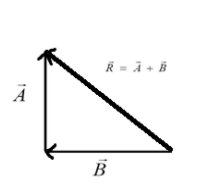
Substituting the values, we get:
$
\vec R = \left( {3\hat i + 4\hat j} \right) + \left( {\alpha \hat i + 3\hat j} \right) \\
\Rightarrow \vec R = \left( {3 + \alpha } \right)\hat i + \left( {4 + 3} \right)\hat j \\
\Rightarrow \vec R = \left( {3 + \alpha } \right)\hat i + 7\hat j \\
$
Where $\hat i$ represents x – axis and $\hat j$ represents y – axis.
According to the question, the resultant of these vectors lies along y- axis, which means the component along x - axis will be equal to zero.
$
\Rightarrow 3 + \alpha = 0 \\
\alpha = - 3 \\
$ [component along x – axis]
Therefore, the unknown value of $\alpha $ in the vector B is -3 and the correct option is B.
Additional information: Vectors are inclined at certain angles which give their direction. The starting point is called tail and ending as head.
Velocity and force are most commonly used vector quantities.
The vector with magnitude 1 is called unit vector and 0 magnitude is called zero vector.
The magnitude of the vector can be calculated either by the Pythagoras theorem or directly taking the square root of the sum of squares of the components along the respective axes.
Note: If two vectors have the same direction, the resultant of these vectors will be in the opposite direction when represented with the help of line segments.
$\hat i$ and $\hat j$ are called unit vectors (magnitude 1) and are used to represent the direction of vectors along the x and y- axis respectively.
The quantities that have both direction and the magnitude are called vectors and they are represented by an arrow over the head.
Complete Step by step answer:The given vectors are:
$\vec A = 3\hat i + 4\hat j$ and
$\vec B = \alpha \hat i + 3\hat j$
Now, the resultant $\left( {\vec R} \right)$ of these vectors is given by their sum:
$\vec R = \vec A + \vec B$
Substituting the values, we get:
$
\vec R = \left( {3\hat i + 4\hat j} \right) + \left( {\alpha \hat i + 3\hat j} \right) \\
\Rightarrow \vec R = \left( {3 + \alpha } \right)\hat i + \left( {4 + 3} \right)\hat j \\
\Rightarrow \vec R = \left( {3 + \alpha } \right)\hat i + 7\hat j \\
$
Where $\hat i$ represents x – axis and $\hat j$ represents y – axis.
According to the question, the resultant of these vectors lies along y- axis, which means the component along x - axis will be equal to zero.
$
\Rightarrow 3 + \alpha = 0 \\
\alpha = - 3 \\
$ [component along x – axis]
Therefore, the unknown value of $\alpha $ in the vector B is -3 and the correct option is B.
Additional information: Vectors are inclined at certain angles which give their direction. The starting point is called tail and ending as head.
Velocity and force are most commonly used vector quantities.
The vector with magnitude 1 is called unit vector and 0 magnitude is called zero vector.
The magnitude of the vector can be calculated either by the Pythagoras theorem or directly taking the square root of the sum of squares of the components along the respective axes.
Note: If two vectors have the same direction, the resultant of these vectors will be in the opposite direction when represented with the help of line segments.
$\hat i$ and $\hat j$ are called unit vectors (magnitude 1) and are used to represent the direction of vectors along the x and y- axis respectively.
The quantities that have both direction and the magnitude are called vectors and they are represented by an arrow over the head.
Recently Updated Pages
Master Class 11 Social Science: Engaging Questions & Answers for Success

Master Class 11 English: Engaging Questions & Answers for Success
Master Class 11 Accountancy: Engaging Questions & Answers for Success
Master Class 11 Physics: Engaging Questions & Answers for Success
Master Class 11 Computer Science: Engaging Questions & Answers for Success
Master Class 11 Business Studies: Engaging Questions & Answers for Success
Trending doubts
Find the value of the expression given below sin 30circ class 11 maths CBSE
One Metric ton is equal to kg A 10000 B 1000 C 100 class 11 physics CBSE
10 examples of friction in our daily life
Draw a diagram of nephron and explain its structur class 11 biology CBSE
The teeth used for biting and cutting food are called class 11 biology CBSE
Proton was discovered by A Thomson B Rutherford C Chadwick class 11 chemistry CBSE