




What is the resultant of three coplanar forces: \[300N\] at \[0^\circ \] , \[400N\] at \[30^\circ \] , \[400N\] at \[150^\circ \] ?
Answer
 Verified
490.2k+ views
Hint: For a two-dimensional vector, it can be split into two components. If the vector is in the x=y plane, it can be split into its x and y components. Considering vector $A$ having two components, its x component will be \[{A_x} = A\cos \theta \] and the y component will be \[{A_y} = A\sin \theta \].
Formulas used:
\[A = {\left( {A\sin \theta } \right)^2} + {\left( {A\cos \theta } \right)^2}\]
Addition of two vectors $a$ and $b$ are,
\[\sqrt {{a^2} + {b^2} + ab\cos \theta } \]
where \[\theta \] is the angle between the two vectors.
Complete step by step answer:
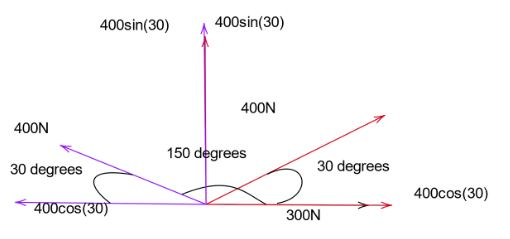
Let us consider three vectors as shown in the figure above. Let us assume their names to be their colors, black, red and blue. Black is not split into its respective components because it is aligned with the x-axis. The value of black is \[300N\].
Red is split into two components as shown, \[400\sin \left( {30} \right)\] and \[400\cos \left( {30} \right)\]. Blue is also split into two components but, since blue is closer to the negative x-axis, we take \[\left( {180 - \theta } \right)\] instead of \[\theta \]. Now the $x$ component of red and $x$ component of blue gets canceled as they are of equal magnitude but are in the opposite direction. Leaving us with
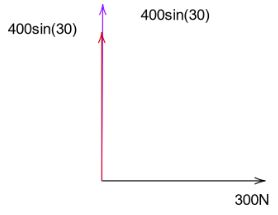
The two vectors each of value \[400\sin \left( {30} \right)\] get added up to \[2 \times 400\sin (30)\]. Since both of the vectors are in the same direction, we directly add and resulting in a vector in the y-direction whose magnitude will be: \[400N\]
(Since the value of \[\sin (30) = \left( {\dfrac{1}{2}} \right)\] and \[2 \times 400 = 800\] )
Now we are left with two vectors, one with a magnitude of \[300N\] in the direction of the x-axis and the other with a magnitude of \[400N\] along the direction of the y axis.The resultant can be found out using the formula:
\[\sqrt {{a^2} + {b^2} + ab\cos \theta } \]
The resultant of the addition will be:
\[\sqrt {{{300}^2} + {{400}^2} + 300 \times 400 \times \cos (90)} = 500N\]
Therefore, the resultant of three coplanar forces: \[300N\] at \[0^\circ \] , \[400N\] at \[30^\circ \] , \[400N\] at \[150^\circ \] will be \[500N\].
Note: The splitting of the forces into their respective components is very important.The cancellation of the components having equal magnitude but in the opposite direction must be carried properly. This is done because the values are equal but in the opposite directions. Any vector can be resolved into an infinite number of components, but we resolve it into the rectangular components only to form simpler equations for the sake of our convenience.
Formulas used:
\[A = {\left( {A\sin \theta } \right)^2} + {\left( {A\cos \theta } \right)^2}\]
Addition of two vectors $a$ and $b$ are,
\[\sqrt {{a^2} + {b^2} + ab\cos \theta } \]
where \[\theta \] is the angle between the two vectors.
Complete step by step answer:
Let us consider three vectors as shown in the figure above. Let us assume their names to be their colors, black, red and blue. Black is not split into its respective components because it is aligned with the x-axis. The value of black is \[300N\].
Red is split into two components as shown, \[400\sin \left( {30} \right)\] and \[400\cos \left( {30} \right)\]. Blue is also split into two components but, since blue is closer to the negative x-axis, we take \[\left( {180 - \theta } \right)\] instead of \[\theta \]. Now the $x$ component of red and $x$ component of blue gets canceled as they are of equal magnitude but are in the opposite direction. Leaving us with
The two vectors each of value \[400\sin \left( {30} \right)\] get added up to \[2 \times 400\sin (30)\]. Since both of the vectors are in the same direction, we directly add and resulting in a vector in the y-direction whose magnitude will be: \[400N\]
(Since the value of \[\sin (30) = \left( {\dfrac{1}{2}} \right)\] and \[2 \times 400 = 800\] )
Now we are left with two vectors, one with a magnitude of \[300N\] in the direction of the x-axis and the other with a magnitude of \[400N\] along the direction of the y axis.The resultant can be found out using the formula:
\[\sqrt {{a^2} + {b^2} + ab\cos \theta } \]
The resultant of the addition will be:
\[\sqrt {{{300}^2} + {{400}^2} + 300 \times 400 \times \cos (90)} = 500N\]
Therefore, the resultant of three coplanar forces: \[300N\] at \[0^\circ \] , \[400N\] at \[30^\circ \] , \[400N\] at \[150^\circ \] will be \[500N\].
Note: The splitting of the forces into their respective components is very important.The cancellation of the components having equal magnitude but in the opposite direction must be carried properly. This is done because the values are equal but in the opposite directions. Any vector can be resolved into an infinite number of components, but we resolve it into the rectangular components only to form simpler equations for the sake of our convenience.
Recently Updated Pages
Master Class 11 Computer Science: Engaging Questions & Answers for Success

Master Class 11 Business Studies: Engaging Questions & Answers for Success
Master Class 11 Economics: Engaging Questions & Answers for Success
Master Class 11 English: Engaging Questions & Answers for Success
Master Class 11 Maths: Engaging Questions & Answers for Success
Master Class 11 Biology: Engaging Questions & Answers for Success
Trending doubts
One Metric ton is equal to kg A 10000 B 1000 C 100 class 11 physics CBSE
There are 720 permutations of the digits 1 2 3 4 5 class 11 maths CBSE
Discuss the various forms of bacteria class 11 biology CBSE
Draw a diagram of a plant cell and label at least eight class 11 biology CBSE
State the laws of reflection of light
Explain zero factorial class 11 maths CBSE