




Respiratory surface of animals must always be moist. Why?
Answer
 Verified
502.8k+ views
Hint: Exchange of gases occurs in both plants and animals. For such exchange to occur, animals have a respiratory system which is made up of particular organs which performs tasks specific to the process of respiration.
Complete answer:
Gas exchange takes place on the respiratory surface which usually includes the gills, trachea, lungs, etc. Alveoli and alveolar blood capillaries lead to the exchange of gases in the lungs.
Image showing respiratory system
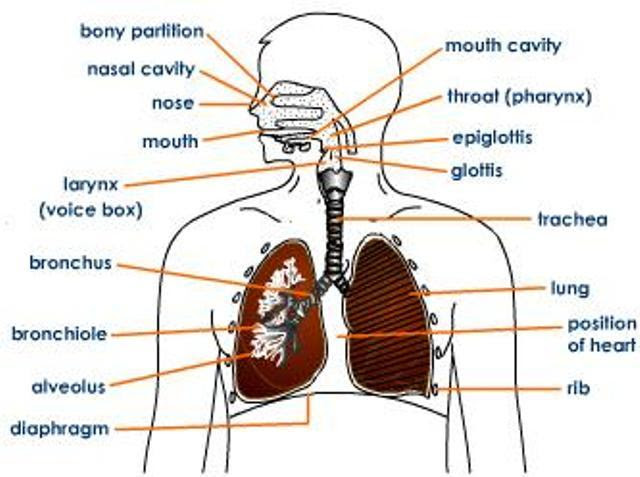
During the process of breathing in animals, which is termed as aerobic respiration, an exchange of gaseous components is conducted where the carbon dioxide leaves the cell and oxygen enters the system. By diffusing gases over their cell membrane, single-celled organisms can diffuse gas directly across their cell membrane.
But by diffusing gas across the outer surface, large animals are unable to sustain their gas exchange. Thin, moist epithelial cells cover the respiratory surface, which allows oxygen and carbon dioxide to get exchanged. Therefore, respiratory surfaces must be wet for these gases to cross cell membranes.
Note:
Humans and other living beings benefit from the respiratory system, which consists of a network of organs and tissues that let them breathe.
A human body's airways, lungs, and blood arteries are part of this system as shown in the image above. The respiratory system also includes the lungs' muscles. These components work together to transport oxygen throughout the body and remove waste gases such as carbon dioxide from the bloodstream.
Complete answer:
Gas exchange takes place on the respiratory surface which usually includes the gills, trachea, lungs, etc. Alveoli and alveolar blood capillaries lead to the exchange of gases in the lungs.
Image showing respiratory system
During the process of breathing in animals, which is termed as aerobic respiration, an exchange of gaseous components is conducted where the carbon dioxide leaves the cell and oxygen enters the system. By diffusing gases over their cell membrane, single-celled organisms can diffuse gas directly across their cell membrane.
But by diffusing gas across the outer surface, large animals are unable to sustain their gas exchange. Thin, moist epithelial cells cover the respiratory surface, which allows oxygen and carbon dioxide to get exchanged. Therefore, respiratory surfaces must be wet for these gases to cross cell membranes.
Note:
Humans and other living beings benefit from the respiratory system, which consists of a network of organs and tissues that let them breathe.
A human body's airways, lungs, and blood arteries are part of this system as shown in the image above. The respiratory system also includes the lungs' muscles. These components work together to transport oxygen throughout the body and remove waste gases such as carbon dioxide from the bloodstream.
Recently Updated Pages
Master Class 11 English: Engaging Questions & Answers for Success

Master Class 11 Maths: Engaging Questions & Answers for Success
Class 11 Question and Answer - Your Ultimate Solutions Guide
Master Class 11 Biology: Engaging Questions & Answers for Success
Master Class 11 Physics: Engaging Questions & Answers for Success
Master Class 11 Accountancy: Engaging Questions & Answers for Success
Trending doubts
Differentiate between an exothermic and an endothermic class 11 chemistry CBSE
One Metric ton is equal to kg A 10000 B 1000 C 100 class 11 physics CBSE
Difference Between Prokaryotic Cells and Eukaryotic Cells
There are 720 permutations of the digits 1 2 3 4 5 class 11 maths CBSE
Draw a diagram of a plant cell and label at least eight class 11 biology CBSE
1 Quintal is equal to a 110 kg b 10 kg c 100kg d 1000 class 11 physics CBSE