




Reptilian ancestry of birds is shown by the presence of
(a) Scales on the hind limb
(b) Non-cleidoic eggs
(c) Teeth in beaks of birds
(d) Three chambered heart
Answer
 Verified
665.1k+ views
Hint: Theropod dinosaurs are characterized by hollow bones and three-toed limbs. They were the most diverse group of saurischian (“lizard-hipped”) dinosaurs, size ranging from the crow-sized Microraptor to the huge Tyrannosaurus rex. Many larger theropods had skin covered with small, bumpy scales.
Complete answer:
Discovery of a specimen of archaeopteryx in the early 1860s has given rise to the concept that birds have evolved from small carnivorous dinosaurs (theropod) of late Jurassic ancestors of living birds. Since the body of a bird is covered with feathers and has scales on their legs and feet. Their beaks and claws also have scales that support the reptilian ancestry of birds.
Archaeopteryx shows the features of both the theropod dinosaurs as well as modern birds. Thus it is widely considered as a transitional fossil between the birds and reptiles.
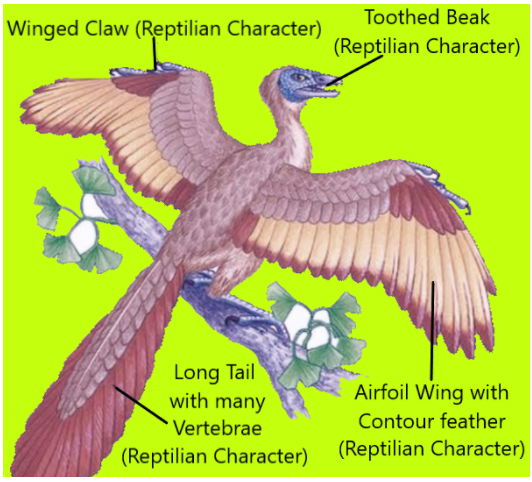
Archeopteryx
Non-cleidoic eggs are not covered with shell and are laid in water without the sufficient nutritive material for the complete development of the embryo. These eggs generally hatch into a larva.
The three-chambered heart is the characteristic of amphibians and reptiles. There occurs some mixing of blood and has double circulation.
So, the correct answer is’ scales on hind limbs’.
Note:
1. The first specimen of Archaeopteryx was discovered(1860) and named(1861) by the German palaeontologist Hermann von Meyer near Solnhofen, Germany.
2. Theropods first appeared in the earliest part of the Upper Triassic about 230 million years ago. They were the sole large terrestrial carnivores from the Lower Jurassic until the close of the Cretaceous, about 65 million years ago.
3. The Discovery of four new fossils of Ichthyornis (bird of Cretaceous Period), which had both a beak and teeth and lived a lifestyle like modern gulls, played an important role in avian evolutionary history.
Complete answer:
Discovery of a specimen of archaeopteryx in the early 1860s has given rise to the concept that birds have evolved from small carnivorous dinosaurs (theropod) of late Jurassic ancestors of living birds. Since the body of a bird is covered with feathers and has scales on their legs and feet. Their beaks and claws also have scales that support the reptilian ancestry of birds.
Archaeopteryx shows the features of both the theropod dinosaurs as well as modern birds. Thus it is widely considered as a transitional fossil between the birds and reptiles.
Archeopteryx
Non-cleidoic eggs are not covered with shell and are laid in water without the sufficient nutritive material for the complete development of the embryo. These eggs generally hatch into a larva.
The three-chambered heart is the characteristic of amphibians and reptiles. There occurs some mixing of blood and has double circulation.
So, the correct answer is’ scales on hind limbs’.
Note:
1. The first specimen of Archaeopteryx was discovered(1860) and named(1861) by the German palaeontologist Hermann von Meyer near Solnhofen, Germany.
2. Theropods first appeared in the earliest part of the Upper Triassic about 230 million years ago. They were the sole large terrestrial carnivores from the Lower Jurassic until the close of the Cretaceous, about 65 million years ago.
3. The Discovery of four new fossils of Ichthyornis (bird of Cretaceous Period), which had both a beak and teeth and lived a lifestyle like modern gulls, played an important role in avian evolutionary history.
Recently Updated Pages
Write any three differences between metals and nonmetals class 10 social science CBSE

Amit standing on a horizontal plane finds a bird flying class 10 maths CBSE
Two circles of radii 5 cm and 3 cm intersect at two class 10 maths CBSE
Solve the following i John and Jivanti together have class 10 maths CBSE
What is the relation between orthocenter circumcentre class 10 maths CBSE
Two plane mirrors are inclined at 70circ A ray incident class 10 physics CBSE
Trending doubts
Explain the Treaty of Vienna of 1815 class 10 social science CBSE
Which country is known as "The land of Fire and Ice"?
1 GB equals how many MB?
10 examples of evaporation in daily life with explanations
What is the full form of POSCO class 10 social science CBSE
Which is the hottest planet in the Solar system A Earth class 10 social science CBSE