




Reproduction in bryophytes takes place by
(This question has multiple correct options)
(a)Gemma cup formation
(b)Sexual method
(c)Fission
(d)Parthenogenesis
Answer
 Verified
618.9k+ views
Hint: Reproduction is bryophytes takes place by both asexual and sexual method. The sexual method is highly dependent on water for the transfer of gametes and hence they are known as the amphibians of the plant world.
Complete answer:
Asexual reproduction in bryophytes takes place by fragmentation or by the formation of gemma cups. Gemmae are green, multicellular, and asexual buds that are borne on the thalli of the parent. They are enclosed inside gemma cups. These gemmae fall off from the plant body and germinate to give rise to a new plant.
Sexual reproduction in bryophytes is as follows:
The plant body is thallus-like, erect, and attached to the substratum by unicellular or multicellular rhizoids. The main plant body of the bryophyte is called gametophyte as it produces gametes (haploid). The sex organs in bryophytes are multicellular. The male sex organ is called the antheridium which is responsible for producing biflagellate antherozoids. The female sex organ is archegonium and produces a single egg. The antherozoids are released into the water where they come in contact with archegonium and fuse with the egg to produce the zygote. Zygotes do not show the reduction division immediately, instead produce a multicellular body called a sporophyte. The sporophyte is attached to the photosynthetic gametophyte and derives nourishment from it. Some cells of the sporophyte undergo reduction division (meiosis) to produce haploid spores which germinate to give the gametophyte again.
So, the correct option is ‘Sexual method’ and ‘Gemma cup formation’.
Note: -Bryophytes are divided into mosses and liverworts.
-Sphagnum moss is used to ship living beings because of their ability to hold water in them.
-Moss and lichens are known as pioneer species as they are the first to start an ecosystem in a barren land i.e. primary succession.
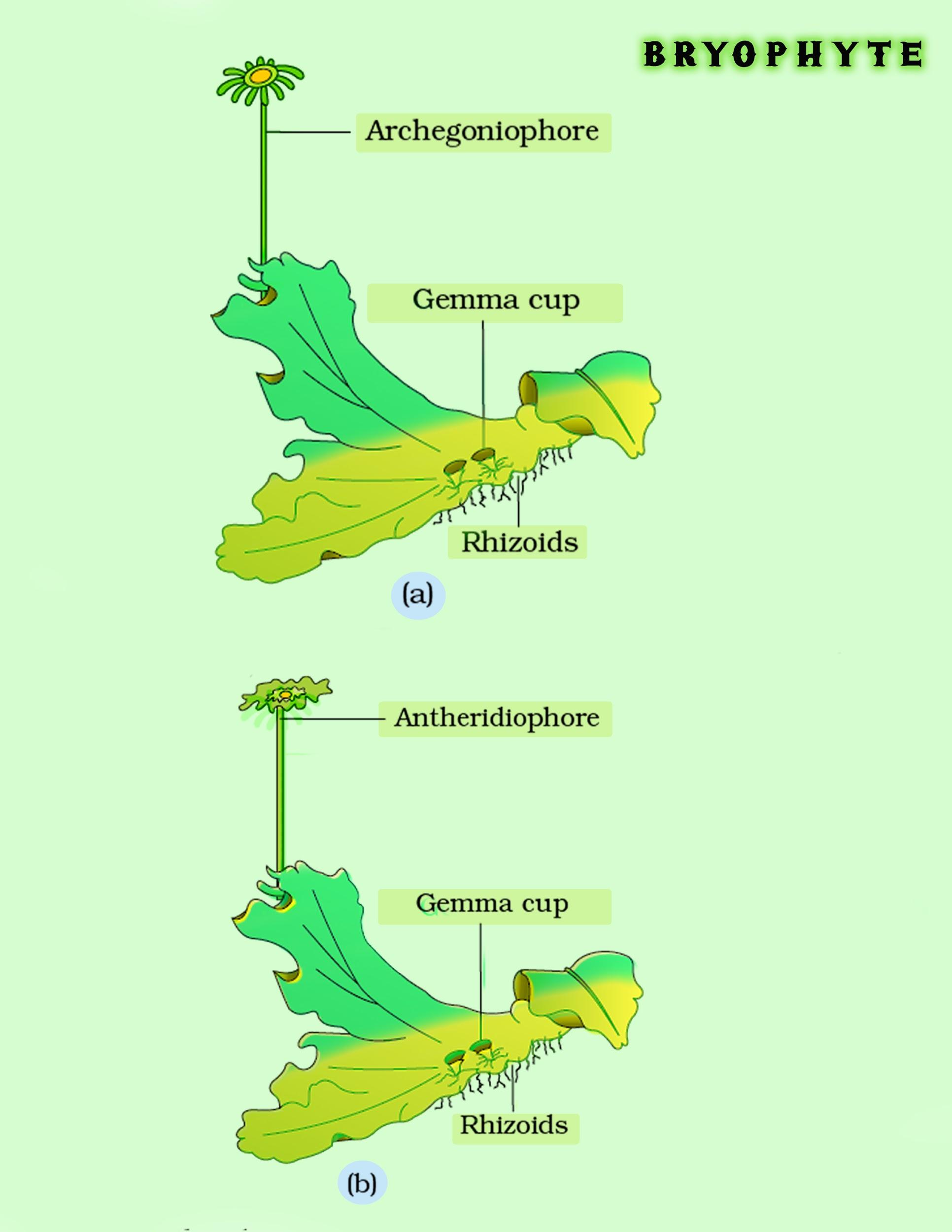
Complete answer:
Asexual reproduction in bryophytes takes place by fragmentation or by the formation of gemma cups. Gemmae are green, multicellular, and asexual buds that are borne on the thalli of the parent. They are enclosed inside gemma cups. These gemmae fall off from the plant body and germinate to give rise to a new plant.
Sexual reproduction in bryophytes is as follows:
The plant body is thallus-like, erect, and attached to the substratum by unicellular or multicellular rhizoids. The main plant body of the bryophyte is called gametophyte as it produces gametes (haploid). The sex organs in bryophytes are multicellular. The male sex organ is called the antheridium which is responsible for producing biflagellate antherozoids. The female sex organ is archegonium and produces a single egg. The antherozoids are released into the water where they come in contact with archegonium and fuse with the egg to produce the zygote. Zygotes do not show the reduction division immediately, instead produce a multicellular body called a sporophyte. The sporophyte is attached to the photosynthetic gametophyte and derives nourishment from it. Some cells of the sporophyte undergo reduction division (meiosis) to produce haploid spores which germinate to give the gametophyte again.
So, the correct option is ‘Sexual method’ and ‘Gemma cup formation’.
Note: -Bryophytes are divided into mosses and liverworts.
-Sphagnum moss is used to ship living beings because of their ability to hold water in them.
-Moss and lichens are known as pioneer species as they are the first to start an ecosystem in a barren land i.e. primary succession.
Recently Updated Pages
Master Class 11 English: Engaging Questions & Answers for Success

Master Class 11 Social Science: Engaging Questions & Answers for Success
Master Class 11 Maths: Engaging Questions & Answers for Success
Master Class 11 Biology: Engaging Questions & Answers for Success
Master Class 11 Physics: Engaging Questions & Answers for Success
Master Class 11 Chemistry: Engaging Questions & Answers for Success
Trending doubts
One Metric ton is equal to kg A 10000 B 1000 C 100 class 11 physics CBSE
Difference Between Prokaryotic Cells and Eukaryotic Cells
1 ton equals to A 100 kg B 1000 kg C 10 kg D 10000 class 11 physics CBSE
Find the value of the expression given below sin 30circ class 11 maths CBSE
Two of the body parts which do not appear in MRI are class 11 biology CBSE
Draw a diagram of a plant cell and label at least eight class 11 biology CBSE