




Represent that the motion of a bob of a pendulum with small amplitude is a linear simple harmonic motion. And therefore obtain an expression for its period. What are the factors on which the period of this pendulum depends upon?
Answer
 Verified
572.1k+ views
Hint: In the displaced position, there are two forces which are acting on the bob. One is gravitational force or the weight$\left( mg \right)$ in the downward direction. The force is found by taking the product of the mass and the acceleration. The negative sign in the equation of force represents that the force and the angular displacement are found to be oppositely directed. This will help you in answering this question.
Complete answer:
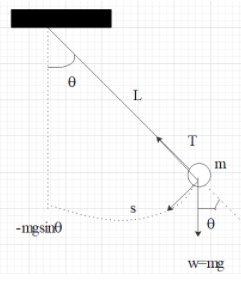
to represent the motion of the bob of the simple pendulum as simple harmonic motion. Consider a simple pendulum of mass $m$and the length $L$.
$L=l+r$
Where $l$ be the length of the string and $r$ be the radius of the bob.
Let us assume that OA be the initial position of the pendulum and OB, be its instantaneous position when the string makes an angle $\theta $ with the vertical.
In the displaced position, there are two forces which are acting on the bob. One is gravitational force or the weight$\left( mg \right)$ in the downward direction. The second one is the tension $T$ in the string. Third one is the weight $mg$ which can be resolved into two rectangular components. The radial component $mg\cos \theta $ along OB and the tangential component $mg\sin \theta $ orthogonal to OB and directed towards the mean position.
Here we can see that $mg\cos \theta $ is balanced by tension $T$ in the string. And the component $mg\sin \theta $ will provide the restoring force.
$\therefore F=mg\sin \theta $
Where the negative sign represents that the force and the angular displacement are found to be oppositely directed. Therefore the restoring force will be proportional to $\sin \theta $ instead of $\theta $. Therefore the net motion will not be simple harmonic.
If the angle is very small, we can write that,
$\sin \theta \approx \theta =\dfrac{x}{L}$
Therefore the force will become,
$\begin{align}
& \therefore F=-mg\dfrac{x}{L} \\
& \Rightarrow \dfrac{F}{m}=\dfrac{-gx}{L} \\
\end{align}$
As we all know the force is found by taking the product of the mass and the acceleration, we can write that,
$\begin{align}
& \dfrac{ma}{m}=\dfrac{-gx}{L} \\
& \therefore a=\dfrac{-gx}{L}........\left( 1 \right) \\
\end{align}$
From this we will get that,
$\begin{align}
& a\propto -x \\
& \because \dfrac{g}{L}=\text{constant} \\
\end{align}$
Hence, the motion of the bob of a simple pendulum will be simple harmonic.
The time period can be formulated as,
In S.H.M
$a=-{{\omega }^{2}}x.............(2)$
Comparing equation 1 and 2 will give,
${{\omega }^{2}}=\dfrac{g}{L}$
As we all know the angular velocity can be shown as,
$\omega =\dfrac{2\pi }{T}$
Substituting this in the equation will give,
$\begin{align}
& {{\left( \dfrac{2\pi }{T} \right)}^{2}}=\dfrac{g}{L} \\
& \Rightarrow \dfrac{2\pi }{T}=\sqrt{\dfrac{g}{L}} \\
& \therefore T=2\pi \sqrt{\dfrac{L}{g}} \\
\end{align}$
Therefore the final equation for time period has been obtained. The period of a simple pendulum is dependent on the length of the pendulum and acceleration due to gravity. Hence the answer for the question has been calculated.
Note:
In physics especially in mechanics, simple harmonic motion is a special form of periodic motion in which the restoring force on the moving body will be directly proportional to the magnitude of the displacement of the body and acts towards the equilibrium position of the object.
Complete answer:
to represent the motion of the bob of the simple pendulum as simple harmonic motion. Consider a simple pendulum of mass $m$and the length $L$.
$L=l+r$
Where $l$ be the length of the string and $r$ be the radius of the bob.
Let us assume that OA be the initial position of the pendulum and OB, be its instantaneous position when the string makes an angle $\theta $ with the vertical.
In the displaced position, there are two forces which are acting on the bob. One is gravitational force or the weight$\left( mg \right)$ in the downward direction. The second one is the tension $T$ in the string. Third one is the weight $mg$ which can be resolved into two rectangular components. The radial component $mg\cos \theta $ along OB and the tangential component $mg\sin \theta $ orthogonal to OB and directed towards the mean position.
Here we can see that $mg\cos \theta $ is balanced by tension $T$ in the string. And the component $mg\sin \theta $ will provide the restoring force.
$\therefore F=mg\sin \theta $
Where the negative sign represents that the force and the angular displacement are found to be oppositely directed. Therefore the restoring force will be proportional to $\sin \theta $ instead of $\theta $. Therefore the net motion will not be simple harmonic.
If the angle is very small, we can write that,
$\sin \theta \approx \theta =\dfrac{x}{L}$
Therefore the force will become,
$\begin{align}
& \therefore F=-mg\dfrac{x}{L} \\
& \Rightarrow \dfrac{F}{m}=\dfrac{-gx}{L} \\
\end{align}$
As we all know the force is found by taking the product of the mass and the acceleration, we can write that,
$\begin{align}
& \dfrac{ma}{m}=\dfrac{-gx}{L} \\
& \therefore a=\dfrac{-gx}{L}........\left( 1 \right) \\
\end{align}$
From this we will get that,
$\begin{align}
& a\propto -x \\
& \because \dfrac{g}{L}=\text{constant} \\
\end{align}$
Hence, the motion of the bob of a simple pendulum will be simple harmonic.
The time period can be formulated as,
In S.H.M
$a=-{{\omega }^{2}}x.............(2)$
Comparing equation 1 and 2 will give,
${{\omega }^{2}}=\dfrac{g}{L}$
As we all know the angular velocity can be shown as,
$\omega =\dfrac{2\pi }{T}$
Substituting this in the equation will give,
$\begin{align}
& {{\left( \dfrac{2\pi }{T} \right)}^{2}}=\dfrac{g}{L} \\
& \Rightarrow \dfrac{2\pi }{T}=\sqrt{\dfrac{g}{L}} \\
& \therefore T=2\pi \sqrt{\dfrac{L}{g}} \\
\end{align}$
Therefore the final equation for time period has been obtained. The period of a simple pendulum is dependent on the length of the pendulum and acceleration due to gravity. Hence the answer for the question has been calculated.
Note:
In physics especially in mechanics, simple harmonic motion is a special form of periodic motion in which the restoring force on the moving body will be directly proportional to the magnitude of the displacement of the body and acts towards the equilibrium position of the object.
Recently Updated Pages
Master Class 11 Computer Science: Engaging Questions & Answers for Success

Master Class 11 Business Studies: Engaging Questions & Answers for Success
Master Class 11 Economics: Engaging Questions & Answers for Success
Master Class 11 English: Engaging Questions & Answers for Success
Master Class 11 Maths: Engaging Questions & Answers for Success
Master Class 11 Biology: Engaging Questions & Answers for Success
Trending doubts
One Metric ton is equal to kg A 10000 B 1000 C 100 class 11 physics CBSE
There are 720 permutations of the digits 1 2 3 4 5 class 11 maths CBSE
Discuss the various forms of bacteria class 11 biology CBSE
Draw a diagram of a plant cell and label at least eight class 11 biology CBSE
State the laws of reflection of light
Explain zero factorial class 11 maths CBSE