




Represent a forest food chain with the help of a flow chart. Also find out the amount of energy available at the third trophic level, of plants that absorb 1000 kilojoules of energy from the sun.
Answer
 Verified
608.1k+ views
Hint: Food chain is defined as the linear unidirectional flow of energy and materials through the food from one trophic level to the other.
Complete answer:
A food chain consists of following trophic levels.
-Producers
-Consumers
-Primary consumers
-Secondary consumers
-Tertiary consumers
-Apex predators
Decomposers: The position an organism occupies in a food web is called a trophic level. The energy always flows in one direction through different trophic levels.
Producers: They are autotrophs. They produce food for all other organisms of an ecosystem.
Consumers: They are generally heterotrophs. They obtain their food from producers directly or indirectly.
Primary consumers: They are the animals who directly feed on plants. They are basically herbivores. Eg. Grasshopper, rabbit
Secondary consumers: They are the animals who feed on primary consumers or plants. They are basically omnivores or carnivores. Eg. Bluebird, jackal
Tertiary consumers: They are the animals who feed on secondary consumers. They are basically carnivores. Eg. Snake, cheetah
Apex predators: They are the animals who get their food from all consumers. They are the top predators and are carnivores. Eg. Owl, Tiger
Decomposer: They feed on dead and decay plants and animals. They help in recycling the nutrients. They complete the cycle of trophic level in the food chain.
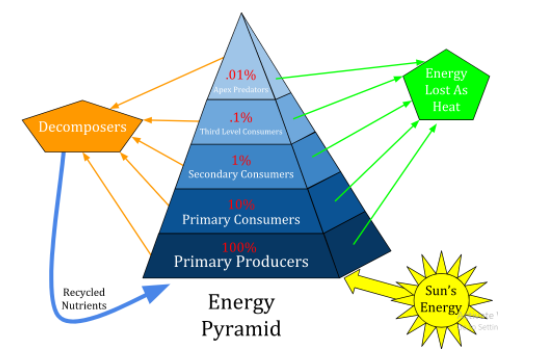
According to the 10 % law of trophic level, each trophic level passes 10% of energy to the next trophic level.
So if plants absorb 1000 kilojoules of energy from the sun, then the amount of energy that passes to the second level is $\dfrac{{10}}{{100}} \times 1000 = 100$ KJ
Similarly, the amount of energy that passes to the third level is $\dfrac{{10}}{{100}} \times 100 = 10$ KJ
Hence, the answer is 10 KJ
Note: A food chain is the transfer of energy in the form of food from one trophic level to another trophic level. It basically consists of producers, consumers and decomposers which together complete the cycle of the food chain. Only 10% of the energy of the previous trophic level is passed to the next trophic level. The rest of energy is lost in the form of heat.
Complete answer:
A food chain consists of following trophic levels.
-Producers
-Consumers
-Primary consumers
-Secondary consumers
-Tertiary consumers
-Apex predators
Decomposers: The position an organism occupies in a food web is called a trophic level. The energy always flows in one direction through different trophic levels.
Producers: They are autotrophs. They produce food for all other organisms of an ecosystem.
Consumers: They are generally heterotrophs. They obtain their food from producers directly or indirectly.
Primary consumers: They are the animals who directly feed on plants. They are basically herbivores. Eg. Grasshopper, rabbit
Secondary consumers: They are the animals who feed on primary consumers or plants. They are basically omnivores or carnivores. Eg. Bluebird, jackal
Tertiary consumers: They are the animals who feed on secondary consumers. They are basically carnivores. Eg. Snake, cheetah
Apex predators: They are the animals who get their food from all consumers. They are the top predators and are carnivores. Eg. Owl, Tiger
Decomposer: They feed on dead and decay plants and animals. They help in recycling the nutrients. They complete the cycle of trophic level in the food chain.
According to the 10 % law of trophic level, each trophic level passes 10% of energy to the next trophic level.
So if plants absorb 1000 kilojoules of energy from the sun, then the amount of energy that passes to the second level is $\dfrac{{10}}{{100}} \times 1000 = 100$ KJ
Similarly, the amount of energy that passes to the third level is $\dfrac{{10}}{{100}} \times 100 = 10$ KJ
Hence, the answer is 10 KJ
Note: A food chain is the transfer of energy in the form of food from one trophic level to another trophic level. It basically consists of producers, consumers and decomposers which together complete the cycle of the food chain. Only 10% of the energy of the previous trophic level is passed to the next trophic level. The rest of energy is lost in the form of heat.
Recently Updated Pages
Master Class 11 English: Engaging Questions & Answers for Success

Master Class 11 Social Science: Engaging Questions & Answers for Success
Master Class 11 Maths: Engaging Questions & Answers for Success
Master Class 11 Biology: Engaging Questions & Answers for Success
Master Class 11 Physics: Engaging Questions & Answers for Success
Master Class 11 Chemistry: Engaging Questions & Answers for Success
Trending doubts
One Metric ton is equal to kg A 10000 B 1000 C 100 class 11 physics CBSE
Difference Between Prokaryotic Cells and Eukaryotic Cells
Find the value of the expression given below sin 30circ class 11 maths CBSE
Difference between physical and chemical change class 11 chemistry CBSE
Two of the body parts which do not appear in MRI are class 11 biology CBSE
Draw a diagram of a plant cell and label at least eight class 11 biology CBSE