




Replum is characteristic of family
(a)Brassicaceae
(b)Asteraceae
(c)Liliaceae
(d)Solanaceae
Answer
 Verified
653.7k+ views
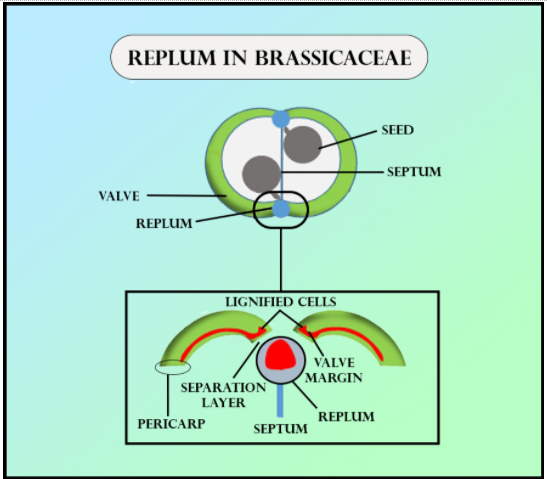
Hint: Replum is seen as a thin false septum, present in some fruits such as siliques and some legumes. Replum acts as a divide and separates two valves or chambers of the fruits. Replum is found in the mustard family or also called as crucifers.
Complete answer:
Their gynoecium is of dicarpellary and syncarpous type, with ovary superior, unilocular, which becomes bilocular due to the development of the false septum called replum.
This septum is actually an extension of its placenta. They show parietal placentation, with many ovules. They have a short style and the stigma may be simple or bifid.
Thus, replum is a characteristic feature of the family Brassicaceae or Cruciferae.
Additional Information:
The Brassicaceae is the 4th largest family, with 169 species and varieties of plants. The family is very important from the economic point of view, which includes mustard, cabbage, cauliflower, turnips, radish, etc.
Plants belonging to the Brassicaceae family are mostly annual, biennial, or perennial herbaceous plants, others are dwarf shrubs and very few are vines.
Flowers may be arranged in a racemose pattern or as panicles, or corymbs too.
The flowers are bisexual having a star symmetry and the ovary positioned superiorly. Flowers have four free or sometimes merged sepals, the lateral two sometimes having a shallow spur, which is shed after flowering. Each flower has four petals, alternating with the sepals, although they may be absent or rudimentary in some species.
It initially is formed of only one cavity but during development, a thin wall grows dividing the cavity, both placentas and thus separates the two chambers. Rarely, a single cavity without a replum may be seen, but in most cases, a replum is seen.
So, the answer is, “Brassicaceae.”
Note: Replum or the false septum is a characteristic feature of this family. However, septa are seen in the ovules of many plants. In those plants, the ovary is said to be bilocular or multilocular depending on the number of septa. Example, Family Solanaceae.
Complete answer:
Their gynoecium is of dicarpellary and syncarpous type, with ovary superior, unilocular, which becomes bilocular due to the development of the false septum called replum.
This septum is actually an extension of its placenta. They show parietal placentation, with many ovules. They have a short style and the stigma may be simple or bifid.
Thus, replum is a characteristic feature of the family Brassicaceae or Cruciferae.
Additional Information:
The Brassicaceae is the 4th largest family, with 169 species and varieties of plants. The family is very important from the economic point of view, which includes mustard, cabbage, cauliflower, turnips, radish, etc.
Plants belonging to the Brassicaceae family are mostly annual, biennial, or perennial herbaceous plants, others are dwarf shrubs and very few are vines.
Flowers may be arranged in a racemose pattern or as panicles, or corymbs too.
The flowers are bisexual having a star symmetry and the ovary positioned superiorly. Flowers have four free or sometimes merged sepals, the lateral two sometimes having a shallow spur, which is shed after flowering. Each flower has four petals, alternating with the sepals, although they may be absent or rudimentary in some species.
It initially is formed of only one cavity but during development, a thin wall grows dividing the cavity, both placentas and thus separates the two chambers. Rarely, a single cavity without a replum may be seen, but in most cases, a replum is seen.
So, the answer is, “Brassicaceae.”
Note: Replum or the false septum is a characteristic feature of this family. However, septa are seen in the ovules of many plants. In those plants, the ovary is said to be bilocular or multilocular depending on the number of septa. Example, Family Solanaceae.
Recently Updated Pages
Which will be the least stable resonating structure class 11 chemistry CBSE

How many 5 digit telephone numbers can be construc-class-11-maths-CBSE
How do you find the angle of the resultant vector class 11 physics CBSE
Draw labelled diagram of the following i Gram seed class 11 biology CBSE
1 Quintal is equal to a 110 kg b 10 kg c 100kg d 1000 class 11 physics CBSE
What is the need and importance of classification class 11 biology CBSE
Trending doubts
One Metric ton is equal to kg A 10000 B 1000 C 100 class 11 physics CBSE
Find the value of the expression given below sin 30circ class 11 maths CBSE
Draw a diagram of nephron and explain its structur class 11 biology CBSE
10 examples of friction in our daily life
Proton was discovered by A Thomson B Rutherford C Chadwick class 11 chemistry CBSE
The teeth used for biting and cutting food are called class 11 biology CBSE