




Reimer- Tiemann reaction involves as intermediate:
(A) Carbocation
(B)Carbanion
(C)Free radical
(D)Carbene
Answer
 Verified
625.8k+ views
Hint: In an electrophilic substitution reaction electrophile is formed as a reaction intermediate.
- Reaction intermediates are highly reactive organic compounds which are formed for a short period of time in the middle stage of a reaction. An intermediate could be electron deficiency or excess of electron or having vacant orbital. Carbocation, Carbanion, free radical, nitrene, or Carbene are different types of reaction intermediates which are formed in a reaction.
Complete Solution :
Reamer-Tiemann reaction is an electrophilic substitution reaction which involves the treatment of phenol with chloroform in aqueous sodium hydroxide solution followed by the acid hydrolysis, which leads to the formation of salicylaldehyde (ortho-hydroxybenzaldehyde) as a chief product of the reaction.
- In this reaction chloroform first reacts with sodium hydroxide to produce dichlorocarbene which is the intermediate of this reaction.
This reaction is represented through following reaction –
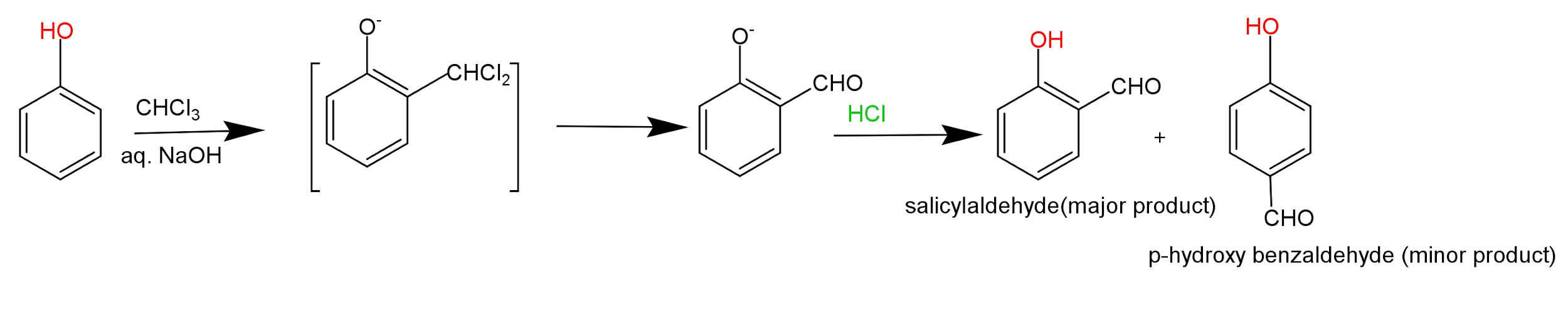
Carbene is an electron deficient neutral species which contains six electrons in their outermost shell. These are uncharged reactive intermediates which contains a divalent carbon atom which is hybridised and contains perpendicular vacant p-orbitals. There are two types of carbene formed in a chemical reaction; singlet carbene (which contains a pair of two non-bonding electrons) and triplet carbene (it contains two nonbonding electrons which are unpaired).
So, the correct answer is “Option D”.
Note: Carbocation and Carbanion are intermediates which are formed in electrophilic and nucleophilic substitution and addition reaction.
- Free radicals are formed in that reaction in which homolytic breakdown of chemical reaction takes place, while carbocation and Carbanion are formed in those reactions in which heterolytic breakdown of chemical bond takes place.
- Reaction intermediates are highly reactive organic compounds which are formed for a short period of time in the middle stage of a reaction. An intermediate could be electron deficiency or excess of electron or having vacant orbital. Carbocation, Carbanion, free radical, nitrene, or Carbene are different types of reaction intermediates which are formed in a reaction.
Complete Solution :
Reamer-Tiemann reaction is an electrophilic substitution reaction which involves the treatment of phenol with chloroform in aqueous sodium hydroxide solution followed by the acid hydrolysis, which leads to the formation of salicylaldehyde (ortho-hydroxybenzaldehyde) as a chief product of the reaction.
- In this reaction chloroform first reacts with sodium hydroxide to produce dichlorocarbene which is the intermediate of this reaction.
This reaction is represented through following reaction –
Carbene is an electron deficient neutral species which contains six electrons in their outermost shell. These are uncharged reactive intermediates which contains a divalent carbon atom which is hybridised and contains perpendicular vacant p-orbitals. There are two types of carbene formed in a chemical reaction; singlet carbene (which contains a pair of two non-bonding electrons) and triplet carbene (it contains two nonbonding electrons which are unpaired).
So, the correct answer is “Option D”.
Note: Carbocation and Carbanion are intermediates which are formed in electrophilic and nucleophilic substitution and addition reaction.
- Free radicals are formed in that reaction in which homolytic breakdown of chemical reaction takes place, while carbocation and Carbanion are formed in those reactions in which heterolytic breakdown of chemical bond takes place.
Recently Updated Pages
Explain the structure of megasporangium class 12 biology CBSE

Why is chloroform kept in dark coloured bottles class 12 chemistry CBSE
Derive the balancing condition of a Wheatstone bri class 12 physics CBSE
Draw VI characteristics of a pn junction diode Explain class 12 physics CBSE
Is it possible to carry pride in ones language too class 12 english CBSE
In a population at Hardy Weinberg equilibrium the allele class 12 biology CBSE
Trending doubts
Draw a labelled sketch of the human eye class 12 physics CBSE
Which are the Top 10 Largest Countries of the World?
Draw ray diagrams each showing i myopic eye and ii class 12 physics CBSE
Which is the correct genotypic ratio of mendel dihybrid class 12 biology CBSE
Differentiate between homogeneous and heterogeneous class 12 chemistry CBSE
Which animal never drinks water in its entire life class 12 biology CBSE