




What is refraction of light? Draw the diagram of refraction of light in a glass slab. Write laws of refraction.
Answer
 Verified
626.1k+ views
Hint: We know that when a ray of light moves from one medium to another then there is deviation of light takes place. The phenomenon of bending of a ray of light when it travels from one medium to another of different optical density is known as refraction of light.
Complete step-by-step answer:
When a ray of light moves from a low refractive medium to the high refractive medium, it bends towards the normal. In this case, angle of refraction (r) is less than the angle of incidence (i) when a ray of light travels from a denser medium to a rarer medium, it bends away from the normal. Here the angle of refraction is greater than the angle of incidence.
When a light goes from one medium to another, the frequency of light does not change. But, the speed of light and wavelength of light change. The intensity of the refracted ray is less compared to the incident ray. It is because there is partial reflection and absorption of light at the surface.
Laws of refraction:
The incident ray, the perpendicular imaginary line drawn (normal) at the point of incidence and the refracted ray all lie in the same plane.
The ratio of the sine of angle of incidence to the sine of angle of refraction is a constant for a given pair of media and for light of given wavelength.
That is, $\dfrac{{\sin i}}{{\sin r}} = {\text{constant = }}{{\text{n}}_{21}}$
The constant in the above equation is called the refractive index of medium 2 with respect to medium 1. This relation is known as Snell’s law.
The diagram of refraction of light in glass:
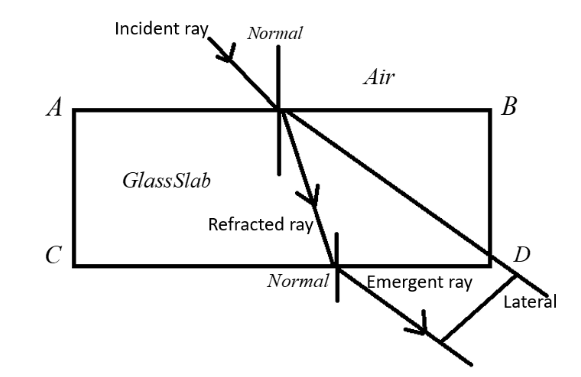
When a ray of light passes through a parallel sided glass slab, the direction of the emergent ray is the same as the direction of the incident ray, but the path of the ray is shifted laterally by a certain distance called the lateral shift.
Note: When a ray of light travels from one medium to another medium there is a change in path of light. This is called refraction of light.
The basic cause of refraction is that the speed of light changes as it travels from one medium to another
Complete step-by-step answer:
When a ray of light moves from a low refractive medium to the high refractive medium, it bends towards the normal. In this case, angle of refraction (r) is less than the angle of incidence (i) when a ray of light travels from a denser medium to a rarer medium, it bends away from the normal. Here the angle of refraction is greater than the angle of incidence.
When a light goes from one medium to another, the frequency of light does not change. But, the speed of light and wavelength of light change. The intensity of the refracted ray is less compared to the incident ray. It is because there is partial reflection and absorption of light at the surface.
Laws of refraction:
The incident ray, the perpendicular imaginary line drawn (normal) at the point of incidence and the refracted ray all lie in the same plane.
The ratio of the sine of angle of incidence to the sine of angle of refraction is a constant for a given pair of media and for light of given wavelength.
That is, $\dfrac{{\sin i}}{{\sin r}} = {\text{constant = }}{{\text{n}}_{21}}$
The constant in the above equation is called the refractive index of medium 2 with respect to medium 1. This relation is known as Snell’s law.
The diagram of refraction of light in glass:
When a ray of light passes through a parallel sided glass slab, the direction of the emergent ray is the same as the direction of the incident ray, but the path of the ray is shifted laterally by a certain distance called the lateral shift.
Note: When a ray of light travels from one medium to another medium there is a change in path of light. This is called refraction of light.
The basic cause of refraction is that the speed of light changes as it travels from one medium to another
Recently Updated Pages
Master Class 11 English: Engaging Questions & Answers for Success

Master Class 11 Social Science: Engaging Questions & Answers for Success
Master Class 11 Maths: Engaging Questions & Answers for Success
Master Class 11 Biology: Engaging Questions & Answers for Success
Master Class 11 Physics: Engaging Questions & Answers for Success
Master Class 11 Chemistry: Engaging Questions & Answers for Success
Trending doubts
Explain the Treaty of Vienna of 1815 class 10 social science CBSE
What is the Total Duration of Football Match?
First Cotton Mill of India
In which year voting age was reduced from 21 to 18?
10 examples of evaporation in daily life with explanations
What planets have no moons Which one has only one moon class 10 physics CBSE