




What is the reference particle and the reference circle?
Answer
 Verified
583.8k+ views
Hint: When a particle is executing Simple Harmonic Motion, it is comparatively hard for us to analyze its motion. This is where the concept of a reference circle comes into play. It is a circle with its center as the point about which the particle is executing Simple Harmonic Motion and the radius being equal to the Amplitude of oscillation. We shall use this to further answer our question.
Complete answer:
A particle executing Simple Harmonic Motion has a fixed point about which it oscillates. This point is known as the center of our reference circle. Now, the amplitude of this SHM gives us the radius of the reference circle. This can be understood with the help of the following diagram:
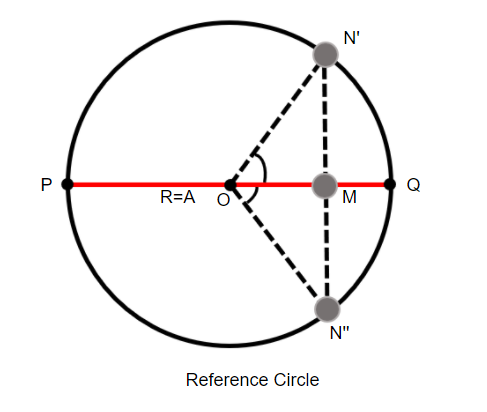
In the above diagram, the particle (M) is executing SHM about the point O. The maximum displacement of the particle from O is at P and Q and this is the amplitude of its Simple Harmonic Motion. This is also equal to the radius of our reference circle.
Now, at this very instant the particle M has two shadows namely, (N’) and (N’’). These shadows of M on the circle are known as the reference points of M. These only move in a circular motion with a uniform speed.
Hence, the reference circle and the reference particle have been explained.
Note:
The two shadows of our particle ‘M’ indicate that we have taken two references. If we observe from above, the shadow will be cast on the lower hemisphere of the reference circle and if we observe the particle from below, the shadow will be cast on the upper hemisphere.
Complete answer:
A particle executing Simple Harmonic Motion has a fixed point about which it oscillates. This point is known as the center of our reference circle. Now, the amplitude of this SHM gives us the radius of the reference circle. This can be understood with the help of the following diagram:
In the above diagram, the particle (M) is executing SHM about the point O. The maximum displacement of the particle from O is at P and Q and this is the amplitude of its Simple Harmonic Motion. This is also equal to the radius of our reference circle.
Now, at this very instant the particle M has two shadows namely, (N’) and (N’’). These shadows of M on the circle are known as the reference points of M. These only move in a circular motion with a uniform speed.
Hence, the reference circle and the reference particle have been explained.
Note:
The two shadows of our particle ‘M’ indicate that we have taken two references. If we observe from above, the shadow will be cast on the lower hemisphere of the reference circle and if we observe the particle from below, the shadow will be cast on the upper hemisphere.
Recently Updated Pages
Which will be the least stable resonating structure class 11 chemistry CBSE

How many 5 digit telephone numbers can be construc-class-11-maths-CBSE
How do you find the angle of the resultant vector class 11 physics CBSE
Draw labelled diagram of the following i Gram seed class 11 biology CBSE
1 Quintal is equal to a 110 kg b 10 kg c 100kg d 1000 class 11 physics CBSE
What is the need and importance of classification class 11 biology CBSE
Trending doubts
One Metric ton is equal to kg A 10000 B 1000 C 100 class 11 physics CBSE
Find the value of the expression given below sin 30circ class 11 maths CBSE
Draw a diagram of nephron and explain its structur class 11 biology CBSE
10 examples of friction in our daily life
Proton was discovered by A Thomson B Rutherford C Chadwick class 11 chemistry CBSE
The teeth used for biting and cutting food are called class 11 biology CBSE