




Refer to the given figures and select the correct option.
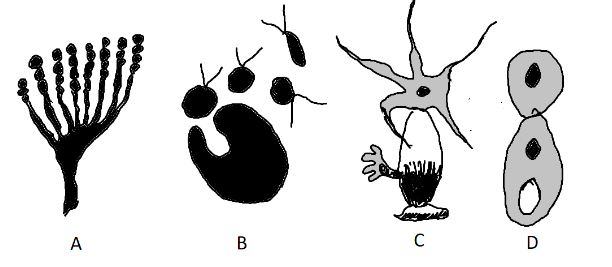
A)C and D reproduce by budding that includes nuclear division only.
B)All of these reproduce by asexual mode of reproduction.
C)B represents multiple fission in alga.
D)A shows spore formation in monera.
Answer
 Verified
547.5k+ views
Hint: The figures given in the question represents the mode of reproduction in lower invertebrates. The organisms shown are yeast, hydra, penicillium, chlamydomonas. This mode of reproduction does not involve intermixing of gametes and the off-springs produced are the exact copies of the parent.
Complete answer:
The lower organisms like Monera, Protista reproduce asexually by the modes of reproduction like budding, fission, spore formation.
In the figure given are certain methods of asexual reproduction. Let us discuss.
A)The figure represents the reproduction of Penicillium in which non-motile conidia are produced either singly or in multiple chains. A conidium is an asexual non-motile spore which is known as chlamydospore. It is the mode of reproduction in fungus. Option D is incorrect.
B)The figure represents Chlamydomonas which reproduce asexually by forming zoospores. These spores are motile and have flagella for locomotion. Option B is incorrect.
C)The figure represents the mode of reproduction in hydra that is budding. The new organism is developed from the outgrowth or the bud. It involves both division of nucleus as well as other organelles and cytoplasm. It is an asexual mode of reproduction.
D)The figure represents reproduction in yeast through budding. It is an asexual mode of reproduction.
Hence, the correct answer is option (B)
Note: The other mode of asexual reproduction is called binary fission. It occurs mostly in amoeba. The parent cell splits into two daughter cells. It involves division of nucleus followed by the division of cytoplasm.
Complete answer:
The lower organisms like Monera, Protista reproduce asexually by the modes of reproduction like budding, fission, spore formation.
In the figure given are certain methods of asexual reproduction. Let us discuss.
A)The figure represents the reproduction of Penicillium in which non-motile conidia are produced either singly or in multiple chains. A conidium is an asexual non-motile spore which is known as chlamydospore. It is the mode of reproduction in fungus. Option D is incorrect.
B)The figure represents Chlamydomonas which reproduce asexually by forming zoospores. These spores are motile and have flagella for locomotion. Option B is incorrect.
C)The figure represents the mode of reproduction in hydra that is budding. The new organism is developed from the outgrowth or the bud. It involves both division of nucleus as well as other organelles and cytoplasm. It is an asexual mode of reproduction.
D)The figure represents reproduction in yeast through budding. It is an asexual mode of reproduction.
Hence, the correct answer is option (B)
Note: The other mode of asexual reproduction is called binary fission. It occurs mostly in amoeba. The parent cell splits into two daughter cells. It involves division of nucleus followed by the division of cytoplasm.
Recently Updated Pages
Master Class 11 Computer Science: Engaging Questions & Answers for Success

Master Class 11 Business Studies: Engaging Questions & Answers for Success
Master Class 11 Economics: Engaging Questions & Answers for Success
Master Class 11 English: Engaging Questions & Answers for Success
Master Class 11 Maths: Engaging Questions & Answers for Success
Master Class 11 Biology: Engaging Questions & Answers for Success
Trending doubts
One Metric ton is equal to kg A 10000 B 1000 C 100 class 11 physics CBSE
There are 720 permutations of the digits 1 2 3 4 5 class 11 maths CBSE
Discuss the various forms of bacteria class 11 biology CBSE
Draw a diagram of a plant cell and label at least eight class 11 biology CBSE
State the laws of reflection of light
Explain zero factorial class 11 maths CBSE