




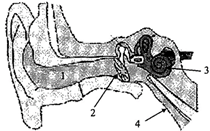
Refer to the given figure of the ear with a few structures marked as 1, 2, 3 & 4. Which labelled structure converts sound waves into mechanical vibrations?
A) 1
B) 2
C) 3
D) 4
Answer
 Verified
407.1k+ views
Hint:
The above picture represents a human ear that serves as an astounding transducer which means it converts sound energy into mechanical energy to a nerve impulse which is transmitted to the brain. Every part of the ear has a specific purpose to detect and interpret sound.
Complete answer:
(1) represents the external auditory canal, (2) represents the tympanic membrane, (3) represents the cochlea and (4) represents the eustachian tube.
The eardrum acts as a boundary between the outer and middle ears. It is a thin, translucent connective tissue membrane, covered by the skin on its external face and by a mucosa internally. Sound waves make the eardrum vibrate; the eardrum, in turn, transfers the sound energy to the tiny bones of the middle ear and sets them into vibration. It converts sound energy to mechanical waves.
The middle ear opens into the Eustachian tube. The eustachian tube opens during swallowing, chewing, and yawning otherwise it is closed to keep the air pressure equalized on the two sides of the eardrum. The cochlea is a coiled tube. Secretions through the cochlea reveal that is divided into three chambers: the cochlear duct, the scala vestibule, and the scala tympani.
Option ‘B’ is correct
Note:
The outer ear consists of the pinna and external auditory meatus (or ear canal). The external auditory meatus is lined with skin that contains numerous modified sweat glands called ceruminous glands, which secrete wax(cerumen). The function of the outer ear Is to collect sound and funnel it to the ear drum or tympanic membrane.
The above picture represents a human ear that serves as an astounding transducer which means it converts sound energy into mechanical energy to a nerve impulse which is transmitted to the brain. Every part of the ear has a specific purpose to detect and interpret sound.
Complete answer:
(1) represents the external auditory canal, (2) represents the tympanic membrane, (3) represents the cochlea and (4) represents the eustachian tube.
The eardrum acts as a boundary between the outer and middle ears. It is a thin, translucent connective tissue membrane, covered by the skin on its external face and by a mucosa internally. Sound waves make the eardrum vibrate; the eardrum, in turn, transfers the sound energy to the tiny bones of the middle ear and sets them into vibration. It converts sound energy to mechanical waves.
The middle ear opens into the Eustachian tube. The eustachian tube opens during swallowing, chewing, and yawning otherwise it is closed to keep the air pressure equalized on the two sides of the eardrum. The cochlea is a coiled tube. Secretions through the cochlea reveal that is divided into three chambers: the cochlear duct, the scala vestibule, and the scala tympani.
Option ‘B’ is correct
Note:
The outer ear consists of the pinna and external auditory meatus (or ear canal). The external auditory meatus is lined with skin that contains numerous modified sweat glands called ceruminous glands, which secrete wax(cerumen). The function of the outer ear Is to collect sound and funnel it to the ear drum or tympanic membrane.
Recently Updated Pages
Basicity of sulphurous acid and sulphuric acid are

Master Class 12 Economics: Engaging Questions & Answers for Success
Master Class 12 Biology: Engaging Questions & Answers for Success
Master Class 11 English: Engaging Questions & Answers for Success
Master Class 11 Physics: Engaging Questions & Answers for Success
Master Class 11 Computer Science: Engaging Questions & Answers for Success
Trending doubts
Hotspots are regions of high A Rarity B Endemism C class 11 biology NEET_UG
What is the Total Duration of Football Match?
What is BLO What is the full form of BLO class 8 social science CBSE
Explain the Treaty of Vienna of 1815 class 10 social science CBSE
Draw a labelled sketch of the human eye class 12 physics CBSE
In football, which nation is called "La Roja"?